
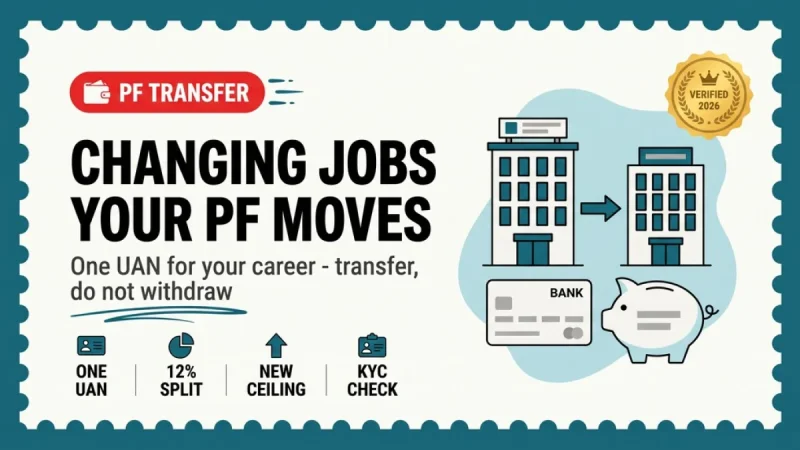
Your provident fund follows you, not the employer. One UAN covers an entire career, and the single most expensive habit among young employees is emptying the account at every job change instead of carrying it forward.
Quick snapshot
- UAN: one Universal Account Number for your whole career, across every employer.
- Your contribution: 12% of wages, every month.
- Employer's: 8.33% to the pension scheme, 3.67% to your PF account.
- Government: contributes 1.16% towards the pension fund.
- Wage ceiling: raised from ₹15,000 to ₹25,000 with effect from 17 September 2026.
- The rule of thumb: transfer on a job change, withdraw only in a genuine emergency.
When you change jobs your provident fund does not end. The UAN stays the same, the new employer links its own member ID to that number, and the old balance can be transferred across so service is treated as continuous. The alternative — withdrawing at each exit — feels like free money and is the costliest ordinary financial decision most people make in their twenties, because it resets both the balance and the service record that pension eligibility is built on.
Where your 12% actually goes
| Who contributes | Rate | Destination |
|---|---|---|
| You | 12% of wages | Entirely to your EPF account |
| Employer | 8.33% of wages | Employees' Pension Scheme |
| Employer | 3.67% of wages | Your EPF account |
| Central Government | 1.16% | Towards the pension fund |
Two separate things are being built here, and conflating them is where most confusion starts. The EPF portion is a balance with your name on it. The pension portion is an entitlement built on years of service, which is why continuity matters independently of the rupee balance.
This is the part withdrawal quietly destroys. Taking the money out does not simply reduce a balance you can rebuild later. It breaks the service record. Someone who withdraws at three job changes has not accumulated eight years of service — they have several short, disconnected stretches.
The ceiling change and what it did to your payslip
The wage ceiling for mandatory EPFO coverage was raised from ₹15,000 to ₹25,000 a month with effect from 17 September 2026. It had not moved since September 2014. The government estimated that more than 51 lakh additional formal-sector workers would be brought under mandatory coverage as a result.
| Monthly PF wages | Your 12% | Employer to pension (8.33%) |
|---|---|---|
| ₹15,000 (old ceiling) | ₹1,800 | ₹1,250 |
| ₹20,000 | ₹2,400 | ₹1,666 |
| ₹25,000 (current ceiling) | ₹3,000 | ₹2,083 |
If your in-hand dropped slightly around that date and nothing else changed, this is almost certainly why. The money was not taken; it moved into an account you own.
Transfer or withdraw: how to decide
The question comes up at every exit, usually while you are distracted by onboarding somewhere else, which is exactly why the default matters.
| Transfer | Withdraw | |
|---|---|---|
| Balance | Carries forward and keeps compounding | Resets to zero |
| Service record | Treated as continuous | Broken |
| Pension eligibility | Keeps building on total service | Starts again |
| Effort | One request, then it runs by itself | A claim each time, repeated every job |
| Sensible when | Almost always | A genuine emergency with no alternative |
Emptying a provident fund account to fund a gap between jobs, a phone or a holiday is extremely common and almost always a bad trade. The balance looks small early in a career, which is precisely when the compounding has the longest time to run.
What to do in the first week of a new job
Give the new employer your existing UAN. Do not let a second UAN be created — two numbers for one person is the most common cause of a messy, slow transfer later.
Check your KYC is complete — Aadhaar, PAN and bank details seeded against the UAN. Transfers and claims stall on incomplete KYC more than anything else.
Confirm the first PF deduction appears on your first payslip. PF attaches to employment, so it applies from your joining date, including through training or probation.
Raise the transfer request for the previous employer's balance once the new member ID is active.
Note your exact exit date from the old job. Service dates decide gratuity separately, and nobody will reconstruct them for you.
Why the balance is worth more than it looks at 23
A provident fund statement early in a career is an unexciting document. The number is small, the deduction is visible every month, and retirement is an abstraction. That combination is why withdrawal feels harmless.
The mechanics work the other way round. The contributions made in the first few working years are the ones with the longest period to compound, so they do disproportionate work over a career. A balance built from age twenty-three and carried through every job change behaves very differently from one that starts over at thirty-two because it was emptied three times on the way.
There is also a less obvious effect. Because the pension component is built on years of service rather than on the balance, continuity has value that does not appear anywhere on the statement. Two people with identical contributions can end up in different positions purely because one kept the record intact.
None of this requires any financial sophistication. It requires one decision at each job change, made in the right direction, and the decision takes about ten minutes.
What provident fund is not
Provident fund, gratuity and leave encashment get discussed as one pot and are three separate entitlements with different rules. Provident fund is funded by both you and the employer and accrues every month from day one. Gratuity is funded by the employer alone, accrues per completed year, and normally needs five years of service — one year for a fixed-term employee. Leave encashment depends on your unused leave balance.
You can leave a job with a healthy provident fund balance and no gratuity at all, simply because you did not cross the service threshold. Knowing which is which prevents a lot of disappointment at final settlement.
The four things that actually go wrong
Provident fund problems are rarely exotic. The same four issues account for most of them, and all four are avoidable in the first week of a job rather than the last week of a claim.
A second UAN. A new employer, given incomplete information, creates a fresh Universal Account Number instead of linking to the existing one. Now one person has two records, and merging them is slower and more manual than simply having given the right number at the start. This is the single most common cause of a stuck transfer.
Incomplete KYC. Aadhaar, PAN and bank details have to be seeded and verified against the UAN. Claims and transfers sit unprocessed on this more often than on anything else, and the fix is administrative rather than difficult. Check it when nothing depends on it.
A mismatch in the basics. A name spelled differently across Aadhaar and employer records, or a date of birth that does not match, will hold a claim indefinitely. These are trivial to correct early and tedious to correct under time pressure.
No record of the exit date. The date of leaving has to be marked correctly against the old employment. If it is missing or wrong, the transfer cannot complete cleanly. Note your own last working day and keep the relieving letter, because reconstructing it later means chasing a company you no longer work for.
A fifth, less common problem is worth knowing about: a period where an employer deducted provident fund from your salary but the contribution does not appear in your account. Your payslip is the evidence that the deduction happened, which is one more reason to keep payslips for every month of every job rather than only the most recent one.
Do the checks when it is boring. Every one of these takes minutes while you are employed and settled, and days of chasing when you need money or are mid-transfer. The worst time to discover a KYC mismatch is the week you are relying on the claim.
Do I get a new UAN when I change jobs?
No. The UAN is a Universal Account Number that stays with you across your whole career. Give your existing UAN to the new employer so it links its member ID to it, rather than letting a second UAN be created.
Should I transfer my PF or withdraw it?
Transfer, in almost every case. Transferring keeps the balance compounding and the service record continuous. Withdrawing resets both, and the service record matters independently because pension entitlement is built on years of service.
How much PF is deducted from my salary?
12% of your PF wages. Your employer separately contributes 8.33% to the pension scheme and 3.67% to your EPF account, and the Central Government contributes 1.16% towards the pension fund.
Why did my in-hand drop in September 2026?
The EPF wage ceiling rose from ₹15,000 to ₹25,000 with effect from 17 September 2026, the first change since September 2014. At 12%, a PF wage of ₹25,000 means a ₹3,000 monthly deduction instead of ₹1,800.
Is PF deducted during training or probation?
Yes. Provident fund attaches to employment rather than to confirmation, so it applies from your joining date including through any training period.
What is the most common reason transfers get stuck?
Incomplete KYC against the UAN, and having more than one UAN because a new employer created a second number. Check both in your first week.
Is PF the same as gratuity?
No. Provident fund is funded by you and the employer and accrues monthly from day one. Gratuity is funded by the employer alone, accrues per completed year, and normally requires five years of service, or one year for a fixed-term employee.
Is the higher ceiling bad for me?
It reduces monthly in-hand slightly and increases what accumulates in an account you own, with the employer's share going in alongside. It is deferred pay rather than a deduction you lose.
Sources: Press Information Bureau, EPFO wage ceiling raised from ₹15,000 to ₹25,000 · Press Information Bureau, Code on Social Security, 2020 · Press Information Bureau, Government makes the four Labour Codes effective.
Related guides on BeInCareer
- EPFO PF Claim Guide 2026
- EPF Withdrawal Rules India 2026
- Gratuity Rules India 2026
- The Four Labour Codes: What Changed for Employees
- NPS vs PPF vs EPF 2026
- Salary Slip Explained: Basic, HRA, DA, PF and PT
- CTC vs In-Hand Salary 2026
- Salary Account for Freshers 2026
- Fixed-Term Employment India 2026
- TCS Fresher Salary 2026