
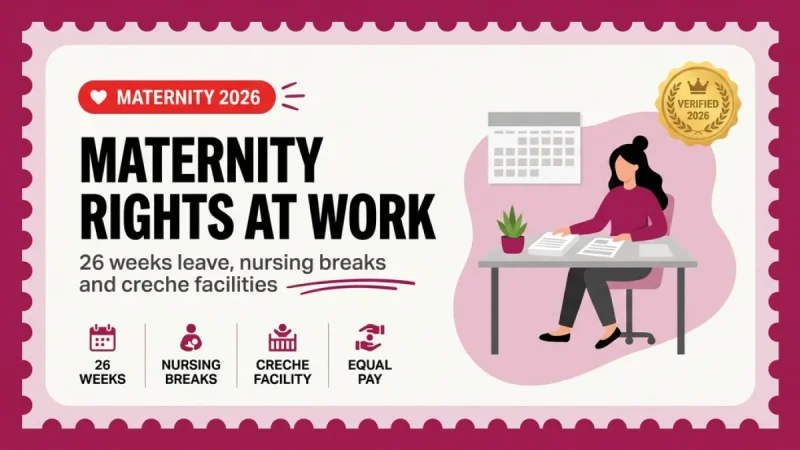
Maternity benefit is a statutory entitlement, not a company perk. Under the Labour Codes it runs to 26 weeks, with nursing breaks and mandatory crèche facilities, and simplified certification.
Quick snapshot
- Maternity leave: 26 weeks.
- Nursing breaks: provided for after returning to work.
- Crèche: mandatory crèche facilities.
- Certification: simplified under the Codes.
- Discrimination: prohibited in recruitment, wages and conditions of work.
- In force since: 21 November 2025, under the four Labour Codes.
Maternity support under the Labour Codes provides 26 weeks of maternity leave, along with nursing breaks after return to work and mandatory crèche facilities, with certification requirements simplified. These sit inside the Code on Social Security, which took effect on 21 November 2025 as one of four Codes replacing 29 earlier laws. They are statutory entitlements rather than discretionary benefits, and they operate alongside a general prohibition on discrimination in recruitment, wages and conditions of work.
What the entitlement covers
| Provision | Position under the Codes |
|---|---|
| Maternity leave | 26 weeks |
| Nursing breaks | Provided for after returning to work |
| Crèche facilities | Mandatory |
| Certification | Simplified |
| Discrimination | Prohibited in recruitment, wages and conditions |
| Equal pay | Guaranteed for equal work |
The crèche requirement is the one most often treated as optional in practice. It is listed among the enhanced maternity supports under the Codes, alongside the leave period and nursing breaks.
Ask before you need it, not when you need it. The point at which someone discovers their employer has no crèche arrangement and no process for maternity leave is usually the point at which they have the least capacity to argue about it. These are reasonable questions to ask about any employer, at any time, including before joining.
Why this belongs in a career conversation, not just an HR one
Maternity provisions get filed under "benefits" and skipped by anyone not currently planning a family. That is a mistake for two reasons.
The first is that these entitlements tell you something about an employer that nothing on its careers page will. An organisation that has thought through maternity leave, return-to-work and crèche arrangements has usually thought through a lot of other things about how people are managed. One that treats it as an unanticipated emergency each time has usually not.
The second is that the same section of the Codes carries the general non-discrimination provisions. Prohibition of discrimination in recruitment, wages and conditions, and equal pay for equal work, apply to everyone. The maternity provisions are the most visible part of a broader framework, not a separate women-only annexe to it.
The wider position on women at work
The Codes also changed where and when women may work. Women are permitted to work in all types of work, including categories previously closed such as underground mining and work with heavy machinery, and to work night shifts — before 6 a.m. and beyond 7 p.m.
Two conditions attach. The work requires the employee's consent, and the employer must make adequate arrangements for safety, facilities and transport.
| Area | Position | Condition |
|---|---|---|
| Night work | Permitted | Consent plus employer-provided safety and transport |
| Categories of work | All, including previously restricted ones | Consent plus safety measures |
| Recruitment and wages | No discrimination permitted | Applies across gender, including transgender persons |
| Pay | Equal pay for equal work | — |
For roles in international-process work, support centres and manufacturing, the transport obligation is the practical one. It is not a benefit the employer chooses to extend; it is a condition attached to asking someone to work those hours.
Questions worth asking any employer
None of these are awkward, and the quality of the answers is informative in itself.
What is the maternity leave process here, and who administers it? A clear answer means it has happened before and worked.
What crèche arrangement exists? Mandatory crèche facilities are part of the framework, so this is a fair question.
What does return to work look like — same role, same team, nursing breaks accommodated?
If the role involves night shifts, what transport is provided, both ways, and what happens when a shift overruns?
Is any of this written down? A policy document is more durable than a manager's assurance, because managers change.
How these entitlements interact with the rest of your employment
Maternity benefit sits inside the Code on Social Security, alongside provident fund, pension and gratuity. That matters because the Code applies one definition of wages across all of them.
Under the Code on Wages, "wages" means basic pay, dearness allowance and retaining allowance, and where excluded allowances exceed 50% of total remuneration the excess is added back. A salary structured with a very small basic therefore no longer shrinks the benefits that are computed on wages.
Service continuity is the other link. Provident fund follows you on one UAN across employers, and gratuity accrues per completed year of service — five years for a permanent employee, one for a fixed-term employee. A period of maternity leave is leave from employment, not a break in it, which is why keeping the paperwork clean matters for entitlements that are computed on service.
What the Codes do not decide
| Question | Where the answer comes from |
|---|---|
| Paternity or parental leave at my company | Employer policy; the provisions summarised here concern maternity |
| Whether I can work from home after returning | Employer policy and your contract |
| My notice period | Your contract and the applicable standing orders |
| Exact crèche standards for my establishment | The applicable rules, which vary by state and establishment size |
| My appraisal while on leave | Employer policy, subject to the non-discrimination provisions |
As with the rest of the Codes, these provisions set a floor. Much of what makes a workplace actually workable after a return sits in policy and in management practice rather than in statute, which is why asking how it has gone for other people is worth more than reading the policy alone.
Returning to work: the part the law cannot fix
The statutory entitlements settle the leave period, the nursing breaks and the crèche. They do not settle what most people actually struggle with, which is the return.
Six months is long enough for a team to reorganise around your absence. Projects move, reporting lines change, someone covers your work and does it well. Coming back into that is a real transition, and it goes much better when it has been planned rather than improvised in the first week.
The things worth agreeing before the leave starts are unglamorous and concrete. What happens to your current projects, and who owns them while you are away. Whether you want any contact during the leave and through which channel, so that the default is explicit rather than awkward. What the first fortnight back looks like — whether you return straight to full responsibility or step up over a couple of weeks. How nursing breaks will work in practice given the office layout and your actual schedule.
Write the answers down and send them to your manager and HR before you go. Not as a demand, but as a plan. Managers change, HR contacts change, and a six-month-old verbal understanding with someone who has since left the company is worth very little.
The signal worth reading at offer stage. Ask how many people have taken maternity leave at the company and come back, and what happened to their roles. A company where this has happened repeatedly and people are still there has solved the problem in practice. A company where nobody can name an example has not solved it yet, whatever the policy document says.
If something goes wrong
The non-discrimination provisions prohibit discrimination in recruitment, wages and conditions of work, and guarantee equal pay for equal work. That framework exists, but using it is slow, and the practical advice is the same as for every other workplace entitlement in this series.
Keep records contemporaneously rather than reconstructing them afterwards. Put important conversations into a short follow-up email so there is a dated written version. Keep your appointment letter, your payslips and anything that documents your role and responsibilities before and after. These are the same records that matter for provident fund and gratuity, which is convenient: one habit covers all of them.
How many weeks of maternity leave am I entitled to?
26 weeks, as part of the enhanced maternity support under the Labour Codes, which also provide for nursing breaks and mandatory crèche facilities.
Is a crèche compulsory?
Mandatory crèche facilities are listed among the maternity provisions under the Codes. Exact standards are set through the applicable rules, which can vary by state and establishment size.
Do I get nursing breaks after returning to work?
Yes. Nursing breaks are provided for as part of the enhanced maternity support, alongside the 26-week leave period and crèche facilities.
Can women be required to work night shifts?
Women may work at night, before 6 a.m. and beyond 7 p.m., with their consent. The employer must make adequate arrangements for safety, facilities and transport.
Can my employer pay me less than a male colleague doing the same job?
No. The Codes guarantee equal pay for equal work and prohibit discrimination in recruitment, wages and conditions of work, including against transgender persons.
Are there jobs women still cannot do?
The Codes permit women to work in all types of work, including categories previously restricted such as underground mining and work with heavy machinery, subject to consent and safety measures.
Does maternity leave break my service for gratuity?
Maternity leave is leave from employment rather than an end to it. Gratuity accrues on completed years of service, so keeping your employment paperwork accurate is what matters for entitlements computed on service.
Is paternity leave covered?
The provisions summarised here concern maternity benefit. Paternity or parental leave at a given company is a matter of employer policy.
Sources: Press Information Bureau, new Labour Codes empower women with greater safety, equality and workplace flexibility · Press Information Bureau, Code on Social Security, 2020 · Press Information Bureau, Government makes the four Labour Codes effective.
Related guides on BeInCareer
- The Four Labour Codes: What Changed for Employees
- Working Hours and Overtime Rules India 2026
- Minimum Wages and the Right to Be Paid on Time
- Your Appointment Letter Is Now Mandatory
- UAN and PF Transfer When Changing Jobs
- Gratuity Rules India 2026
- Fixed-Term Employment India 2026
- Probation Period Explained
- Salary Slip Explained
- Private Bank Jobs for Freshers 2026