
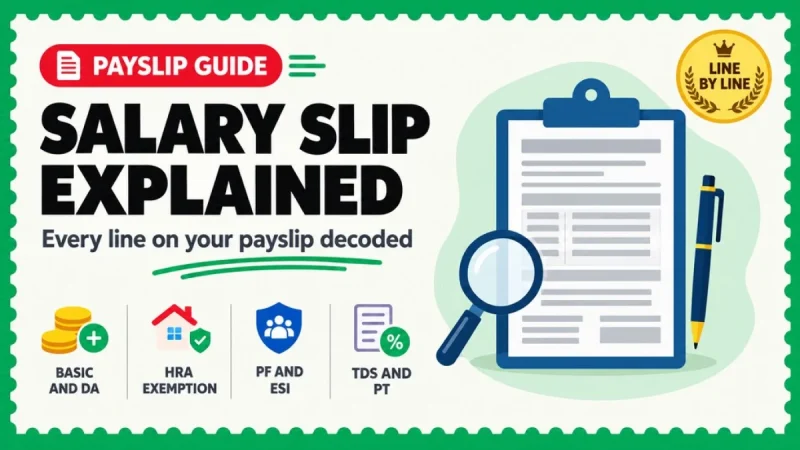
Most people never read their payslip past the net credit. That single PDF decides your home loan eligibility, your HRA exemption, your PF corpus and your tax refund. Here is what every line actually means.
Quick snapshot
- A payslip has two halves: earnings (gross) and deductions. Gross minus deductions = net credited.
- Basic salary drives almost everything else — PF, gratuity, HRA exemption and leave encashment are all computed on it.
- Special allowance is fully taxable. It exists only to balance the structure, and it carries no exemption at all.
- HRA exemption is the least of three amounts under Section 10(13A), and it is available only under the old tax regime.
- Professional tax is a state tax, capped by the Constitution at ₹2,500 per person per year. The monthly slab differs from state to state.
- Your payslip is the document banks, landlords and visa officers ask for. Keep every month's PDF.
- Three lines must be checked every single month: PF amount, UAN, and the TDS figure.
A salary slip lists your earnings on top and your deductions below. The earnings side typically has Basic salary, Dearness Allowance (in government and PSU jobs), House Rent Allowance, conveyance or transport allowance, and a special allowance that balances the structure. Added together these give your gross salary.
The deductions side typically has employee Provident Fund at 12% of Basic + DA, professional tax as a fixed monthly state slab, ESI if your wages are below the coverage threshold, income tax deducted at source (TDS), and any loan or notice-pay recovery. Gross minus deductions is your net or in-hand salary, which is the figure credited to your bank account.
1. The header: the part everybody skips
Before the numbers, your payslip carries identity fields. They matter more than people realise, because a single wrong character here causes a rejected PF claim or a mismatched tax credit later.
| Field | Why it matters |
|---|---|
| Employee name and code | Must match your Aadhaar and bank name exactly, or EPF claims get rejected on name mismatch |
| UAN (Universal Account Number) | Your permanent PF identity across every job you will ever have. If it is blank, your PF may not be getting credited — raise it the same month |
| PF number | Establishment-specific. Changes with every employer; your UAN does not |
| PAN | TDS is credited against this. A wrong PAN means your tax credit disappears and the deduction is made at a higher rate |
| ESIC number | Present only if you are covered by ESI |
| Designation, department, location | Location decides your professional tax slab and your HRA metro/non-metro status |
| Days paid / LOP days | "Loss of pay" days explain a short month before you panic |
| Bank account number | Should match the account seeded with your UAN, or online PF withdrawal will fail |
2. Earnings side: every line explained
| Earnings line | What it actually is | Taxable? |
|---|---|---|
| Basic salary | The core fixed component, usually 30–50% of CTC. The base for PF, gratuity, HRA exemption, leave encashment and notice recovery | Fully taxable |
| Dearness Allowance (DA) | Inflation-linked addition, revised periodically. Standard in central/state government, PSU and bank jobs; rare in private IT | Fully taxable. Counts with Basic for PF and gratuity where it is "DA forming part of pay" |
| House Rent Allowance (HRA) | Paid to cover rent, usually set at 40–50% of Basic | Partly exempt under Section 10(13A) if you actually pay rent — old regime only |
| Conveyance / transport allowance | Travel to and from work | Taxable for most employees under the current structure. A specific exemption continues for employees with disabilities |
| Special allowance | The balancing figure. Whatever is left after the other components are fixed | Fully taxable, no exemption |
| Medical allowance | A cash allowance, distinct from employer-paid insurance | Fully taxable as an allowance |
| Leave Travel Allowance (LTA) | Travel cost for you and family within India | Exempt on actual travel, within limits and block-year rules — old regime only |
| Food / meal allowance | Often given as meal cards rather than cash | Treated as a perquisite; the exemption position depends on how it is provided and your regime |
| Shift / night allowance | Paid for non-standard hours; common in BPO and manufacturing | Fully taxable |
| Overtime | Paid under the applicable labour law or company policy | Fully taxable |
| Performance incentive / variable pay | Conditional on rating and company performance | Fully taxable in the month it is paid |
| Arrears | Back pay from an increment or revision applied retrospectively | Taxable; relief is available under Section 89 with Form 10E in some cases |
| Gross salary | The sum of all the above | — |
Why your special allowance is so large
Companies fix Basic, HRA and a couple of named allowances by policy, then dump the remainder into "special allowance" so that the total hits your agreed CTC. There is nothing improper about it, but understand the consequence: special allowance carries zero tax exemption and does not increase your PF or gratuity. A structure that is 60% special allowance is a structure optimised for the company's simplicity, not your benefit.
3. HRA exemption: the three-way rule
This is the single most valuable line on a private-sector payslip for anyone paying rent — and it is also the one most often claimed wrongly.
Under Section 10(13A) read with Rule 2A, the exempt portion of your HRA is the least of these three:
The actual HRA you received
Straight from the earnings line on your payslip, for the months in question.
Rent actually paid minus 10% of salary
Here "salary" means Basic + DA (where DA forms part of pay), not gross.
50% of salary in a metro, 40% elsewhere
Delhi, Mumbai, Kolkata and Chennai are the metros for this purpose. Hyderabad, Bengaluru, Visakhapatnam and Vijayawada fall in the 40% bracket.
Worked example
Assume Basic + DA of ₹20,000 a month, HRA of ₹10,000 a month, rent actually paid of ₹12,000 a month, living in Visakhapatnam (non-metro). Annual figures: Basic + DA ₹2,40,000, HRA received ₹1,20,000, rent paid ₹1,44,000.
| Test | Calculation | Amount (₹) |
|---|---|---|
| Actual HRA received | ₹10,000 × 12 | 1,20,000 |
| Rent paid minus 10% of salary | 1,44,000 − 24,000 | 1,20,000 |
| 40% of salary (non-metro) | 40% of 2,40,000 | 96,000 |
| Exempt HRA = least of the three | — | 96,000 |
| Taxable portion of HRA | 1,20,000 − 96,000 | 24,000 |
Three things that destroy an HRA claim
- You chose the new tax regime. HRA exemption is an old-regime benefit. The new regime is the default, so if you file the easy way you get nothing from HRA no matter how much rent you pay.
- You have no rent proof. You need a rent agreement and receipts. Above the prescribed annual rent threshold you must also report the landlord's PAN; if the landlord will not give it, the claim is at risk.
- You paid no rent, or paid it to yourself. You cannot claim HRA for a house you own and live in. Rent paid to a parent is permissible in principle but must be genuine, documented, and declared as income by the parent.
4. Deductions side: every line explained
| Deduction line | How it is computed | Where it goes |
|---|---|---|
| Employee PF / EPF | 12% of Basic + DA + retaining allowance | Your own EPF account, tracked under your UAN |
| VPF (Voluntary PF) | Any additional percentage you opt for, over and above the statutory 12% | Your EPF account. The employer does not match it |
| Professional tax | A fixed monthly amount per salary slab, notified by your state. Constitutionally capped at ₹2,500 per person per year | State government |
| ESI | Employee share of wages, only while your wages stay below the ESI coverage threshold | ESIC, in exchange for medical benefits |
| TDS / income tax | Projected annual tax, divided across the remaining months of the financial year | Income Tax Department, credited against your PAN |
| NPS employee contribution | Only if you have opted in, or mandatorily in government service under NPS | Your PRAN account |
| Loan / advance recovery | As per your agreement with the employer | Employer |
| Notice pay recovery | Contractual. Check whether it is computed on Basic or on gross — the difference is large | Employer |
| LOP / leave without pay | Shown either as reduced earnings or as a deduction, depending on the payroll system | Not paid |
| Insurance / canteen / transport | Company-specific recoveries | Employer or vendor |
Professional tax: why your friend in another state pays a different amount
Professional tax is levied by state governments on "professions, trades, callings and employments". Article 276 of the Constitution permits it and caps the total at ₹2,500 per person per year. Within that cap, each state fixes its own monthly slabs, its own exemptions and its own list of who must register. Some states and union territories do not levy it at all.
The practical consequences for you: the amount on your payslip depends on your work location, not your home town; it does not change with your tax regime because it is not income tax; and if you change state mid-year your deduction changes. Under the old regime, professional tax paid is deductible from salary income. Check your own state's commercial taxes department for the current slab rather than relying on a number you read online.
5. The gross-to-net arithmetic, end to end
An illustrative payslip for a fresher with Basic of ₹18,000 a month. The professional tax figure here is purely illustrative.
| Earnings | ₹ / month | Deductions | ₹ / month |
|---|---|---|---|
| Basic salary | 18,000 | Employee PF (12% of Basic) | 2,160 |
| House Rent Allowance | 9,000 | Professional tax (illustrative) | 200 |
| Special allowance | 9,975 | ESI | Not applicable |
| — | — | TDS | As per regime and declarations |
| Gross salary | 36,975 | Total deductions | 2,360 + TDS |
Net salary before TDS = 36,975 − 2,360 = ₹34,615. Alongside this, the employer is contributing another ₹2,160 a month to your EPF and EPS, which does not appear in either column but is part of your CTC.
6. What to check on your payslip every month
Is the PF deduction exactly 12% of Basic + DA?
If it is lower, the employer may be restricting contributions to the statutory wage ceiling. That is legal, but you should know about it.
Is your UAN printed, and is the PF actually reaching EPFO?
A deduction on the payslip is not proof of deposit. Log in to the EPFO member portal or check your passbook and confirm the monthly credit appears.
Does the TDS deducted appear in Form 26AS / AIS?
Check on the income tax e-filing portal. If TDS was cut from your salary but never deposited, you cannot claim the credit — and you need to raise it with your employer immediately.
Are the days paid and LOP days correct?
Payroll errors on leave are the most common cause of an unexpectedly short month.
Has any new deduction appeared without explanation?
Ask the same month. Recoveries are far harder to reverse after a quarter has closed.
Before you sign your full and final settlement
When you resign, the F&F statement is a payslip with extra lines. Check all of these before you sign:
- Leave encashment — the balance and the rate used (usually Basic + DA).
- Gratuity — whether you crossed the qualifying service period, and the amount computed.
- Notice pay — days short, and whether recovery is on Basic or gross.
- Variable pay — the pro-rated portion for the current cycle, if your policy allows it on exit.
- Joining bonus clawback — if you are inside the lock-in period, check whether it is being recovered gross or net of the tax already deducted.
- Reimbursement claims — submit every pending claim before your last working day.
- PF — do not withdraw. Transfer it to your new employer and keep the service continuous.
Also collect, before you lose system access: your relieving letter, experience letter, the final Form 16, and a PDF of every payslip. Nobody will send these to you cheerfully six months later.
Frequently asked questions
What is the difference between gross salary and net salary on a payslip?
Gross salary is the total of every line in the earnings column, before anything is taken out. Net salary is what remains after employee PF, professional tax, ESI if applicable, TDS and any recovery. Net salary is the figure credited to your bank account, and it is what people mean by "in-hand".
Is special allowance taxable?
Yes, fully. Special allowance exists only to balance your salary structure up to the agreed CTC. It carries no exemption, and it does not increase your PF or your gratuity. This is why two people on the same gross salary can have very different tax liabilities depending on how much of their pay is Basic and HRA versus special allowance.
Can I claim HRA if I chose the new tax regime?
No. HRA exemption under Section 10(13A) is available only under the old regime, and the new regime is the default. If you want to claim HRA you must consciously opt for the old regime and be able to show that the HRA exemption plus your other old-regime deductions beat what the new regime gives you. Run both numbers before deciding.
Why is professional tax different for my friend in another state?
Because it is a state tax, not a central one. Article 276 of the Constitution caps it at Rs 2,500 per person per year, but each state sets its own monthly slabs within that cap, and some states do not levy it at all. Your deduction depends on your work location.
My payslip shows a PF deduction but my EPFO passbook is empty. What should I do?
Raise it with your employer in writing immediately and keep the payslip as evidence. A deduction on the payslip is not proof that the money reached EPFO. Check your passbook on the EPFO member portal every quarter. If the employer does not resolve it, you can escalate through the EPFO grievance mechanism. The longer you leave it, the harder reconciliation becomes.
What is VPF and should I opt for it?
Voluntary Provident Fund is any contribution you make above the statutory 12%. It earns the same rate as EPF and is convenient because it comes straight out of your salary. The employer does not match it, so it is a savings decision, not free money. It also reduces your in-hand immediately and the money is locked until withdrawal conditions are met, so build an accessible emergency fund first.
Is ESI deducted from every salary?
No. ESI applies only while your wages are below the coverage threshold notified under the ESI Act. Most engineering, IT and graduate-entry salaries are above it, which is why you will not see an ESI line. If you are covered, you get ESIC medical benefits for yourself and your dependants, which is a genuine benefit rather than a pure cost.
How many years of payslips should I keep?
Keep all of them, as PDFs, in cloud storage. You will need them for home and car loan applications, visa applications, background verification during job changes, rent agreements, PF and gratuity disputes, and for reconstructing your income if a Form 16 is never issued. They are small files and they are impossible to get back once you lose system access to an old employer's portal.
Sources: EPFO — FAQs on contribution rates and the wage ceiling; Income Tax Department e-filing portal (Form 26AS, AIS, regime options); ESIC — coverage and contribution; Ministry of Labour & Employment; Article 276 of the Constitution of India for the professional tax ceiling. Professional tax slabs are notified by individual state governments.
Related guides on BeInCareer
- CTC vs in-hand salary: how to calculate your real take-home
- Form 16 explained: Part A vs Part B and how to file your ITR
- Save tax on your first salary: new regime vs old regime
- How to file your ITR for the first time as a fresher
- EPFO PF claim guide: UAN, forms and online withdrawal
- NPS vs PPF vs EPF: which retirement plan suits you
- Probation period rules: salary, leave and resignation
- Offer letter checklist before you join
- After campus placement: from offer letter to first salary
- How to manage money as a college student