
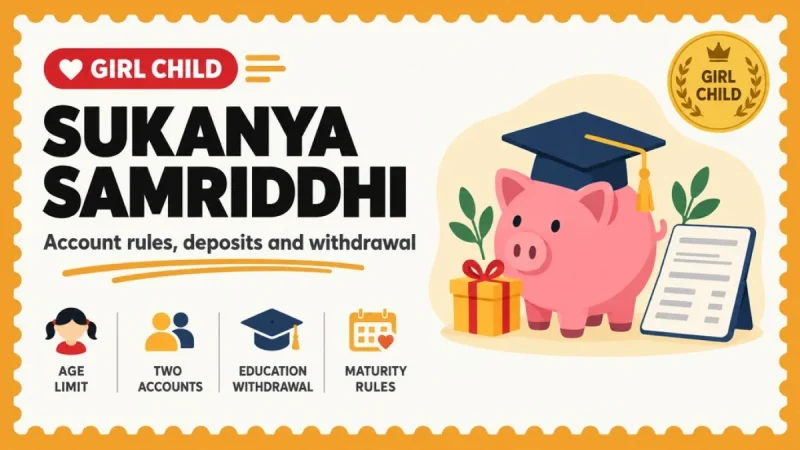
The scheme is governed by the Sukanya Samriddhi Account Scheme, 2019, notified by G.S.R. 914(E). Here is what the notified rules actually say about who can open an account, how long you pay in, when you can take money out, and the one deadline most parents miss.
Quick snapshot
- An account can be opened by a guardian in the name of a girl child who has not attained the age of ten years on the date of opening.
- A maximum of two accounts in one family, with a defined exception for twins and triplets.
- Minimum ₹250 to open and ₹250 in a financial year thereafter; maximum ₹1,50,000 in a financial year.
- Deposits run for 15 years. The account matures at 21 years. The six-year gap in between is the part people get wrong.
- A defaulted account can be regularised till 15 years from opening on payment of ₹50 penalty for each year of default plus the minimum deposit for those years.
- Education withdrawal of up to 50% of the preceding year-end balance, allowed only after she turns 18 or passes the tenth standard, whichever is earlier.
- Deposits qualify for the Section 80C deduction and the interest and withdrawals were made exempt by inserting clause (11A) in Section 10 — the EEE treatment.
Sukanya Samriddhi Yojana is a government small savings scheme for a girl child under the age of ten, with a 15-year deposit period and a 21-year maturity period. You deposit a minimum of ₹250 and a maximum of ₹1,50,000 in a financial year, at a post office or at an authorised bank branch. Only two accounts are allowed in one family, except where twins or triplets are born.
Money can be taken out before maturity in only three situations: a 50% withdrawal for the girl's higher education after she turns 18 or clears class 10; premature closure for her marriage, if she will be at least 18 on the date of marriage; and premature closure on death or on documented extreme compassionate grounds after five years. There is no ordinary "I need the money" exit.
1. Who can open the account, and the ten-year cut-off
Paragraph 3 of the Scheme is short and strict. The account may be opened by one of the guardians in the name of a girl child who has not attained the age of ten years as on the date of opening of the account. There is no lower age limit, so an account can be opened days after birth.
Three consequences follow directly from that wording:
- The cut-off is her tenth birthday, not her tenth year. Once she has attained ten years, the door is closed. There is no late-entry window and no penalty route back in.
- Every account holder shall have a single account. You cannot open a second account for the same girl at another post office or bank to get around the annual deposit ceiling.
- The application must carry her birth certificate. Form-1 has to be accompanied by the birth certificate of the girl child, along with the guardian's own KYC documents.
The account is operated by the guardian until the account holder attains the age of eighteen years. After she turns eighteen, she operates it herself on submitting the necessary documents. That is a handover, not a maturity event — the account keeps running.
2. Two accounts per family, and the twins or triplets exception
An account under the Scheme may be opened for a maximum of two girl children in one family. "Family" is defined in the Scheme as an individual, the individual's spouse and their children, adopted or otherwise.
The exception is narrower than most people assume, so read it slowly. More than two accounts may be opened in a family if such children are born in the first or in the second order of birth, or in both, on submission of an affidavit by the guardian supported with the birth certificates of the twins or triplets.
Then comes the proviso that trips families up: that relaxation does not apply to a girl child of the second order of birth if the first order of birth in the family has already resulted in two or more surviving girl children.
| Family situation | Accounts permitted |
|---|---|
| Two daughters, born separately | Two accounts |
| One daughter, then twin daughters in the second order of birth | Three accounts, on affidavit plus birth certificates of the twins |
| Twin daughters in the first order of birth, then one more daughter | Three accounts, on affidavit plus birth certificates of the twins |
| Twin or triplet daughters in the first order of birth, and a girl child in the second order of birth | The relaxation does not extend to the second-order girl child — the proviso expressly excludes this case |
| Three daughters, all single births | Two accounts only |
Carry the affidavit and the birth certificates with you the first time. Counter staff cannot open a third account on verbal assurance.
3. Where to open it: post office or an authorised bank
The scheme is not post-office-only. The Ministry of Finance factsheet on the Sukanya Samriddhi Account records that it is operated through all post offices, branches of public sector banks and three private sector banks — HDFC Bank, Axis Bank and ICICI Bank. The list of authorised institutions is set by government notification and can change, so confirm with the branch before you travel.
Practical points on choosing where to open:
Opening at a post office
- Available at every post office that handles savings schemes.
- India Post Internet Banking lets you deposit into an existing SSA account online once you are registered.
- The ePassbook facility covers SSA, so you can check balance and a mini statement without visiting the counter.
Opening at an authorised bank
- Convenient if you already bank there and want standing-instruction transfers.
- Only notified banks and notified branches can accept the account — not every branch of a listed bank does it.
- Rules, rates and limits are identical. The scheme is a central government scheme; the bank is only the operating agency.
The account is transferable anywhere in India from one post office or bank to another, which matters for transferable jobs and for families that relocate.
4. Deposits: the minimum, the maximum and the 15-year clock
Under paragraph 4 of the Scheme:
- The account may be opened with a minimum initial deposit of ₹250, and thereafter in multiples of ₹50.
- At least ₹250 must be deposited in a financial year in one account.
- The total amount deposited in an account shall not exceed ₹1,50,000 in a financial year. A deposit above that, if accepted by accounting error, earns no interest and is returned immediately.
- Deposits may be made only till the completion of fifteen years from the date of opening the account.
That last line is the single most misunderstood rule in the scheme.
You pay in for 15 years. The account matures at 21 years. For the six years in between, you deposit nothing and the balance keeps earning interest at the rate applicable to the scheme. The account does not become inactive, and it does not stop compounding.
So an account opened in the year a girl is born takes deposits until she is about 15 and pays out when she is 21. An account opened when she is 9 takes deposits until she is 24 and matures when she is 30 — the maturity is counted from the date of opening, not from her age.
Interest is calculated for the calendar month on the lowest balance between the close of the fifth day and the end of the month, and credited at the end of each financial year. If you intend to deposit in a given month, do it on or before the 5th. Depositing on the 20th buys you nothing for that month.
What the interest rate is, and why we are not pinning a number to it
Small savings rates are notified quarterly by the Ministry of Finance, Department of Economic Affairs (Budget Division). The office memorandum dated 30 September 2026 kept the rates for the third quarter of FY 2026-27 (1 October 2026 to 31 December 2026) unchanged from the second quarter, and the memorandum dated 30 March 2026 had done the same for the first quarter.
India Post currently lists the Sukanya Samriddhi Account at 8.2% per annum, calculated yearly and compounded yearly. Treat that as the rate for the current quarter only. Before you build a projection, open the current quarterly notification on the Department of Economic Affairs small savings page and the India Post saving schemes page and read the rate off there.
5. Account under default, and how to revive it
An account in which the minimum of ₹250 has not been deposited in a financial year is treated as an account under default.
The revival rule, and the trap inside it
A defaulted account may be regularised any time till the completion of fifteen years from the date of opening, on payment of a penalty of ₹50 for each year of default, along with the minimum annual deposit for each defaulted year.
The trap: the revival window closes with the deposit period. Once fifteen years are up, you cannot go back and regularise.
If a defaulted account is not regularised within that window, the Scheme provides that the whole deposit, including deposits made before the date of default, is eligible for interest at the rate applicable to the Scheme till closure of the account. So the money is not punished retrospectively — but you lose the years you did not fund, and you lose the right to fund them later.
If you are running the account on a thin budget, set a calendar reminder for one ₹250 deposit in each financial year. That single deposit keeps the account regular.
6. Withdrawal, premature closure and maturity
The Scheme allows money out in four defined situations and no others.
Partial withdrawal for education
Up to 50% of the balance at the end of the financial year preceding the year of application, on Form-3, for the education of the account holder. Allowed only after she attains 18 years or has passed the tenth standard, whichever is earlier.
Premature closure for marriage
Permitted before 21 years on a declaration on non-judicial stamp paper, attested by a notary, with proof of age confirming she will not be less than eighteen years on the date of marriage. No such closure is allowed before one month from the date of the intended marriage, or after three months from the date of marriage.
Closure on death of the account holder
Closed immediately on Form-2 with the death certificate. Balance and interest till the date of death are paid to the guardian. For the period between death and closure, interest is paid at the Post Office Savings Account rate.
Extreme compassionate grounds
The accounts office may allow premature closure where it is satisfied, on complete documentation and a written order, that continuing the account causes undue hardship — for example medical support in life-threatening disease of the account holder, or death of the guardian. Not before five years from the date of opening.
The education withdrawal has conditions attached that are easy to miss. The application must be supported by a confirmed offer of admission or a fee slip showing the financial requirement, and the amount is restricted to the actual fee and charges shown in that document. It may be taken in a lump sum or in instalments — not more than one a year, for a maximum of five years — all within the 50% ceiling.
| Her age / stage | What the rules allow |
|---|---|
| Under 10 at opening | Account can be opened by a guardian in her name |
| Up to 18 | Account operated by the guardian |
| Turns 18, or passes class 10 earlier | Education withdrawal of up to 50% of the preceding year-end balance becomes available |
| Turns 18 | She operates the account herself on submitting documents; marriage-related premature closure becomes possible |
| 15 years from opening | Deposit period ends. No fresh deposits, no revival of defaults. Balance keeps earning interest |
| 21 years from opening | Account matures. Balance plus interest is paid to the account holder on Form-4 |
7. Tax treatment: what EEE actually means here
The tax position was set out in the Memorandum to the Finance Bill, 2015 when the benefits were legislated. Three separate things were provided for:
- Deposits are eligible for deduction under Section 80C. The scheme was notified under clause (viii) of sub-section (2) of Section 80C by notification number 9/2015, S.O. 210(E) dated 21 January 2015.
- Interest accruing on deposits is exempt from income tax.
- Withdrawals in accordance with the scheme rules are exempt from tax. Clause (11A) was inserted in Section 10 so that any payment from an account opened under the scheme is not included in total income.
That is the full Exempt-Exempt-Exempt structure: contribution deductible, interest untaxed, maturity untaxed. Very few retail products in India have all three.
Two cautions before you plan around the deduction
The 80C deduction is a deduction, not a refund. It reduces taxable income under the old tax regime. If you are taxed under the regime that does not allow these deductions, the 80C part of the benefit does nothing for you — though the exempt interest and exempt maturity still do.
The law itself has been rewritten. The Income-tax Act, 2025 replaced the Income-tax Act, 1961 with effect from 1 April 2026, and section numbering has changed. The policy on Sukanya Samriddhi has been carried forward, but if you are citing a section number in a return or a submission, check the corresponding provision for your tax year on the Income Tax Department site rather than quoting "80C" and "10(11A)" from memory.
8. Things the rules do not let you do
- You cannot open an account for a girl who has turned ten. No relaxation, no late fee route.
- You cannot run two accounts for the same girl. One account holder, one account.
- You cannot deposit after 15 years. Money sent after the deposit period is not a deposit.
- You cannot take a loan against the balance. Unlike PPF, the Scheme has no loan provision.
- You cannot withdraw for a house, a business or a family emergency. Only education, marriage, death, or documented extreme compassionate grounds.
- You cannot close it at 18 just because she is an adult. Eighteen changes who operates the account and unlocks education withdrawal and marriage closure. Maturity stays at 21 years from opening.
- A guardian cannot treat the money as their own. On maturity, the balance is payable to the account holder.
One useful detail from the Ministry of Finance factsheet: interest continues to be paid even after maturity if the account is not closed. That is a cushion, not a plan — close it and move the money into something you have chosen deliberately.
Frequently asked questions
What is the age limit for opening a Sukanya Samriddhi account?
The account may be opened by a guardian in the name of a girl child who has not attained the age of ten years as on the date of opening. There is no minimum age, so it can be opened soon after birth. Once she has turned ten, the account cannot be opened at all — the Scheme provides no late-entry window.
How many Sukanya Samriddhi accounts can one family open?
A maximum of two, one for each of two girl children. More than two may be opened where the children are born in the first or second order of birth, or both, on an affidavit from the guardian supported by the birth certificates of the twins or triplets. That relaxation does not apply to a girl child of the second order of birth if the first order of birth already produced two or more surviving girl children.
What is the minimum and maximum deposit in SSY?
The account opens with a minimum of Rs 250 and thereafter deposits are in multiples of Rs 50, with at least Rs 250 to be deposited in each financial year. The maximum is Rs 1,50,000 in a financial year. A deposit above that limit, if accepted by accounting error, earns no interest and is returned to the depositor immediately.
What is the difference between the deposit period and the maturity period?
Deposits may be made only till the completion of fifteen years from the date of opening the account, but the account matures on completion of twenty-one years from the date of opening. During the six-year gap you deposit nothing and the balance continues to earn interest at the rate applicable to the scheme. Both periods run from the date of opening, not from the girl's age.
Can I withdraw money from SSY for my daughter's college fees?
Yes, up to fifty per cent of the balance at the end of the financial year preceding the year of application, on Form-3, and only after she attains eighteen years or has passed the tenth standard, whichever is earlier. The application must carry a confirmed offer of admission or a fee slip, and the amount is restricted to the actual fee and charges shown. It can be taken in a lump sum or in up to one instalment a year for a maximum of five years.
Can the account be closed before 21 years for marriage?
Yes. Closure before twenty-one years is permitted for the intended marriage of the account holder, on a declaration signed on non-judicial stamp paper and attested by a notary, supported with proof of age confirming she will not be less than eighteen on the date of marriage. No such closure is allowed before one month from the date of the intended marriage or after three months from the date of marriage.
What happens if I miss the minimum deposit in a year?
The account is treated as an account under default. It can be regularised any time until fifteen years from the date of opening, on payment of a penalty of Rs 50 for each year of default plus the minimum annual deposit for those years. If it is not regularised in that window, the whole deposit, including deposits made before the default, remains eligible for interest at the scheme rate till closure.
Is Sukanya Samriddhi Yojana tax free?
The Memorandum to the Finance Bill, 2015 provided that deposits are eligible for deduction under Section 80C, interest accruing on the account is exempt, and withdrawals made in accordance with the scheme rules are exempt, with clause (11A) inserted in Section 10 for that purpose. That is the EEE treatment. Note that the deduction side depends on the tax regime you choose, and that the Income-tax Act, 2025 replaced the 1961 Act from 1 April 2026, so verify current section references for your tax year.
Sources: National Savings Institute — Sukanya Samriddhi Account Scheme, 2019 (G.S.R. 914(E) dated 12.12.2019, amended by G.S.R. 288(E) dated 05.05.2020); Ministry of Finance / PIB — Factsheet on the Sukanya Samriddhi Account scheme; Memorandum to the Finance Bill, 2015 — tax benefits under Section 80C and clause (11A) of Section 10; India Post — Post Office Saving Schemes and current rates; Ministry of Finance, Department of Economic Affairs — Small Savings: quarterly interest rate notifications.
Related guides on BeInCareer
- Post office savings schemes compared: RD, TD, MIS, SCSS, NSC, KVP, PPF and SSY
- TDS on FD interest and how Form 15G and 15H work
- NPS vs PPF vs EPF: which retirement plan suits you
- Best investment plans for salaried employees in India
- New regime vs old regime: saving tax on your salary
- Best investment plans for students in India
- Emergency fund: FD vs RD vs liquid funds
- Mutual funds for beginners in India
- What to do with idle money lying in your bank account
- Why saving alone will not make you rich in India