
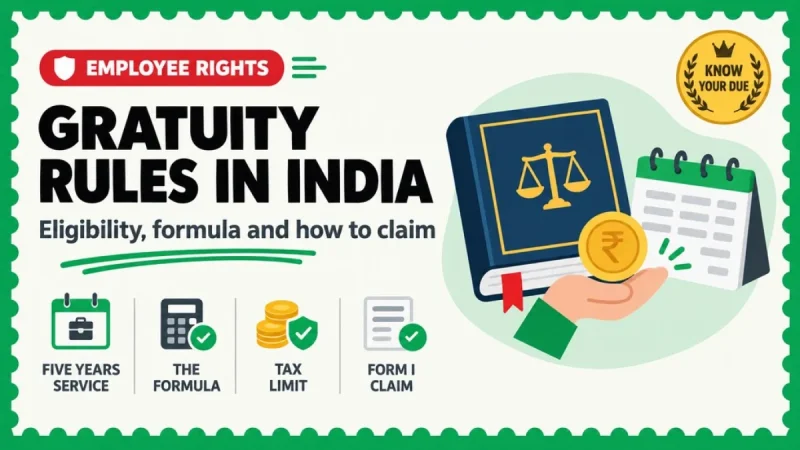
Gratuity sits inside your CTC from day one but only becomes cash if you qualify. Here is who is covered, how the 15/26 formula works, what the ₹20 lakh ceiling means, and how to claim it when you resign.
Quick snapshot
- The Payment of Gratuity Act, 1972 applies to establishments with 10 or more employees, and once covered an establishment stays covered.
- You generally need five years of continuous service with the same employer. The five years are not required in case of death or disablement.
- Formula: last drawn Basic + DA × 15/26 × completed years of service, with any part year beyond six months counted as a full year.
- The statutory ceiling was raised from ₹10 lakh to ₹20 lakh with effect from 29 March 2018 by notification 1420(E).
- Gratuity received is exempt from tax up to the prescribed limit under Section 10(10); anything above that is taxable as salary.
- You claim it with Form I, and the employer is required to pay it within 30 days of it becoming payable.
- The gratuity line in your CTC is a provision of about 4.81% of annual Basic — not a monthly payment.
Gratuity is a lump sum your employer pays you for long service, calculated as last drawn Basic + DA × 15/26 × number of completed years. Under the Payment of Gratuity Act, 1972 it becomes payable on resignation, retirement, superannuation, death or disablement, after five years of continuous service — except in death and disablement cases, where the five-year condition does not apply.
The maximum amount payable under the Act is ₹20 lakh, raised from ₹10 lakh with effect from 29 March 2018. Example: on a last drawn Basic + DA of ₹50,000 with 10 years of service, gratuity = 50,000 × 15 ÷ 26 × 10 = ₹2,88,462.
1. Who is covered by the Gratuity Act
The Payment of Gratuity Act, 1972 applies to factories, mines, oilfields, plantations, ports, railway companies, shops and establishments in which ten or more persons are employed, or were employed on any day in the preceding twelve months, along with other establishments notified by the central government.
Two consequences people miss:
- Once covered, always covered. If the headcount later drops below ten, the Act continues to apply to that establishment. You do not lose your right because the company shrank.
- Coverage is about the establishment, not your designation. If you are an employee of a covered establishment, you are covered — the Act's definition of "employee" is broad and is not limited by salary level.
If your employer has fewer than ten employees and was never covered, gratuity is a matter of contract rather than statute. In that case, whatever your appointment letter or company policy says is what governs — so read it.
2. The five-year rule, and the "4 years 240 days" question
Section 4 of the Act makes gratuity payable on termination of employment after continuous service of not less than five years. The exceptions, where five years are not required, are death and disablement — and the Act also provides for cases such as the expiry of fixed-term employment and other events notified by the central government.
"Continuous service" is a defined term, and it is not the same as "five calendar years on the payroll". Authorised leave, lay-off, strike that is not illegal, and absence due to an accident do not break continuity. A year in which you worked for a prescribed minimum number of days is treated as continuous service for that year.
About the popular "4 years and 240 days" claim
You will constantly read that you qualify for gratuity after 4 years and 240 days. This reading comes from the definition of continuous service combined with judicial decisions — notably rulings that have treated the fifth year as complete where the employee worked 240 days in it — and some high courts have taken this view.
But treat it as a contested interpretation, not settled statutory text. The Act itself says five years. Many employers will reject a claim at 4 years and 8 months, and whether you win depends on your jurisdiction, your facts and your willingness to litigate. If you are within a few months of five years and gratuity matters to you, the safest move is to serve out the five years. Do not resign on the strength of a blog post.
3. The formula, and how the rounding works
For establishments covered by the Act, gratuity for each completed year of service is 15 days' wages based on the rate of wages last drawn. Because a month is treated as 26 working days, this becomes:
Gratuity = (Last drawn Basic + DA) × 15 ÷ 26 × Number of completed years of service
"Last drawn" means the rate of wages at the time of exit, not an average. "Wages" here means Basic plus Dearness Allowance — not gross salary, and not HRA or special allowance.
Rounding the years
The Act counts every completed year of service, plus any part of a year in excess of six months as a full year. So:
- 10 years 4 months → counted as 10 years
- 10 years 7 months → counted as 11 years
- 10 years exactly 6 months → counted as 10 years, because the part year must exceed six months
That single month can be worth a full extra year of gratuity. If you are resigning at, say, 7 years and 5 months, working one more month changes the payout.
Worked examples
All figures below are arithmetic, computed with 15 ÷ 26 = 0.576923. Treat the salaries as illustrations.
| Last drawn Basic + DA | Completed years | Calculation | Gratuity payable |
|---|---|---|---|
| ₹30,000 | 5 | 30,000 × 15 ÷ 26 × 5 | ₹86,538 |
| ₹50,000 | 10 | 50,000 × 15 ÷ 26 × 10 | ₹2,88,462 |
| ₹80,000 | 15 | 80,000 × 15 ÷ 26 × 15 | ₹6,92,308 |
| ₹1,50,000 | 25 | 1,50,000 × 15 ÷ 26 × 25 = ₹21,63,462 | Restricted to ₹20,00,000 |
The last row shows the ceiling at work. The formula produced ₹21.63 lakh, but the amount payable under the Act is capped at ₹20 lakh. An employer may pay more than the ceiling voluntarily or under a better contract, and often does — but then the excess is not protected by the Act, and the tax treatment of the excess is different.
Establishments not covered by the Act
Where the Act does not apply and gratuity is paid as a matter of policy, the computation commonly used is based on half a month's average salary for each completed year rather than 15/26 of last drawn wages, using the average of the last ten months. The tax exemption rules for non-covered employees also differ. If your employer is not covered, ask payroll in writing which basis they use before you plan around a number.
4. The ceiling and the tax treatment
The ceiling under the Payment of Gratuity Act was enhanced from ₹10 lakh to ₹20 lakh with effect from 29 March 2018, through notification 1420(E) issued under the Payment of Gratuity (Amendment) Act, 2018. The corresponding limit for computing the tax exemption under Section 10(10)(ii) was aligned to ₹20 lakh as well.
How the tax works, in plain terms:
| Who you are | Tax position on gratuity received |
|---|---|
| Government employee | Gratuity received is fully exempt from income tax |
| Employee covered by the Gratuity Act | Exempt up to the least of: the prescribed monetary limit, the amount computed by the statutory formula, or the gratuity actually received. The balance is taxable as salary |
| Employee not covered by the Act | Exempt up to the least of the prescribed limit, half a month's average salary for each completed year, or the amount received. Different computation, same principle |
| Nominee receiving death gratuity | Treated separately; check the position for the specific assessment year |
Two practical notes. First, the exemption limit is a lifetime limit across employers, not a per-job limit — if you received exempt gratuity at an earlier employer, that consumes part of your overall exemption. Second, central government employees have a separate retirement and death gratuity structure under pension rules; the Department of Pension and Pensioners' Welfare has issued instructions raising that maximum from ₹20 lakh to ₹25 lakh linked to the dearness allowance rate reaching 50%. That is a government-pension provision and does not change the private-sector ceiling under the Act.
5. How to claim gratuity when you leave
Check your service length and your last drawn Basic + DA
Compute the amount yourself using the formula above before you talk to payroll. Apply the six-month rounding rule.
Submit Form I to the employer
Form I is the employee's application for gratuity under the Gratuity Rules. A nominee uses Form J and a legal heir uses Form K. Submit it in writing and keep an acknowledged copy.
The employer must determine the amount and give notice
The employer is required to compute the amount and issue a notice of payment to you and to the controlling authority, whether or not you applied.
Payment within 30 days
Gratuity must be paid within 30 days from the date it becomes payable. Delay beyond that attracts simple interest for the delayed period, at the rate notified by the central government.
If it is refused or short-paid, escalate
Raise a dispute with the Controlling Authority under the Act — usually the Assistant Labour Commissioner for your area. The authority can decide the dispute and direct payment. Keep your appointment letter, payslips, relieving letter and the acknowledged Form I.
Nomination: the five minutes that prevents a legal mess
File Form F with your employer nominating who receives your gratuity if you die in service. Update it after marriage or any change in family. Without a valid nomination, your family has to establish entitlement as legal heirs, which is slow and occasionally contested. It takes five minutes and most employees never do it.
6. Common mistakes and misconceptions
Six things people get wrong about gratuity
- "Gratuity is calculated on my gross salary." No. It is Basic + DA only. On a typical private-sector structure where Basic is 40% of CTC, the gratuity figure will feel much smaller than people expect.
- "It is in my CTC so I have already earned it." The CTC line is an accounting provision of roughly 4.81% of annual Basic. If you exit before qualifying, you receive nothing from it.
- "I worked 5 years across three companies, so I qualify." Continuous service is with one employer. Service does not aggregate across employers the way EPF does. A genuine transfer within the same group, with service continuity formally recognised, is a different matter — get it in writing.
- "My employer can forfeit my gratuity because I resigned." Resignation does not forfeit gratuity. The Act permits forfeiture only in defined situations, such as termination for an act of wilful omission causing damage, or for riotous conduct or an offence involving moral turpitude in the course of employment — and even then, within limits.
- "Contract and fixed-term staff never get gratuity." The position has changed over time and the Act provides for expiry of fixed-term employment. Check your own contract and the current rules rather than assuming you are excluded.
- "Gratuity is paid along with my final salary." It is often processed separately and later. Track it explicitly in your full and final settlement rather than assuming it was included.
A note on the new labour codes
India has consolidated several labour statutes, including gratuity provisions, into the new labour codes. Implementation and the state-level rules have been rolled out in stages, and the Ministry of Labour & Employment publishes FAQs on which rules apply. Because the position differs by state and by notification date, we are deliberately not summarising the code provisions here as if they were settled everywhere. Check the Ministry of Labour & Employment site and your state's labour department for what applies to you today.
Frequently asked questions
How is gratuity calculated in India?
For employees covered by the Payment of Gratuity Act, gratuity = last drawn Basic + DA multiplied by 15, divided by 26, multiplied by the number of completed years of service. Any part of a year exceeding six months counts as a full year. The amount payable under the Act is capped at Rs 20 lakh.
Do I get gratuity if I resign before five years?
Under the Act, gratuity requires five years of continuous service, with the five-year condition waived in cases of death or disablement. The widely quoted "4 years and 240 days" position comes from the definition of continuous service and from court rulings, but it is an interpretation rather than settled statutory text, and many employers reject such claims. If you are close to five years and the amount matters, serve out the full period.
Is gratuity calculated on Basic salary or gross salary?
On Basic plus Dearness Allowance only. HRA, special allowance, conveyance, bonus and incentives are excluded. This is why gratuity on a private-sector salary with a low Basic component is much smaller than people expect, and it is a good reason to pay attention to how your Basic is set when you negotiate an offer.
What is the maximum gratuity I can receive?
The ceiling under the Payment of Gratuity Act is Rs 20 lakh, raised from Rs 10 lakh with effect from 29 March 2018 by notification 1420(E). An employer may choose to pay more under a better contract or policy, but the amount above the ceiling is not protected by the Act and is treated differently for tax. Central government employees have a separate retirement and death gratuity limit under pension rules.
Is gratuity taxable?
Gratuity received by a government employee is fully exempt. For an employee covered by the Act, the exemption under Section 10(10) is the least of the prescribed monetary limit, the amount computed by the statutory formula, or the gratuity actually received; anything beyond that is taxable as salary. The exemption limit applies across your working life, not per employer, so earlier exempt gratuity consumes part of it.
How long does the employer have to pay my gratuity?
Within 30 days from the date gratuity becomes payable. If the employer delays beyond that, simple interest is payable on the amount for the period of delay at the rate notified by the central government. If payment is refused or short, raise a dispute with the Controlling Authority under the Act, usually the Assistant Labour Commissioner for your area.
Can my employer refuse to pay gratuity?
Not simply because you resigned. The Act allows forfeiture only in defined circumstances, such as termination for wilful omission or negligence causing damage or loss, or for riotous or disorderly conduct or an offence involving moral turpitude committed in the course of employment, and even then subject to limits. If gratuity is withheld without a lawful ground, the Controlling Authority can direct payment.
Does gratuity add up across different companies?
No. Unlike EPF, which follows you through your UAN, gratuity is based on continuous service with one employer. Five years spread across three companies gives you no gratuity from any of them. The exception is a formally recognised transfer within the same group where your past service is expressly carried forward — always get that confirmation in writing at the time of transfer.
Sources: India Code — The Payment of Gratuity Act, 1972 (full text); Ministry of Labour & Employment — brief on the Payment of Gratuity (Amendment) Act, 2018; PIB — Payment of Gratuity (Amendment) Act, 2018 brought into force on 29 March 2018; Income Tax India — effective date of the Rs 20 lakh limit for Section 10(10)(ii); PIB — DoPPW instructions on retirement and death gratuity for central government employees; Ministry of Labour & Employment — labour codes FAQs.
Related guides on BeInCareer
- CTC vs in-hand salary: how to calculate your real take-home
- Salary slip explained line by line
- EPFO PF claim guide: UAN, forms and online withdrawal
- Form 16 explained: Part A vs Part B and how to file your ITR
- Probation period rules: salary, leave and resignation
- Offer letter checklist before you join
- NPS vs PPF vs EPF: which retirement plan suits you
- Save tax on your first salary: new regime vs old regime
- After campus placement: from offer letter to first salary
- 8th Pay Commission: DA, arrears and salary impact