
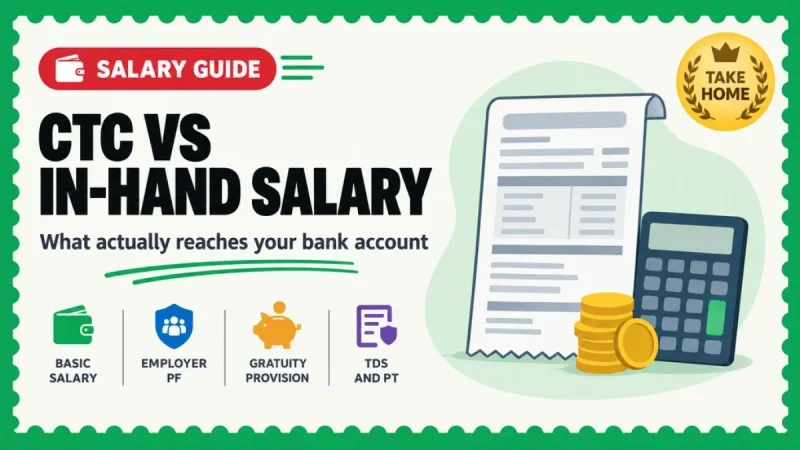
Your offer letter says one number. Your bank account gets a smaller one. Here is the full waterfall from CTC to in-hand, with the arithmetic done line by line so you can check your own offer in ten minutes.
Quick snapshot
- CTC is not salary. It is everything the company spends on you in a year, including money that never reaches you monthly.
- In-hand is almost always 12–30% below CTC ÷ 12. The gap widens as CTC rises, because TDS grows.
- The usual "paper" components are employer PF, gratuity provision, insurance premium, variable pay and joining bonus.
- EPF is 12% of Basic + DA from you and 12% from the employer; of the employer's 12%, 8.33% goes to the pension fund (EPS) subject to the ₹15,000 wage ceiling.
- Gratuity shown inside CTC is a provision of about 4.81% of annual Basic — you only receive it on exit, and usually only after qualifying service.
- Professional tax is a state tax. The Constitution caps it at ₹2,500 per person per year, but the monthly slab differs by state.
- Two offers with the same CTC can differ by thousands a month purely because of how Basic is set.
CTC (Cost to Company) is the company's total annual spend on you. In-hand salary is what lands in your bank after statutory deductions. To get from one to the other: start with CTC, remove the components that are not paid to you monthly (employer PF, gratuity provision, group insurance premium, variable pay, bonuses) to get your annual gross. Divide that by 12 for monthly gross. Then subtract employee PF (12% of Basic + DA), professional tax, ESI if applicable, and TDS. What remains is your in-hand.
For a typical ₹4,80,000 CTC fresher offer with Basic set at ₹18,000 a month, the in-hand works out to roughly ₹34,615 a month — not ₹40,000. The full table is in section 5 below.
1. What CTC actually means
CTC stands for Cost to Company. It is an accounting figure, not a pay figure. It answers the question "how much does this employee cost us per year?" — and that includes money paid about you rather than to you.
This is why recruiters quote CTC. It is the biggest honest number they can put in front of you. Nobody is lying when they say "₹6 LPA". But if you mentally divide 6,00,000 by 12 and expect ₹50,000 in your account, you will be disappointed every month for the rest of your first year.
There are four numbers you need to keep separate in your head:
| Term | What it is | Who sees it |
|---|---|---|
| CTC | Total annual company spend: your pay plus employer contributions, provisions and premiums | Your offer letter and the recruiter |
| Gross salary | The total of the earnings lines on your payslip, before any deduction | Top half of your payslip |
| Net / in-hand | Gross minus PF, professional tax, ESI and TDS | Your bank statement |
| Taxable income | Gross minus exemptions and deductions you are eligible for | Form 16 Part B and your ITR |
Only the third one pays your rent.
2. The CTC to in-hand waterfall
Work top to bottom. Every step either removes something that never reaches you, or removes something that reaches the government instead.
Start with annual CTC
The number in the offer letter. Ask HR for the component-wise break-up in writing — the annexure, not just the headline.
Remove the employer's retirement and insurance cost
Employer PF contribution, gratuity provision, group medical and group term life premiums, and in some companies the NPS employer contribution. These are real costs to the company and real benefits to you — but they are not monthly cash.
Remove variable pay and one-time payouts
Performance bonus, retention bonus, joining bonus, shift allowance. These are conditional or annual, so they must not be counted in a monthly calculation.
You now have annual gross. Divide by 12
This is your monthly gross — the total of the earnings column on your payslip.
Subtract employee PF
12% of Basic + DA. This is your own money going into your own EPF account, but it is not spendable this month.
Subtract professional tax and ESI
Professional tax applies in states that levy it. ESI applies only below a wage threshold — most engineering and IT freshers are above it and will not see an ESI line.
Subtract TDS
Your employer estimates your annual tax in April and deducts it in twelve instalments. This depends on your regime choice and your declared deductions, so two colleagues on identical CTC can have different TDS.
3. Which CTC components are real cash and which are paper
Reaches you every month
- Basic salary
- House Rent Allowance (HRA)
- Dearness Allowance, where applicable
- Conveyance / transport allowance
- Special allowance (the balancing figure)
- Food or meal allowance, if paid in cash
- Any fixed monthly incentive
Sits in CTC but not in your account
- Employer EPF contribution
- Gratuity provision
- Group health insurance premium
- Group term life / accident premium
- Employer NPS contribution, if offered
- Variable / performance pay
- Joining and retention bonuses
- Notional perks: laptop, training cost, relocation
The right-hand column is where the gap comes from. None of it is a scam — employer PF genuinely builds your retirement corpus, and group health cover genuinely saves you a premium you would otherwise pay. But it is not money you can spend in October.
Why Basic salary is the number you should negotiate
Almost every statutory calculation hangs off Basic:
- Your PF is 12% of Basic + DA. Higher Basic means a bigger deduction now and a bigger corpus later.
- Employer PF is also pegged to Basic + DA, so higher Basic can mean a larger employer contribution.
- Gratuity is calculated purely on last drawn Basic + DA.
- HRA is usually set as a percentage of Basic, and the HRA exemption formula uses Basic too.
- Leave encashment and notice-period recovery are usually computed on Basic.
A company that keeps Basic low and special allowance high gives you a slightly higher in-hand today and a noticeably smaller retirement corpus and gratuity. A company that keeps Basic high does the opposite. Neither is wrong — but you should know which offer you are holding.
4. Every deduction line, explained
| Deduction | How it is computed | Where the money goes | Do you get it back? |
|---|---|---|---|
| Employee PF | 12% of Basic + DA + retaining allowance | Your EPF account | Yes — it is your money, withdrawable or transferable |
| Employer PF (shown in CTC, not deducted from gross) | 12% of Basic + DA, of which 8.33% is diverted to the pension fund (EPS) subject to the ₹15,000 wage ceiling and 3.67% to EPF | Your EPF account and EPS | EPF portion yes; EPS becomes a pension, not a lump sum |
| EDLI premium | Employer pays 0.5% on the wage ceiling of ₹15,000 | EPFO insurance pool | No — it is life cover for your nominee |
| Professional tax | Fixed monthly slab fixed by your state. Constitutionally capped at ₹2,500 per year per person | State government | No. It is deductible from salary income under the old regime |
| ESI | Employee share of wages, only if your wages are below the ESI coverage threshold | ESIC | No cash back, but you get ESIC medical benefits |
| TDS | Estimated annual tax ÷ remaining months, based on your regime and declarations | Income Tax Department, credited against your PAN | Excess is refunded when you file your ITR |
| Notice pay / loan recovery | Contractual, usually on Basic | Employer | No |
Note the asymmetry: the employer PF contribution and EDLI premium are part of your CTC but they are not subtracted from your gross, because they were never in your gross to begin with. Only the employee share shows up as a deduction on the payslip. A lot of confusion about "why is PF cut twice" comes from mixing these two up.
5. Worked example: a ₹4,80,000 CTC fresher offer
This is an illustration, not a quote from any company. The structure below is typical of Indian IT, BPO and core-engineering fresher offers. Your own annexure will differ — use the method, not the numbers.
Assumptions: CTC ₹4,80,000 per year. Basic set at ₹18,000 per month (45% of CTC). HRA at 50% of Basic. Employer PF at 12% of actual Basic. Gratuity provision at 4.81% of annual Basic. Special allowance is the balancing figure. No variable pay in this example. Professional tax taken as ₹200 a month purely as an illustration.
Step A: what the ₹4,80,000 is made of
| Component | Per month (₹) | Per year (₹) | Monthly cash to you? |
|---|---|---|---|
| Basic salary | 18,000 | 2,16,000 | Yes |
| House Rent Allowance | 9,000 | 1,08,000 | Yes |
| Special allowance | 9,975 | 1,19,700 | Yes |
| Monthly gross | 36,975 | 4,43,700 | Yes |
| Employer PF contribution | 2,160 | 25,920 | No — goes to EPF/EPS |
| Gratuity provision (4.81% of Basic) | 865 | 10,380 | No — paid on exit, if eligible |
| Total CTC | 40,000 | 4,80,000 | — |
Check the arithmetic: 4,43,700 + 25,920 + 10,380 = 4,80,000. The ₹40,000 a month you mentally expected is CTC ÷ 12, and ₹3,025 of it was never going to be monthly cash.
Step B: gross to in-hand
| Line | Per month (₹) | Per year (₹) |
|---|---|---|
| Monthly gross | 36,975 | 4,43,700 |
| Less: employee PF (12% of ₹18,000) | −2,160 | −25,920 |
| Less: professional tax (illustrative) | −200 | −2,400 |
| Less: ESI | Not applicable at this wage | — |
| Less: TDS | Depends on your regime and declarations | Depends |
| In-hand before TDS | 34,615 | 4,15,380 |
So the gap between the headline and the bank credit is ₹5,385 a month, about 13.5% of CTC — and that is before any TDS. On a higher CTC where TDS actually bites, the gap gets wider.
Two things worth noticing. First, ₹2,160 of that "loss" is your own PF, and the employer is putting in another ₹2,160 alongside it — so ₹4,320 a month is being saved for you whether you feel it or not. Second, the gratuity provision of ₹865 a month only becomes cash if you stay long enough to qualify. If you leave in eighteen months, that part of your CTC simply never existed for you.
Step C: the same CTC, structured differently
Here is why you should ask for the annexure. Take the same ₹4,80,000 and set Basic at 30% instead of 45%:
| Line | Basic = 45% of CTC | Basic = 30% of CTC |
|---|---|---|
| Basic per month | ₹18,000 | ₹12,000 |
| Employee PF | ₹2,160 | ₹1,440 |
| Employer PF | ₹2,160 | ₹1,440 |
| Gratuity provision | ₹865 | ₹577 |
| Monthly gross | ₹36,975 | ₹37,983 |
| In-hand before TDS | ₹34,615 | ₹36,343 |
| Going into PF each month (you + employer) | ₹4,320 | ₹2,880 |
The low-Basic offer puts about ₹1,728 more in your hand every month and ₹1,440 less into your retirement account every month. Over a three-year stint that is roughly ₹52,000 of extra spending money versus roughly ₹52,000 less in EPF, before interest. Decide deliberately rather than by accident.
6. The traps: variable pay, joining bonus and retention bonus
Do not count conditional money as salary
- Variable / performance pay is usually paid annually or quarterly and is tied to company and individual rating. A 10% variable component means up to 10% — and in a bad year, a fraction of it. If a recruiter's CTC includes 10% variable, mentally reduce the offer by that much until you have seen one payout cycle.
- Joining bonus almost always carries a clawback. Leave inside the lock-in period and you repay it, often grossed up for the tax already deducted. It is a loan with a loyalty condition, not salary.
- Retention bonus is the same thing spread over time. Read the exact month it vests.
- Relocation and training cost sometimes appear inside CTC. You will never see this as cash.
- Service agreement / bond amounts are not a deduction, but they are a liability. Note the amount and the period.
- Notice period recovery is the one deduction that can wipe out a full month. Check whether it is computed on Basic or on gross — the difference is large.
Why your first payslip is often the smallest
Freshers routinely panic at the first credit. Common reasons, all normal:
- You joined mid-month, so the month was pro-rated by days.
- PF registration was completed late, and two months of PF were deducted together in the next cycle.
- You had not submitted your investment declaration, so the employer applied the default regime and deducted TDS on the full figure.
- A one-time deduction — ID card, uniform, training kit — was recovered in month one.
7. What to ask HR before you sign
"Can I have the component-wise CTC break-up?"
Ask for it in writing, before you accept. A company that will not share the annexure is telling you something.
"What is the fixed component and what is variable?"
Get the split as a rupee figure, not a percentage, and ask what the actual average payout of the variable component was last year.
"Is employer PF on actual Basic or restricted to the ₹15,000 ceiling?"
This changes your corpus materially and almost nobody asks it.
"Is the insurance premium inside my CTC or paid by the company separately?"
If it is inside CTC, you are funding your own group cover out of your package.
"What is the notice period, and is recovery on Basic or gross?"
Also ask whether the notice period can be bought out, and at what rate.
"What is my expected monthly in-hand for the first month?"
Ask for the number, then check it yourself using section 5. If their figure and yours differ a lot, something in the annexure needs explaining.
Frequently asked questions
Is in-hand salary the same as net salary?
Yes. In-hand, net salary and take-home all mean the same thing: gross salary minus employee PF, professional tax, ESI if applicable, TDS and any contractual recovery. It is the amount credited to your bank account.
Why is my in-hand so much lower than CTC divided by 12?
Because CTC includes money that never reaches you monthly — the employer's PF contribution, the gratuity provision, group insurance premiums, and any variable or one-time bonus. Those are removed first. Then your own PF, professional tax and TDS come out of what is left. A 12–30% gap between CTC ÷ 12 and in-hand is normal.
Is a higher Basic salary good or bad for me?
It depends on what you need. Higher Basic means a larger PF deduction and therefore slightly lower monthly in-hand, but a larger retirement corpus, a larger employer PF contribution and a larger gratuity on exit. Lower Basic gives you more cash now and less long-term benefit. If you are supporting a family on the salary, lower Basic may genuinely suit you better; if you are living at home, higher Basic is usually the better deal.
Can I opt out of PF to increase my take-home?
Only in limited circumstances, and generally only at the time of joining your first covered job if your Basic + DA is above the statutory wage ceiling and you have never been an EPF member. Once you are an EPF member you cannot simply opt out. Check your exact position with your employer and with EPFO rather than relying on a general answer, and remember you would be giving up the employer's matching contribution too.
Does the employer's PF contribution come out of my salary?
It is part of your CTC, so in that accounting sense it is funded from your package. But it is not deducted from your monthly gross — only the employee 12% appears as a payslip deduction. If you see two PF lines of similar size on a payslip, one is usually shown for information rather than deducted twice.
Why did my TDS change in the middle of the year?
Because your employer recomputes the annual tax projection whenever something changes: you submit or fail to submit proofs for your declared deductions, you get an increment or a bonus, you switch regime, or you declare other income. TDS is simply the projected annual tax split across the remaining months, so any change in the projection changes the monthly deduction.
Do I get the gratuity amount shown in my CTC if I leave early?
Generally no. Gratuity under the Payment of Gratuity Act requires a qualifying period of continuous service, with an exception in cases of death or disablement. The provision shown in your CTC is an accounting accrual by the employer, not a balance you own from day one. If you exit before qualifying, that portion of your CTC never becomes cash for you.
How do I compare two offers with different CTCs?
Do not compare CTC. Compare three numbers side by side: monthly in-hand before TDS, total monthly PF going into your account from both sides, and the realistic value of the variable component based on last year's actual payout. Then add the non-cash items you would otherwise pay for yourself, such as health insurance cover for your parents. A lower-CTC offer with higher fixed pay and real insurance often beats a higher-CTC offer stuffed with variable pay.
Sources: EPFO — Frequently Asked Questions on contribution rates and wage ceiling; EPFO — Change of wage limit, Para 2(f) of the EPF Scheme 1952; Ministry of Labour & Employment; Income Tax Department e-filing portal. Professional tax slabs are notified by individual state governments — check your own state's commercial taxes department for the current slab.
Related guides on BeInCareer
- Salary slip explained: Basic, HRA, DA, PF, PT and TDS line by line
- Form 16 explained: Part A vs Part B and how to file your ITR with it
- Save tax on your first salary: new regime vs old regime
- How to file your ITR for the first time as a fresher
- EPFO PF claim guide: UAN, forms and online withdrawal
- After campus placement: from offer letter to first salary
- Offer letter checklist before you join
- Probation period rules: salary, leave and resignation
- Start an SIP with your first salary
- Build an emergency fund: FD vs RD vs liquid funds