
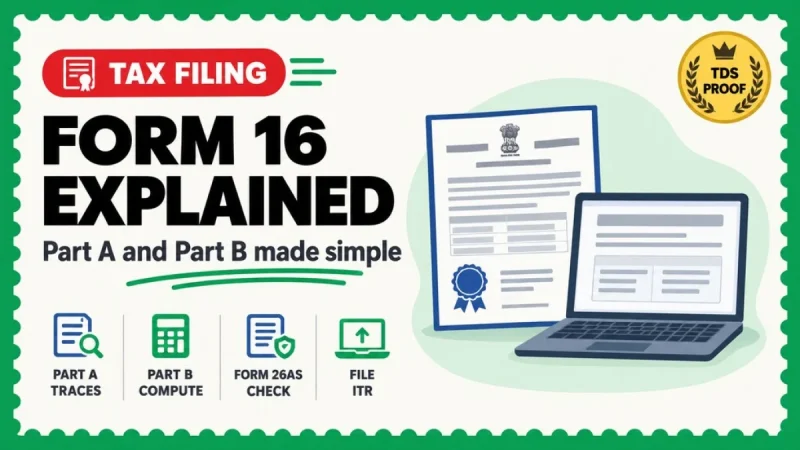
Form 16 is not your tax return. It is your employer's certificate of what they paid you and what tax they deposited. Here is how to read both parts, map them into ITR-1, and what to do if you never receive one.
Quick snapshot
- Form 16 is the TDS certificate for salary, issued under Section 203 by your employer.
- Part A is generated from the TRACES portal and shows TAN, PAN and the quarter-wise tax deducted and deposited.
- Part B is the annexure: your full salary break-up, exempt allowances, deductions and the tax computed.
- Employers are generally required to issue it by 15 June following the end of the financial year (Rule 31).
- No Form 16 does not mean no ITR. You can file using payslips plus AIS and Form 26AS.
- Changed jobs mid-year? You get two Form 16s and you must combine them — otherwise you under-report income and get a notice.
- Always cross-check Form 16 against Form 26AS and AIS on the e-filing portal before you file.
Form 16 has two parts and they come from different places. Part A is pulled from the Income Tax Department's TRACES system, so it is standardised: it carries your employer's TAN, your PAN, the assessment year, the period of employment and a quarter-by-quarter table of salary paid and TDS deducted and deposited. It also carries a unique certificate number and a digital signature.
Part B is prepared by your employer. It is the working: gross salary broken into components, allowances exempt under Section 10, the standard deduction, deductions claimed under Chapter VI-A such as 80C and 80D, your taxable income, and the tax computed including rebate, surcharge and cess.
To file ITR-1, you mostly copy Part B into the return and use Part A to claim the TDS credit. The figures must reconcile with Form 26AS and AIS, which the portal pre-fills for you.
1. What Form 16 actually is — and what it is not
When your employer deducts tax from your salary, the law requires them to give you a certificate of that deduction. That certificate is Form 16. It is issued under Section 203 of the Income Tax Act, and the form and timeline are prescribed in Rule 31 of the Income Tax Rules.
Three misconceptions worth clearing immediately:
What Form 16 is
- Proof that TDS was deducted and deposited against your PAN
- A ready-made summary of your salary income for the year
- Accepted as income proof by banks, landlords and visa offices
- The starting point for filing ITR-1 or ITR-2
What Form 16 is not
- Not your income tax return — receiving it does not mean you have filed
- Not a complete picture of your income — it only covers salary from that employer
- Not issued if no TDS was deducted, in many organisations
- Not final — if it is wrong, the employer must revise it
The second point catches a lot of freshers. If you had a part-time income, interest on a fixed deposit, a freelance payment, or capital gains from selling shares or mutual funds, none of that is in Form 16. You still have to declare it.
2. Part A, field by field
Part A is downloaded by the employer from TRACES. Because it is system-generated, it looks identical regardless of which company you work for — and if someone hands you a "Part A" that was typed in Word, it is not a valid Part A.
| Field in Part A | What it means | What to check |
|---|---|---|
| Certificate number | Unique TRACES-generated reference | Must be present. Its absence means the form was not generated from TRACES |
| Name and address of deductor | Your employer | Should match your offer letter entity, not just the brand name |
| TAN of deductor | The employer's Tax Deduction Account Number | You will need this in your ITR to claim the credit |
| PAN of deductee | Your PAN | A single wrong character means the TDS is credited to nobody. Fix it immediately |
| Assessment year | The year in which the income is assessed, one year ahead of the financial year | Confirm you are looking at the right year before you file |
| Period of employment | From and to dates with that employer | Critical if you changed jobs — the two periods must not overlap or leave a gap you cannot explain |
| Quarterly summary of amount paid | Salary credited in each quarter | Add the four quarters and compare with your payslips |
| Quarterly summary of tax deducted and deposited | TDS cut from you, and TDS actually paid to the government | These two must match. If deducted is more than deposited, you have a problem to escalate |
| Receipt numbers of TDS returns | Acknowledgement of the employer's quarterly filings | Their presence is what makes your credit traceable |
| Verification and digital signature | Signed by the authorised person | Open the PDF and check the signature validates |
The one thing in Part A that can cost you money
Tax deducted and tax deposited are two separate columns for a reason. Your employer can legally deduct TDS from your salary and then fail to deposit it with the government. If that happens, the credit will not show in your Form 26AS, and you cannot claim it in your return even though the money left your salary.
So check both columns, and check them against Form 26AS on the e-filing portal. If there is a shortfall, raise it with your employer in writing and keep the payslips. This is not a theoretical risk — it happens, usually at small or financially stressed companies.
3. Part B, field by field
Part B is the computation. This is where your actual tax position lives.
| Part B section | What it contains |
|---|---|
| 1. Gross salary | Salary under Section 17(1), perquisites under 17(2) and profits in lieu of salary under 17(3), totalled |
| 2. Less: allowances exempt under Section 10 | HRA exemption, LTA, gratuity exemption, leave encashment exemption and similar — old regime items |
| 3. Net salary | Gross salary minus the exempt allowances |
| 4. Less: deductions under Section 16 | Standard deduction, entertainment allowance for government employees, and professional tax paid |
| 5. Income chargeable under the head Salaries | The figure that goes into your ITR as salary income |
| 6. Add: any other income you reported | Only income you declared to the employer, for example house property loss or interest income |
| 7. Gross total income | Salary plus declared other income |
| 8. Less: Chapter VI-A deductions | 80C, 80CCD(1B), 80D, 80E, 80G, 80TTA and so on — shown as both the gross amount and the deductible amount |
| 9. Total taxable income | Rounded off as prescribed |
| 10. Tax on total income | Computed at the rates applicable to your chosen regime |
| 11. Rebate under Section 87A | Applied if your income is within the eligible limit |
| 12. Surcharge, health and education cess | Cess is applied on tax plus surcharge |
| 13. Relief under Section 89 | Only where arrears relief was claimed with Form 10E |
| 14. Net tax payable and tax deducted | The difference tells you whether you owe more tax or are due a refund |
The regime line is the most important line in Part B
Part B is computed under whichever regime your employer applied. The new regime is the default. If you did not consciously opt for the old regime with your employer, Part B will show no HRA exemption, no 80C and no 80D — and it will look as if you have no deductions at all.
Here is the part most people do not know: for salaried taxpayers without business income, you can generally switch regime when you actually file your return, regardless of what your employer applied during the year. So if your employer deducted TDS under the new regime but the old regime is better for you because of rent, a home loan and 80C investments, you can compute under the old regime in your ITR and claim a refund. Run both numbers — do not just accept Part B.
4. Mapping Form 16 into ITR-1
ITR-1 (Sahaj) is the form most salaried people with one employer, modest interest income and no capital gains will use. Most of it is pre-filled on the e-filing portal, but you are responsible for the numbers, so check each mapping.
| From Form 16 | Goes into ITR-1 at | Watch out for |
|---|---|---|
| Part A — employer name and TAN | Schedule TDS, details of tax deducted from salary | Two employers means two rows |
| Part B item 1 — gross salary | Schedule Salary, gross salary | Include perquisite value if any |
| Part B item 2 — exempt allowances | Schedule Salary, allowances exempt under Section 10, by nature of allowance | Only valid under the old regime |
| Part B item 4 — standard deduction and professional tax | Schedule Salary, deductions under Section 16 | Professional tax is a Section 16(iii) deduction, not an 80C item |
| Part B item 5 — income chargeable under Salaries | Part B-TI, salary income | This is the figure that must tie to AIS |
| Part B item 8 — Chapter VI-A deductions | Schedule VI-A (80C, 80D, 80E, 80TTA and so on) | You may add deductions the employer did not consider — keep the proofs |
| Part A — total tax deducted | Taxes paid, TDS on salary | Must equal the Form 26AS figure, not the Form 16 figure, if they differ |
| Bank interest from your passbook or AIS | Income from other sources | Not in Form 16. Freshers forget this constantly |
Before you hit submit: the three-way reconciliation
Form 16 Part A vs Form 26AS
Log in to the e-filing portal and open Form 26AS. The TDS figures must match. If Form 26AS shows less, the employer has not deposited or has filed the return with a wrong PAN. Claim only what is in 26AS and chase your employer for the rest.
Form 16 Part B vs AIS
The Annual Information Statement shows salary reported by your employer plus interest, dividends, mutual fund transactions, property transactions and more. If AIS shows income Form 16 does not, you must report it.
Form 16 vs your own payslips
Add twelve months of gross salary from your payslips. It should reconcile with Part B item 1. A gap usually means a bonus, arrears or a reimbursement was treated differently than you expected.
5. Changed jobs mid-year? You have two Form 16s
This is where most genuine notices originate. Each employer computes your tax as if they are your only employer, which means each one applies the standard deduction and the basic exemption limit afresh. Add the two certificates naively and you have claimed the same relief twice — and under-deducted tax.
Do this instead:
- Add the gross salary from both Part Bs to get your true annual salary.
- Claim the standard deduction once, not twice.
- Claim each Chapter VI-A deduction once, within its overall ceiling. If both employers gave you 80C relief on the same investments, you cannot keep both.
- Add the TDS from both Part As and list both TANs separately in the TDS schedule.
- Expect to pay additional tax. Because each employer taxed you on a lower base, the combined liability is almost always higher than the sum of the two TDS figures. Pay the balance as self-assessment tax before filing.
- Avoid this next time by submitting Form 12B to your new employer at joining, declaring the salary and TDS from the previous employer. Then your new employer deducts correctly and there is no shortfall in March.
6. What if you never get a Form 16?
There are two common reasons, and only one of them is a problem.
Reason one: no TDS was deducted. If your income was below the threshold at which tax was payable, your employer may not have deducted any TDS, and many employers do not issue Form 16 in that case. This is normal. You can still file your return, and if your income is above the basic exemption limit you must.
Reason two: the employer is non-compliant. TDS was deducted but no certificate was issued, or the company has shut down, or payroll has simply stopped responding. This needs action.
Either way, you can file without Form 16. Reconstruct your salary from these:
Your twelve payslips
Add the gross for each month. Note each deduction separately. This gives you salary income and professional tax.
Form 26AS and AIS
Both are free on the e-filing portal. AIS shows the salary your employer reported and 26AS shows the TDS actually deposited. Between them you have the two numbers the department already has.
Your bank statement
Confirms what was actually credited, and surfaces the interest income you need to declare.
Your own investment proofs
You can claim eligible deductions in your return even if the employer never considered them. Keep the receipts; you may be asked.
Escalate in parallel
Ask the employer in writing for the certificate. Failure to issue a TDS certificate carries a penalty for the deductor, and you can report it to your jurisdictional Assessing Officer or through the e-filing grievance facility.
Common Form 16 mistakes
- Treating Form 16 as the return. Receiving it is not filing. You still have to submit an ITR and e-verify it.
- Ignoring bank and FD interest. It is not in Form 16, it is in AIS, and it is fully taxable at your slab.
- Claiming TDS that is not in Form 26AS. The claim will be disallowed and the refund reduced.
- Double-claiming after a job change. The standard deduction and each deduction ceiling apply once per year, not once per employer.
- Accepting the employer's regime without checking. You can usually switch when filing and claim a refund.
- Not e-verifying. An unverified return is treated as not filed.
- Losing the PDF. Save every year's Form 16 permanently. Loans, visas and background checks ask for the last two or three years.
Frequently asked questions
What is the difference between Form 16 Part A and Part B?
Part A is generated from the TRACES portal and is standardised: it carries the employer's TAN, your PAN, the period of employment and a quarter-wise table of tax deducted and deposited. Part B is prepared by the employer and is the actual tax computation: your salary break-up, exempt allowances, deductions and the tax worked out. Part A proves the credit; Part B shows the working.
When should my employer give me Form 16?
Rule 31 of the Income Tax Rules generally requires the salary TDS certificate to be issued by 15 June following the end of the financial year. Confirm the current year's date on the Income Tax Department portal, since compliance dates are occasionally extended. If your employer misses it without an extension, you can ask in writing and escalate through the e-filing grievance facility.
Can I file my ITR without Form 16?
Yes. Form 16 is a convenience, not a precondition. Reconstruct your salary from your twelve payslips, pull your TDS from Form 26AS and your reported income from AIS on the e-filing portal, add bank interest from your statement, and claim your eligible deductions with proofs in hand. The return you file this way is just as valid.
I changed jobs this year. Why do I owe extra tax?
Because each employer computed your tax as if they were your only employer, so each applied the standard deduction and the lower slabs afresh. Your combined annual income sits in a higher bracket than either employer assumed, so the total TDS falls short. Add both Part Bs, claim each relief only once, and pay the balance as self-assessment tax. Next time, submit Form 12B to the new employer at joining so they deduct correctly.
My Form 16 shows more TDS than Form 26AS. What should I do?
Claim only the amount reflected in Form 26AS, because that is what the department can verify. Then raise the gap with your employer in writing, attaching the Form 16 and the relevant payslips. The usual causes are a TDS return filed with the wrong PAN, a quarter not yet filed, or tax deducted but not deposited. The first two are correctable by the employer filing a revised TDS return.
Can I choose a different tax regime from the one in my Form 16?
For salaried taxpayers without business income, you can generally choose the regime at the time of filing, independently of what your employer applied for TDS. So if your employer deducted under the new regime but the old regime gives you more because of rent, a home loan and 80C investments, compute under the old regime in your return and claim the refund. Check the current year's rules on the Income Tax Department portal before relying on this.
Is Form 16 the same as Form 16A?
No. Form 16 is the TDS certificate for salary income. Form 16A is the TDS certificate for non-salary payments such as bank interest, professional fees, rent or commission. If a bank deducted tax on your FD interest, you get a Form 16A from the bank, not a Form 16. There is also Form 16B for TDS on property purchase and Form 16C for TDS on rent.
Does Form 16 show my full income for the year?
No. It only shows salary from that one employer, plus any other income you specifically declared to that employer. Freelance earnings, savings and FD interest, dividends, rental income, capital gains from shares or mutual funds, and income from a previous employer are not in it. All of those still have to go into your return, and most of them now appear in your AIS, so the department already knows.
Sources: Income Tax Department e-filing portal — Form 26AS, AIS, ITR filing and grievances; TRACES — TDS Reconciliation Analysis and Correction Enabling System; Income Tax India — Act, Rules and forms (Section 203, Rule 31). Compliance dates and regime rules change — confirm the current position on the official portal before filing.
Related guides on BeInCareer
- How to file your ITR for the first time as a fresher
- Save tax on your first salary: new regime vs old regime
- CTC vs in-hand salary: how to calculate your real take-home
- Salary slip explained line by line
- EPFO PF claim guide: UAN, forms and online withdrawal
- Education loan repayment and the Section 80E deduction
- NPS vs PPF vs EPF: which retirement plan suits you
- PAN–Aadhaar linking: how to do it online
- After campus placement: from offer letter to first salary
- Probation period rules: salary, leave and resignation