
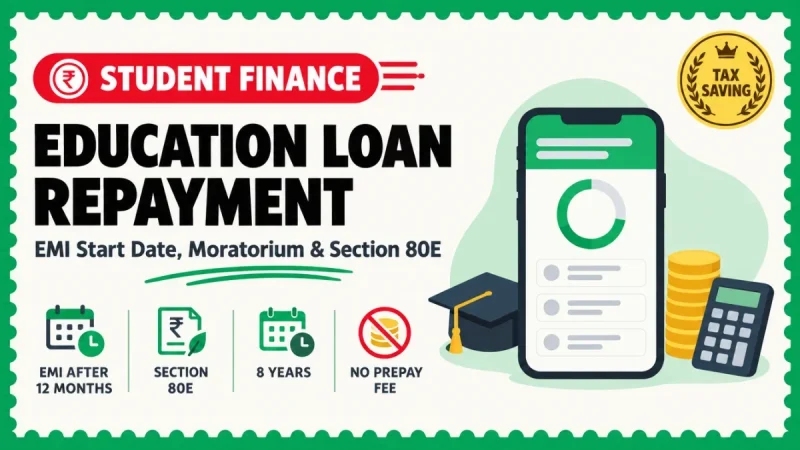
Most education loan guides stop at "how to get the loan". This one starts where the money actually hurts — the day repayment begins. Including the one Section 80E rule that quietly cancels the tax benefit for most people today.
Quick snapshot
- EMI starts: 12 months after your course ends, or 6 months after you get a job — whichever comes first.
- During the moratorium: interest still accrues, as simple interest. It does not pause.
- Section 80E: deduction on the interest only, no upper limit, for 8 assessment years.
- The catch: 80E is available only under the old tax regime. The new regime is the default since AY 2024-25.
- Prepayment: on a floating-rate education loan, banks and NBFCs cannot charge foreclosure or prepayment penalties.
- Maximum tenure: up to 15 years, excluding the moratorium.
Education loan EMI repayment starts 12 months after course completion, or 6 months after you get a job — whichever is earlier. That gap is called the moratorium (or repayment holiday). Interest is charged throughout the course and the moratorium on a simple-interest basis. You are not required to pay anything during this period, but if you don't, the accumulated interest is added to your principal and every future EMI becomes larger.
1. The moratorium — what it actually is
Under the Indian Banks' Association (IBA) Model Education Loan Scheme that almost every bank follows, you are given a moratorium period — a window where you are not asked to pay EMIs.
| Stage | What you pay | What is happening to the loan |
|---|---|---|
| During the course | Nothing is compulsory | Interest accrues as simple interest on each amount disbursed |
| Moratorium (after course) | Nothing is compulsory | Interest keeps accruing, still simple interest |
| Repayment begins | Full EMI | Accrued interest, if unpaid, is added to principal first |
| Repayment period | Up to 180 EMIs | Maximum 15 years, counted after the moratorium |
The phrase people get wrong is "interest-free period". The moratorium is an EMI holiday, not an interest holiday. The bank is simply not asking you for money yet.
2. Should you pay the interest during the moratorium?
This is the single biggest money decision in the whole loan, and most students are never told about it.
If you leave the interest unpaid, it gets capitalised — added to your principal — and your EMI is then calculated on the bigger number. If you pay just the interest each month while studying or job-hunting, your principal stays where it is.
A worked example
Take a ₹10,00,000 loan at 10% per annum, with a 1-year moratorium and a 10-year repayment term. To keep the arithmetic clean, assume the full amount is outstanding through the moratorium.
| If you do NOT service interest | If you DO service interest | |
|---|---|---|
| Paid during moratorium | ₹0 | ₹8,333 per month (₹1,00,000 total) |
| Principal when EMI starts | ₹11,00,000 | ₹10,00,000 |
| Monthly EMI | ₹14,537 | ₹13,215 |
| Total paid over 10 years | ₹17,44,390 | ₹15,85,809 |
| Total outgo including moratorium | ₹17,44,390 | ₹16,85,809 |
| Difference | Servicing the interest saves ₹58,581 — and your EMI is ₹1,322 lighter every single month. | |
Many banks also give an additional interest concession to borrowers who service interest during the study period. The size of that concession varies by bank and by scheme, so check the figure written in your own sanction letter rather than trusting a number you read online.
If anyone in the family can put ₹5,000–₹10,000 a month towards the loan while you are still studying, it should go to the interest, not into a savings account. It is the highest-certainty return available to you — a guaranteed saving at your exact loan rate, with no market risk.
3. Section 80E — the tax deduction on education loan interest
Section 80E of the Income-tax Act lets you deduct the interest you pay on an education loan from your taxable income.
| Rule | What it means |
|---|---|
| What is deductible | Interest only. The principal portion of your EMI gets nothing. |
| Maximum limit | No upper limit. The entire interest paid in the financial year qualifies. |
| How long | 8 assessment years — the initial assessment year plus the 7 immediately following it, or until the interest is fully paid, whichever is earlier. |
| When the clock starts | The "initial assessment year" is the year in which you start repaying the interest — not the year the loan was sanctioned. |
| Who can claim | Individuals only. Not HUFs, not companies. |
| Whose education | Yourself, your spouse, your children, or a student for whom you are the legal guardian. |
| Which lender | A recognised financial institution or an approved charitable institution. A loan from friends or relatives does not qualify. |
The rule almost every article skips
Section 80E is available only under the old tax regime. The new tax regime has been the default since AY 2024-25. If you simply file your return without actively opting for the old regime, you get zero benefit from 80E — no matter how much interest you paid.
This matters most to freshers. A lot of people take the education loan, start their first job, file under the default new regime because it is simpler, and never realise the deduction they were counting on was never applied.
So how much does 80E actually save you?
80E reduces your taxable income, not your tax bill directly. The saving equals the interest you paid multiplied by your marginal tax rate, plus the 4% Health and Education Cess that applies on top of the computed tax.
| Interest paid in the year | If your marginal rate is 20% | If your marginal rate is 30% |
|---|---|---|
| ₹50,000 | ₹10,400 saved | ₹15,600 saved |
| ₹1,00,000 | ₹20,800 saved | ₹31,200 saved |
| ₹1,50,000 | ₹31,200 saved | ₹46,800 saved |
(Each figure includes the 4% cess — for example, ₹1,00,000 × 20% = ₹20,000, plus 4% cess = ₹20,800.)
Which means the real question is not "should I claim 80E" — it is "does the old regime beat the new regime for me once 80E is included?" For a fresher with a large loan, it often does. For someone with a small loan and no other deductions, it often does not. We have worked through that comparison in detail in our guide on how freshers can save tax on their first salary.
How to actually claim it
Get the interest certificate
Ask your bank for the education loan interest certificate for the financial year. It splits your EMIs into principal and interest. Most banks let you download it from net banking.
Choose the old regime
While filing, you must actively opt out of the default new regime. If you skip this, 80E does nothing.
Enter only the interest figure
Claim the interest amount under the 80E field. Do not include the principal — that is the most common filing error on this section.
If the loan is in a parent's name
The deduction belongs to whoever is legally repaying the loan. If your parent is the borrower and is paying the EMIs, your parent claims it — not you.
4. PM Vidyalaxmi — interest subvention during the moratorium
Separate from the tax deduction, the central government pays part of your moratorium interest under the PM Vidyalaxmi scheme, approved by the Union Cabinet and operating through the PM Vidyalaxmi portal, live since 25 February 2025.
| Annual family income | Benefit | On loans up to |
|---|---|---|
| Up to ₹4.5 lakh | 100% interest subvention during the moratorium | ₹10 lakh |
| Up to ₹8 lakh | 3% interest subvention during the moratorium | ₹10 lakh |
- The moratorium here is defined as course period plus one year.
- The 3% subvention is capped at 1 lakh students per year, so applying early matters.
- Loans up to ₹7.5 lakh carry a 75% credit guarantee from the Government of India, which is why banks are more willing to sanction them without heavy collateral.
- Repayment tenure under the scheme goes up to 15 years, excluding the moratorium.
If you qualify for the 100% band, your moratorium interest problem largely disappears — but you have to apply for the subvention, it is not automatic. Our complete education loan guide covers the application side.
5. Prepaying your education loan — the RBI rule in your favour
Once you start earning, the obvious question is whether to clear the loan early. There is a regulation that makes this much easier than most borrowers assume.
Banks and NBFCs are not permitted to levy foreclosure charges or prepayment penalties on floating-rate term loans sanctioned to individual borrowers for purposes other than business, with or without co-obligants. An education loan taken by an individual falls squarely inside this.
Two practical consequences:
- If your loan is floating-rate — which most education loans are — you can prepay partially or fully, any time, at zero penalty.
- If your loan is fixed-rate, this protection does not apply, and the bank may charge a foreclosure fee. Check your sanction letter for which type you have before you plan a big prepayment.
But should you prepay, or claim 80E?
This trips people up, so be clear about the direction: 80E is a discount on interest you are already paying, not a reason to keep paying it.
If your loan rate is 10% and you are in the 30% bracket, 80E brings your effective cost down to roughly 7% — still a real cost. Prepaying eliminates it entirely. The deduction is a consolation, not an investment case.
The one genuine reason to not rush a prepayment is if you have no emergency fund yet. Clearing a loan with money you might need back in three months is how people end up on a credit card at 40%. Build the buffer first — we cover the sizing in our guide to emergency funds for freshers.
6. Mistakes that cost real money
Six things to avoid
- Assuming the moratorium is interest-free. It is not. Interest accrues from the first disbursement.
- Filing under the default new regime and expecting 80E. You get nothing. You must opt for the old regime.
- Claiming the principal under 80E. Only interest qualifies. This is a common notice trigger.
- Missing the 8-year window. The clock starts when repayment of interest begins and does not reset.
- Letting EMIs bounce during the job hunt. Education loan defaults show up on your credit report like any other loan and will affect your CIBIL score for years. Talk to the bank before you miss a payment, not after.
- Not telling the bank you got a job. Your moratorium can end 6 months after employment, earlier than the 12-month default. Knowing your actual EMI start date prevents a surprise bounce.
Frequently asked questions
When does education loan EMI start in India?
EMI starts 12 months after your course is completed, or 6 months after you secure employment, whichever is earlier. The gap between disbursement and that date is the moratorium period.
Is interest charged during the education loan moratorium?
Yes. Interest accrues throughout the course and the moratorium on a simple-interest basis. If you do not pay it, it is added to your principal when repayment begins, which raises every future EMI.
Is there a maximum limit on the Section 80E deduction?
No. There is no upper limit — the entire interest paid during the financial year can be claimed. However, only the interest qualifies; the principal portion of your EMI does not.
Can I claim Section 80E under the new tax regime?
No. Section 80E is available only under the old tax regime. Since the new regime is the default, you must specifically opt for the old regime while filing, otherwise the deduction will not apply.
How many years can Section 80E be claimed?
For a maximum of 8 assessment years — the initial assessment year plus the seven immediately following it — or until the interest is paid in full, whichever happens earlier. The initial assessment year is the one in which you start repaying the interest.
Is there a penalty for prepaying an education loan?
Not on floating-rate loans. Banks and NBFCs are not permitted to levy foreclosure charges or prepayment penalties on floating-rate term loans sanctioned to individuals for non-business purposes. Fixed-rate loans are not covered by this protection, so check your sanction letter.
Who gets the 80E deduction if my parent took the loan?
Whoever is legally repaying the loan. If the loan is in your parent's name and your parent pays the EMIs, your parent claims the deduction. The deduction is available for a loan taken for the education of yourself, your spouse, your children, or a student for whom you are the legal guardian.
What is the maximum repayment tenure for an education loan?
Up to 15 years, which works out to a maximum of 180 EMIs. This period is counted after the moratorium ends, not from the date of sanction.
Sources
Section 80E, Income-tax Act, 1961 — Income Tax Department, Government of India · PM Vidyalaxmi scheme details — Press Information Bureau, Government of India · Levy of foreclosure charges / pre-payment penalties on floating rate term loans — Reserve Bank of India · IBA Model Educational Loan Scheme — Indian Banks' Association. Figures in the worked example are our own calculation on the stated assumptions and are illustrative.
Read next
- Education Loan Complete Guide India 2026 — PM Vidyalakshmi
- How Freshers Can Save Tax on First Salary — New vs Old Regime
- SBI Education Loan 2026 — Interest Rate, Eligibility & Application
- HDFC Education Loan 2026 — Interest Rate, Eligibility & Application
- Education Loan for Study Abroad 2026 — Which Is Best
- Emergency Fund for Freshers — FD vs RD vs Liquid Funds
- How to Improve Your CIBIL Score Fast — From 600 to 750
- After Campus Placements — Offer Letter to First Salary
- How to Manage Money as a College Student in India