
FINANCE GUIDE · 30 OCT 2026
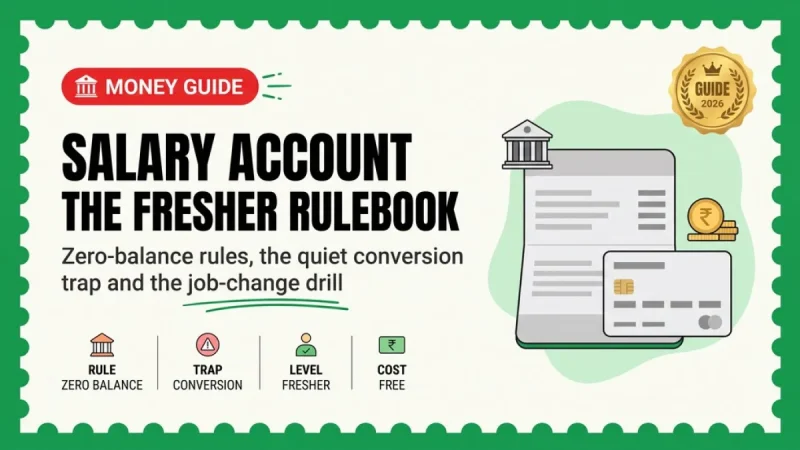
Salary Account, Explained for Freshers: the Zero-Balance Rules, the Perks and the Trap Nobody Mentions at Joining
On joining day, HR opens a bank account in your name and your salary lands there every month. Nobody explains the rules of that account — least of all the one that matters most: what it quietly becomes the month your salary stops crediting. This page is the rulebook, written before you need it.
ADVERTISEMENT
❗The problem this page is trying to fix
A fresher’s first bank account is usually not chosen — it is assigned. The employer has a corporate tie-up with one bank, a form is signed during onboarding, and a salary account appears. It works smoothly exactly as long as the salary keeps coming.
The problems start at the edges nobody explains: what the “zero balance” promise actually depends on, what happens to the account when you change jobs or sit between jobs, why people end up with three dormant accounts by their third company, and which charges appear only after the salary credits stop.
Below: how a salary account differs from the savings account you already have, the conversion rule that catches almost everyone, and the exact checklist to run on joining day, on quitting day, and in between.
🔍The account, stated honestly
What a salary account is
A savings account opened under your employer’s corporate banking arrangement. Legally it is your personal account — the employer only routes salary into it. The employer cannot see your balance or transactions.
The zero-balance promise
Salary accounts waive the minimum balance requirement — but the waiver is conditional on regular salary credits, not permanent. The account type, not your goodwill, carries the benefit.
The silent conversion
When salary credits stop for a few consecutive months — job change, gap, studies — banks typically reclassify the account as a regular savings account. Minimum balance rules and penalty charges then apply, often without a clear notification you will notice.
Perks attached to it
Corporate salary accounts often bundle benefits — debit card variants, accident insurance cover, locker or forex concessions. These vary by bank and by your employer’s specific tie-up tier; read your own kit instead of assuming.
What we do not quote
We do not quote minimum balance amounts, penalty charges or the exact number of months before conversion — these differ by bank and change with schedules of charges, and current verified figures are not published in our source. Your bank’s official schedule of charges page is the only reliable reference.
Who this page is for
Freshers about to join, employees switching jobs, and anyone holding an old salary account from a previous company that is quietly gathering charges.
📋Salary account vs regular savings — and the paperwork around it
Three columns: what makes the salary account different, what to check on joining day, and the accounts you should actually hold as a fresher.
🏦 How it differs from regular savings
Zero balance — while salary credits continueOpened via employer, owned fully by youOften a better debit card variantMay include accident insurance coverConverts to regular savings when credits stopSame account number survives conversionCan be converted back at a new employerClosing it needs your request, not HR’s
✅ Joining-day checklist
Collect the full welcome kit, not just the cardActivate net banking and the bank’s appSet up UPI on the new accountNote the IFSC — payslips and ITR need itCheck nomination — add a nominee nowRead the insurance cover terms, if bundledLink the account in the EPFO/UAN record laterKeep the account-opening letter safely
💼 Accounts a fresher should hold
The salary account — receive and spendOne personal savings account — savings live hereMove a fixed sum out on salary day itselfEmergency fund sits in the personal accountAvoid holding three-plus active accountsClose or convert old salary accountsOne UPI handle per account, labelled clearlyReview all accounts once a quarter
ADVERTISEMENT
✨What changed — and why old advice is stale
Job changes became frequent, dormant accounts became normal. The parents’ generation held one account for decades. A fresher today may see three employers — and three salary accounts — in five years. The cleanup habit now matters as much as the opening paperwork.
UPI made the salary account the spending account. Once UPI is linked, the salary account becomes the default wallet for everything. That is exactly why the move-savings-out-first habit on salary day is the single highest-value rule on this page.
Banks digitised conversion, not notification. Reclassification from salary to regular savings happens automatically in core banking systems. The charge entries appear quietly in the statement; the burden of noticing is on you.
Corporate kits became tiered. The same bank gives different salary-account variants to different companies. Comparing your kit with a friend’s at another firm tells you nothing; only your own kit documents count.
Autopay mandates attach to the account. SIPs, subscriptions and EMI mandates set up on a salary account keep hitting it after you change jobs — a dormant account with live mandates is how penalty spirals start.
🎓What you can do this week, at zero cost
Every step below is free and takes minutes. Most account problems on this page are prevented by the first three.
If you just joined: run the joining-day checklist in the table above — especially the nominee addition, which almost every fresher skips and every family regrets.
If you hold an old salary account from a previous employer: log in today and check whether it has already converted to regular savings and started charging. The statement, not memory, is the truth.
Decide the salary-day split now: the moment salary credits, a fixed transfer moves to your personal savings account. Automate it as a standing instruction so discipline needs no willpower.
List every autopay and mandate attached to each account you hold. Anything attached to an account you plan to abandon must be remapped first — mandates do not die with your interest in the account.
Read your bank’s official schedule of charges page once — ten minutes that replaces every rumour about minimum balance penalties with your bank’s actual printed rules.
If your salary account’s branch is in another city, read our branch transfer guide linked below — the account number survives the move, only the IFSC changes.
🗺The job-change protocol, step by step
1
Before the last working day
Download statements of the old salary account, list the mandates on it, and note which services use its IFSC. Exit paperwork is easier with the account still fully active.
2
When the new employer assigns a bank
If it is the same bank, ask payroll to route salary to your existing account — many banks simply re-tag it to the new corporate arrangement and the zero-balance status continues.
3
If it is a different bank
Open the new account through onboarding, then decide the old account’s fate within the first month — convert it into your personal savings account deliberately, or close it. Deciding nothing is the only wrong option.
4
Remap before you abandon
Move UPI, SIPs, subscriptions and any EMI mandates to the account that will stay alive. Only then stop using the old one.
5
Close formally, keep proof
Account closure needs a signed request and usually a branch visit; surrender the card and chequebook and keep the closure acknowledgment. A “zero balance and forgotten” account is not a closed account.
ADVERTISEMENT
⚠️ What this page deliberately does NOT tell you
No bank-wise charge tables. Minimum balance amounts, penalty slabs and conversion timelines differ by bank and revise with schedules of charges; current verified figures are not published in our source, so we print none. Your bank’s official charges page is the reference.
No “best salary account” ranking. You rarely choose the bank — the employer’s tie-up does. Energy spent comparing salary accounts is better spent on the two-account discipline above.
No insurance-cover amounts. Bundled accident covers vary by card variant and tie-up tier and are revised yearly; verified current amounts are not published in our source. Read your own kit terms.
No investment advice. Where the moved-out savings should go — deposits, funds, anything — is a separate decision with its own guides linked below. This page ends at the account layer.
💬Frequently Asked Questions
Is a salary account different from a normal savings account?
Structurally it is a savings account with the minimum-balance requirement waived because of your employer’s corporate tie-up. The waiver is conditional on regular salary credits — stop the credits and the account typically reverts to regular savings rules.
What happens to my salary account if I quit my job?
Nothing on day one — and that is the trap. After salary credits stop for a few consecutive months (the exact period is bank-specific), the account converts to a regular savings account and minimum balance rules with penalties apply. Convert it deliberately or close it formally; do not just abandon it.
Can my employer see my salary account transactions?
No. The account is legally yours alone; the employer only credits salary into it. HR has no visibility into your balance, spending or other credits.
Should I keep my old salary account when changing jobs?
Keep it only as a deliberate choice — converted into a personal savings account whose rules you accept. If the new employer uses the same bank, ask payroll to re-tag the existing account instead of opening another. Otherwise close the old one formally and keep the acknowledgment.
Can I open a salary account myself without an employer?
No — the salary account classification comes from a corporate arrangement. What you can open yourself is a regular or zero-balance savings account; our zero-balance account guide linked below covers those options.
Why does this page not list minimum balance amounts?
Because they differ by bank, by account variant and by corporate tier, and revise with each schedule of charges — current verified figures are not published in our source. Printed amounts here would go stale and mislead; your bank’s official page will not.
📚Read Next on BeInCareer
Daily job & course updates, free
Walk-in drives, admission dates and new government courses — the day they are announced.
Source: This is personal-finance guidance written by the BeInCareer editorial team on 30 October 2026, explaining the structure and lifecycle of employer-opened salary accounts in India. It deliberately contains no bank-wise charge figures, no minimum balance amounts and no conversion timelines, because current verified figures are not published in our source and these vary by bank and revise frequently. Verify every charge and rule on your own bank’s official schedule of charges before acting.