Close

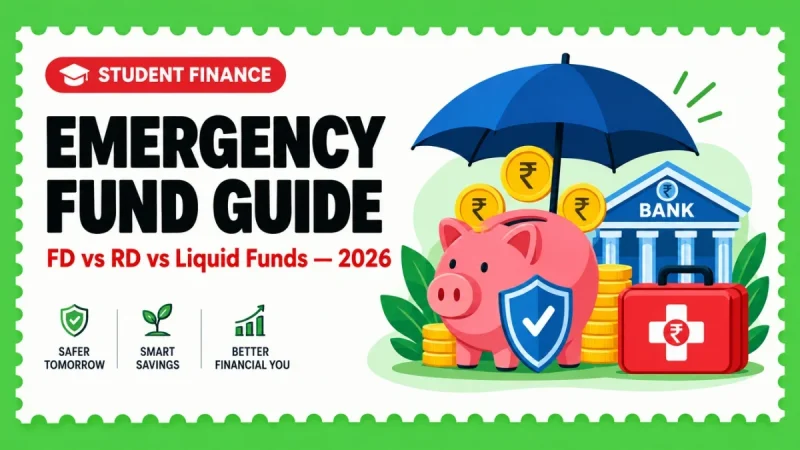
Emergency Fund for Freshers 2026 — FD vs RD vs Liquid Funds Compared

Emergency Fund for Freshers 2026 — FD vs RD vs Liquid Funds Compared
BUILD THIS BEFORE YOU INVEST · FRESHERS
Emergency Fund for Freshers — FD vs RD vs Liquid Funds (2026)

Layoff rumour, bike repair, sudden hospital bill, notice-period gap between jobs — this is the money that saves you from credit card debt and panic loans. How much you need, where to park it, and the exact split that works.

🎯 3–6 months target🏦 FD vs RD vs liquid fund🔁 Sweep-in FD trick🛡️ DICGC ₹5L cover
Level Up Your Career →
⚡ Quick Snapshot
Target size3–6 months expenses
Savings a/c interest~2.5–4%
Bank FD (1 yr)~6–7.5%
Liquid fund (typical)~6–7%*
Deposit insuranceDICGC ₹5L/bank
Stocks/equity here?❌ Never
📌 FEATURED ANSWER

How should a fresher build an emergency fund in 2026? Save 3–6 months of essential expenses (essentials ₹15,000/month → target ₹45,000–90,000) before serious investing. Split it three ways: ~1 month in savings/sweep-in FD (instant access), the rest in bank FDs (guaranteed, DICGC-insured up to ₹5 lakh) and optionally a liquid mutual fund (~6–7%, T+1 withdrawal). Build it in 6–12 months by auto-saving on salary day — then start your SIPs with full confidence.

🧯 Why This Comes Before SIPs, Stocks — Everything

A fresher's income has one giant weakness: a single source. One layoff email, one "project ramp-down", one family medical event — and your salary stops while rent doesn't. Without a buffer, you reach for the worst money in India: credit card revolving at 36–42%/year, instant-loan apps, or borrowing from friends.

The emergency fund is the firewall. It's not an investment — don't judge it by returns. Its only job is to be there, intact, within 24 hours when life goes wrong. That's also why it comes first in the money order: emergency fund → insurance → index SIPs → direct stocks.

🎯 How Much? The 3–6 Month Formula

Your situationTargetExample (essentials ₹15k/mo)
Living with parents, stable IT job3 months₹45,000
Renting, single income, stable job4–5 months₹60,000–75,000
Contract role / startup / supporting family6 months₹90,000

Count only essentials: rent, food, transport, phone/wifi, EMIs, money sent home. Not movies, not Swiggy. And don't let the number scare you — use mini-goals: first ₹10,000 → 1 month → 3 months. Auto-transfer a fixed amount on salary day (pay-yourself-first, same trick as the 50/30/20 rule), and dump windfalls — joining bonus, tax refund — straight in.

ADVERTISEMENT

🏦 Where to Park It — Savings vs FD vs RD vs Liquid Fund

OptionReturns (typical)Access speedSafetyBest for
Savings account~2.5–4%Instant (UPI/ATM)DICGC-insured up to ₹5L/bankFirst ~1 month of expenses
Sweep-in FD~6–7% on swept amountInstant (auto-breaks)Same DICGC coverLazy upgrade to the savings slice
Fixed deposit (FD)~6–7.5% (1 yr), guaranteedSame day online (small penalty ~0.5–1% on premature)DICGC ₹5L/bankThe guaranteed core of the fund
Recurring deposit (RD)~6–7%, guaranteedCan close anytime (penalty)DICGC ₹5L/bankBuilding the fund monthly, not storing it
Liquid mutual fund~6–7%, market-linked*T+1 day (some give ₹50k instant redemption)Low-risk debt, but NOT insured/guaranteedThe flexible slice once fund crosses ~₹50k
Equity funds / stocksHigh but volatileT+1/T+2Can be −20% exactly when you need it❌ Never for emergency money

*Liquid funds invest in debt instruments maturing within 91 days — among the lowest-risk mutual fund categories, but returns are not guaranteed and past returns don't promise future ones.

The simple 3-bucket split (₹90,000 example)

⚡
₹15k — Instant
Savings account or sweep-in FD. Covers tonight's hospital deposit or bike breakdown via UPI.
🏦
₹45k — FDs
Two or three online FDs. Guaranteed, DICGC-insured, breakable same-day from the bank app.
💧
₹30k — Liquid fund
Direct-plan liquid fund. T+1 redemption, no premature penalty, slightly better tax behaviour on long holding.
💡 FD laddering — break less, lose less
Instead of one ₹45,000 FD, make three of ₹15,000. A ₹20k emergency means breaking only two FDs — the rest keep earning full interest. Online FDs from your bank app take 2 minutes each, and premature closure penalty (~0.5–1% of interest) applies only to what you break.
ADVERTISEMENT

🔁 Sweep-In FD: The Set-and-Forget Upgrade

Most big banks (SBI MODS, HDFC sweep-in, ICICI flexi) offer auto-sweep: anything above a threshold (say ₹25,000) in your savings account automatically becomes an FD; when you spend, the FD breaks silently in units and money appears like normal balance. You get FD interest with savings-account liquidity — activate it once in net banking and the instant slice of your fund manages itself.

🧾 Tax on Your Emergency Fund — 60-Second Version

FD/RD interest is added to your income and taxed at slab. The bank cuts 10% TDS only if your interest in that bank crosses ₹50,000/year (limit raised from FY 2025-26) — at fresher corpus sizes you'll rarely hit it. Earning under the taxable limit? Submit Form 15G to the bank so no TDS is cut at all; if it's already cut, claim it back by filing ITR. And remember, under the new regime most freshers up to ₹12.75 lakh pay zero tax anyway — details in the fresher tax guide. Liquid fund gains are also taxed at slab when you redeem.

Safety note: DICGC (an RBI subsidiary) insures deposits up to ₹5 lakh per bank per depositor — principal + interest, covering savings, FD and RD together. A fresher-sized fund in any scheduled bank is fully covered. Chasing an extra 1.5% at a shaky co-operative bank is not worth it for this money.

ADVERTISEMENT

🚫 4 Emergency-Fund Mistakes Freshers Make

📈
Parking it in equity "for better returns"
Markets fall exactly when layoffs happen. Your ₹90k buffer becoming ₹70k in a crash — during a job loss — defeats the whole point.
🛍️
"Sale is also an emergency"
iPhone launches, Goa trips and festival sales are not emergencies. Keep the fund in a different bank than your spending account — out of sight, out of UPI.
⏳
Waiting for a "big amount" to start
₹2,000/month auto-transferred beats a ₹50k plan that never starts. An RD is perfect for this building phase — it forces the habit.
🩹
Not refilling after use
Used ₹20k for a bike repair? Pause your extra spends (not your SIP) and refill within 2–3 months. An empty firewall protects nothing.
🤖 AI QUICK ANSWER · KEY FACTS
  • Emergency fund = 3–6 months of essential expenses, built before serious investing; essentials ₹15k/month → ₹45,000–90,000 target.
  • 3-bucket split: ~1 month in savings/sweep-in FD (instant), core in bank FDs (guaranteed, laddered in small pieces), optional slice in a liquid mutual fund (~6–7%, T+1 redemption, not guaranteed).
  • DICGC insures deposits up to ₹5 lakh per bank per depositor (savings + FD + RD, principal + interest); liquid funds carry no such insurance.
  • FD/RD interest taxed at slab; 10% TDS only above ₹50,000 interest/year per bank (FY 2025-26 onwards); Form 15G avoids TDS if income is below taxable limit.
  • Never keep emergency money in equity/stocks; RD is for building the fund monthly, sweep-in FD automates the instant-access slice.

❓ Frequently Asked Questions — Emergency Fund

How much emergency fund does a fresher need?
3 to 6 months of your essential monthly expenses — rent, food, travel, EMIs, phone. If your essentials are ₹15,000/month, target ₹45,000–90,000. Start with a 1-month mini-goal and build up over 6–12 months.
Where should I keep my emergency fund — FD, RD or liquid fund?
Split it: keep about 1 month of expenses in your savings account (or a sweep-in FD) for instant access, and the rest in a mix of bank FDs and a liquid mutual fund. All three let you withdraw within a day; avoid equity funds and stocks for this money.
Is a liquid fund safe for an emergency fund?
Liquid funds invest in very short-term debt (up to 91 days) and are among the lowest-risk mutual funds, but they are not bank deposits — returns are not guaranteed and there is no DICGC insurance. Bank deposits are insured up to ₹5 lakh per bank by DICGC. Many people keep part in FD (guaranteed) and part in a liquid fund.
What is a sweep-in FD?
A sweep-in (auto-sweep) facility moves money above a threshold in your savings account into an FD automatically, and breaks it back instantly when you spend. You earn FD-level interest while keeping savings-account liquidity — ideal for the quick-access slice of an emergency fund.
Is FD interest taxable for freshers?
Yes — FD and RD interest is added to your income and taxed at your slab. Banks deduct TDS at 10% if your interest across the bank crosses ₹50,000 in a year (from FY 2025-26). Most freshers under the new regime owe zero tax anyway, so you can claim the TDS back when filing ITR, or avoid TDS upfront by submitting Form 15G if your total income is below the taxable limit.
Secure your money — and your career
Free certifications, mock interviews and resume tools on BeInCareer Genie.
Join Genie Free →
⚠️ Important Disclaimer
This article is for education only and is not investment or tax advice. Interest rates, fund returns and tax rules change — verify with your bank, on rbi.org.in and incometax.gov.in. Mutual fund investments are subject to market risk. BeInCareer / Trybinc never asks anyone to pay money for a job or selection.
Never miss a job, result or free certificate
Join lakhs of AP & Telangana students who follow BeInCareer every day.
© BeInCareer 2026 · beincareer.com · A Trybinc Network product

I build brands that dominate digitally — from identity and strategy to AI-powered automation, content, campaigns, and traffic that converts.With 8+ years across brand development, digital marketing, AI tools, and creative production, I deliver end-to-end brand growth — not just plans, but execution that drives real numbers.🚀 Initiator & Creator of BeInCareer I conceptualized, built, and launched BeInCareer from zero — the brand identity, website architecture, content system, SEO strategy, social media channels, and monetization framework are all built by me. BeInCareer is my vision brought to life.📊 Proof of Results: 🔹 Ranked for top competitive keywords within 24 hours 🔹 Drove 4,00,000+ organic views/month 🔹 Achieved top Google & Bing positioning 🔹 200K+ followers & 3,489+ student placements in 2 yearsCurrently leading brand & digital strategy at SRI Tech Solutions Inc. and BeInCareer — India's growing career guidance platform.As Founder & CEO of Buyer Interest (est. 2019), I've built brand ecosystems from zero — combining AI, automation, creativity, and strategy into scalable digital systems.🏢 Brands & Platforms I've Worked With: Credai · MVV · MK Builders · NRI Hospital · Park Hotel · Padmabhushan · Malikappuram · Ravanasura · Kalki 2 · BeInCareer · Clover Solutions · Bindas · Eazy Rooms · Gatox Ice Creams · Trybinc · BeInSkills · BeInSarkari⚡ Full Spectrum Capabilities:🎨 Brand & Creative ✅ Brand Development & Visual Identity ✅ Graphic Design — Adobe Suite (Photoshop, Illustrator, Premiere Pro, After Effects) ✅ Video Editing & Motion Content ✅ Employer Branding & Campaign Creatives📈 Digital Marketing & Growth ✅ Google Ads Campaign Management (Certified) ✅ Meta Ads (Facebook & Instagram Advertising) ✅ SEO — Technical · Content · Local · AEO ✅ AI SEO & Automation SEO ✅ Traffic Ranking & Google Positioning Strategy ✅ Brand Monetization & AdSense Optimization🤖 AI & Automation ✅ AI-Powered Brand & Marketing Strategy ✅ Workflow Automation (n8n / Zapier / Make) ✅ AI Content Generation & Optimization ✅ AI SEO Tools & Automation Pipelines ✅ Prompt Engineering for Marketing Use Cases🌐 Web & Content ✅ WordPress · Elementor · Schema/JSON-LD ✅ Content Marketing & Editorial Planning ✅ Social Media Strategy & Analytics ✅ Community Building & Platform GrowthMBA in Digital Marketing · Engineering Graduate (JNTUK) · Google Ads Creative CertifiedI don't just plan brands — I build, automate, and scale them using the latest AI tools and proven digital strategies.📩 Open to brand development, AI-powered marketing projects, digital consulting, and creative collaborations.

Leave a Reply

Your email address will not be published. Required fields are marked *

Leave a comment
scroll to top