
FINANCE GUIDE · 30 OCT 2026
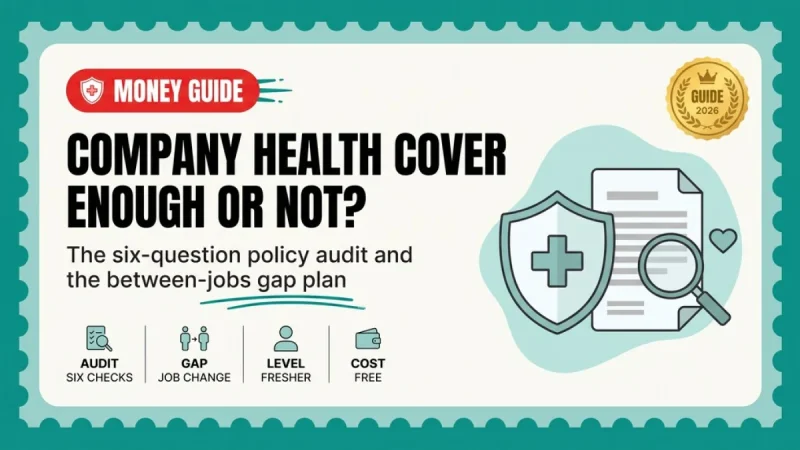
Company Health Insurance: What the Group Policy Really Covers, Where It Ends, and When You Need Your Own
“Health insurance is covered by my company” is the most common sentence freshers say about insurance — and the least examined. The group policy is real and useful, but it has edges: it ends the day you leave, it carries sub-limits nobody reads, and it builds nothing that belongs to you. This page maps exactly what to check.
ADVERTISEMENT
❗The problem this page is trying to fix
On joining, HR mentions a group health policy and most freshers file the thought under “done”. The policy document — the actual PDF with the cover amount, the room-rent limit, the exclusions — usually goes unread until a hospital admission forces the reading at the worst possible time.
The group policy is genuinely valuable: it typically starts from day one and skips the waiting periods an individual policy imposes. But it is rented cover, not owned cover. It ends with the job, it is renegotiated by the employer every year, and its terms are whatever the employer purchased — not what your situation needs.
Below: what group policies typically include, the six questions to answer from your own policy document this week, and the honest framework for deciding when an own policy becomes necessary.
🔍The group policy, stated honestly
What it is
One master policy the employer buys from an insurer, covering all employees — sometimes with spouse, children or parents added. You are a member of the employer’s policy, not the owner of your own.
Its genuine strengths
Cover usually starts from day one of employment, pre-existing conditions are typically covered without the waiting periods individual policies impose, and no medical tests are asked. For day-one protection it is excellent.
Its structural weakness
The cover ends when employment ends — resignation, layoff or retirement. Between jobs you are uninsured unless you arranged something of your own. The years you spent under group cover build no waiting-period credit in a policy you own.
The fine print that bites
Room-rent limits, disease-wise sub-limits, co-pay clauses and network-hospital rules decide the real payout — not the headline cover amount. These live in the policy document HR shared, not in the welcome speech.
What we do not quote
We do not quote typical cover amounts, premium figures or claim statistics — group terms differ by employer and renegotiate annually, and current verified figures are not published in our source. Your own policy document is the only document that counts.
Who this page is for
Freshers in their first job, anyone whose only health cover is the company policy, and anyone adding parents to a corporate plan without reading the terms.
📋What to check, what group cover includes, and the ownership gap
Three columns: the questions to answer from your own policy PDF, what group policies commonly include, and what owning your own policy adds.
🔍 Six answers to find in your policy PDF
The actual cover amount per personRoom-rent limit or category capDisease-wise sub-limits, if anyCo-pay clause — your share per claimWhether parents are covered, on what termsThe cashless network hospitals near youMaternity terms, if relevant to youThe claims process and the TPA contact
🏥 What group policies commonly include
Hospitalisation cover from day onePre-existing conditions without waitingCashless treatment in network hospitalsSpouse and children as dependents, oftenParent cover as paid add-on, sometimesNo medical tests at enrolmentPremium paid or deducted via employerAnnual renegotiation of all terms
🛡 What an own policy adds
Cover that survives job changes and gapsWaiting periods completed while youngTerms you chose for your own situationNo-claim benefits that accrue to youPortability rights under IRDAI rulesTax deduction under Section 80DCover amount independent of employer budgetContinuity into self-employment, if ever
ADVERTISEMENT
✨What changed — and why “company covers me” aged badly
Job gaps became normal, cover gaps came with them. Switches, layoffs and study breaks mean months where the group policy has ended and nothing has replaced it. A hospitalisation in that window is entirely self-funded.
Medical inflation outran group cover budgets. Employers buy group cover against a budget, and hospital costs in metro cities rose faster than those budgets. The headline amount that sounded large at onboarding decides less than the sub-limits do.
Waiting periods made the young-buyer advantage real. Individual policies impose waiting periods for pre-existing conditions and specific treatments. Buying young — while healthy — completes those clocks early and locks lower entry premiums, which is an advantage that cannot be recreated later.
Parent add-ons got repriced. Covering parents under corporate plans became costlier and more restricted as insurers tightened group terms; the add-on premium and its co-pay terms now deserve the same reading as any standalone policy.
IRDAI portability gave group members an exit lane. Rules allow migrating from a group policy to an individual policy with the same insurer, with some continuity benefits — useful at resignation, but only if invoked within the window and confirmed with the insurer in writing.
🎓What you can do this week, at zero cost
Everything below is reading and listing — no purchase required. The first item alone puts you ahead of most employees.
Find the actual group policy document — HR portal, onboarding email or the insurer’s app — and answer the six questions in the table above in writing. Twenty minutes, once.
Locate the nearest cashless network hospitals on the insurer or TPA list and save the claims helpline in your phone. Admissions are the wrong time to search.
If parents are addable, read the parent add-on terms — especially co-pay and sub-limits — before the enrolment window closes; most corporate plans open that window only once a year.
Write down your between-jobs plan: if you resigned today, what covers next month? If the answer is “nothing”, that is the gap an own policy or a planned port fills.
Read our health insurance guides linked below to understand waiting periods, no-claim bonuses and how individual policies are compared — before any agent frames the choice for you.
Note that premiums you pay for an own policy can qualify for deduction under Section 80D — the current limits are on the Income Tax Department’s official site; verify there, not from forwards.
🗺The decision framework, step by step
1
Read the group policy first
Every sensible decision starts from what you already have. The six-question audit above tells you whether your real cover is strong, thin or conditional — most people discover conditional.
2
Classify your dependents honestly
Single with no dependents and a strong group policy is a different situation from supporting parents in a metro city. The add-on terms for parents are where group cover is usually weakest; audit that section hardest.
3
Decide the own-policy question on gaps, not fear
The structural case for an own policy is continuity: job changes, gaps, and waiting periods completed young. If your audit shows real exposure in those three, the case is made — independent of any agent’s pitch.
4
If buying, buy against your audit
Choose cover for the city you would actually be treated in, check room-rent terms and waiting periods first, and compare using our insurance guides below — not using whichever plan an agent leads with.
5
At every job change, run the port-or-bridge check
Before the last working day: confirm when group cover ends, ask the insurer about portability in writing if you want it, and never let the cover gap be discovered by a hospital billing desk.
ADVERTISEMENT
⚠️ What this page deliberately does NOT tell you
No premium or cover-amount figures. Group terms differ by employer and renegotiate annually; individual premiums depend on age, city and history. Current verified figures are not published in our source, so we print none — quotes belong on insurer websites, not here.
No insurer or plan recommendations. Plan terms shift yearly and commissions bias most published “rankings”. Our linked guides explain how to compare; the shortlist must be yours.
No tax amounts. Section 80D limits and conditions are set by the Income Tax Department and change with budgets; verify current limits on the official incometax.gov.in portal rather than trusting any static page, including this one.
No medical advice. This page is about the financing of healthcare, not healthcare itself. Coverage decisions involving existing conditions deserve a conversation with both doctor and insurer, in that order.
💬Frequently Asked Questions
Is my company health insurance enough?
It is enough exactly while two things hold: you stay employed there, and your claims fit inside its sub-limits. The audit on this page tells you how true both are for you. For many freshers the honest answer is “enough for now, with a plan needed for the gaps”.
What happens to my health insurance when I quit?
Group cover ends with employment — typically on your last working day or the policy’s stated exit date. Between jobs you are uninsured unless you bought an own policy or ported. Confirm the exact end date with HR before you leave.
Can I convert my company policy to a personal one?
IRDAI rules allow migration from a group policy to an individual policy with the same insurer, with some continuity benefits — but conditions, timelines and the insurer’s own process apply. Ask the insurer in writing before your last working day; after exit the window narrows.
Should a healthy 22-year-old really buy own health insurance?
The structural argument says the earlier the better: waiting periods complete while you are healthy, entry premiums lock lower, and no-claim benefits start accruing to you rather than to an employer’s policy. Whether it is worth it this year depends on your dependents and gap exposure — run the audit first.
Are my parents covered by my company policy?
Only if your specific plan includes or offers parents — sometimes free, more often as a paid add-on with its own co-pay and sub-limits. The enrolment window is usually annual. Read the add-on terms as carefully as any standalone policy; that section is where group plans are weakest.
Why does this page not name the best health insurance plan?
Because plan terms change yearly, the right plan depends on your city, dependents and health history, and current verified comparison figures are not published in our source. A page that names one winner for everyone is advertising, not guidance; our linked guides teach the comparison instead.
📚Read Next on BeInCareer
Daily job & course updates, free
Walk-in drives, admission dates and new government courses — the day they are announced.
Source: This is personal-finance guidance written by the BeInCareer editorial team on 30 October 2026, explaining how employer group health policies work in India, their structural limits, and the framework for deciding on own cover. It deliberately contains no premium figures, no cover amounts and no plan recommendations, because group terms vary by employer and current verified figures are not published in our source. Verify every term in your own policy document and every tax limit on the official incometax.gov.in portal before acting.