
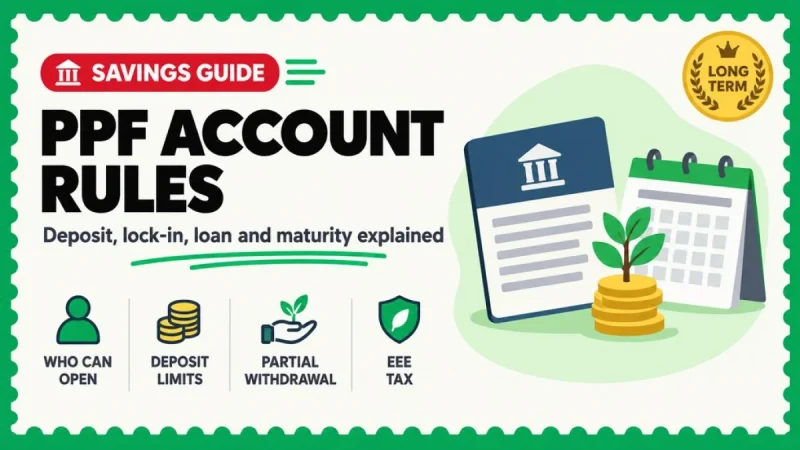
Every PPF rule you actually need comes from one document — the Public Provident Fund Scheme, 2019. It fixes the ₹500 minimum, the ₹1.5 lakh ceiling, the 15-year maturity and the odd interest formula that punishes you for depositing after the 5th of the month.
Quick snapshot
- Minimum deposit ₹500 a year, maximum ₹1,50,000 a year, in multiples of ₹50.
- Maturity is 15 financial years counted from the end of the year the account was opened.
- Interest is paid on the lowest balance between the close of the 5th day and the end of each month.
- Loan window: 3rd to 6th financial year. Partial withdrawal: from the 7th financial year onwards.
- Only one account per person. Joint accounts are not allowed under the Scheme.
- Deposit qualifies under Section 80C; interest and maturity proceeds are exempt — the EEE treatment.
- The balance cannot be attached by a court decree for the account holder's debts.
A PPF account is governed by the Public Provident Fund Scheme, 2019 (G.S.R. 915(E) dated 12 December 2019). A resident individual may hold one account, opened at a post office or an authorised bank with a minimum of ₹500. You may deposit between ₹500 and ₹1,50,000 in a financial year, in multiples of ₹50, in one lump sum or any number of instalments. The account matures 15 years from the end of the financial year of opening, and can then be extended in five-year blocks, with or without fresh deposits. The rate is currently 7.1% per annum, but it is reviewed by the Government every quarter, so check the live rate before you plan around it.
1. Who can open a PPF account, and where
An individual opens a PPF account by applying in Form-1 at a post office or at a bank authorised to run the scheme. The declaration printed on Form-1 is the real eligibility test, and it carries three undertakings most people sign without reading.
You declare that you have not already opened a PPF account in your own name at any post office or bank in the country — one person, one account. You declare that you and the minor (if you are opening for a child) are resident citizens of India and will report any change in that status; a change in residency is one of the three grounds for premature closure. And you undertake to respect the deposit ceiling across your own account and any account you operate as guardian.
Minor accounts and guardianship
A guardian may open one account on behalf of each minor or each person of unsound mind in his care. Only one account may exist for that minor, opened by any one guardian — a mother and a father cannot open one each for the same child. The guardian operates it until the child attains majority. Joint accounts are expressly barred; a PPF account always stands in one name.
2. Deposit limits and the ₹1.5 lakh ceiling that includes your child's account
The Scheme sets a floor and a ceiling for each financial year.
| Rule | What the Scheme says |
|---|---|
| Minimum initial deposit | ₹500 to open the account |
| Minimum per financial year | ₹500 |
| Maximum per financial year | ₹1,50,000 |
| Deposit multiple | Any sum in multiples of ₹50 |
| Number of instalments | Lump sum or any number of instalments |
| Ceiling coverage | Inclusive of deposits into the minor's account you operate as guardian |
That last row trips up parents. Put ₹1,00,000 into your own PPF and ₹1,00,000 into your child's in the same year and you have breached the ceiling — ₹1,50,000 applies to the combined deposits. Excess deposits are treated as in contravention of the Scheme. One useful exception: where you clear arrears for earlier years of default, the annual total includes those arrear deposits but excludes the default fee.
3. How PPF interest is actually calculated
This is the single most misunderstood rule in the scheme, and it costs people money every month.
Interest for a calendar month is payable on the lowest balance standing to the credit of the account between the close of the fifth day and the end of that month. Interest is then credited to the account at the end of each financial year, not monthly.
Read it literally. A deposit that lands on the 6th earns nothing for that month, because the lowest balance in the measurement window is the balance before it arrived. A deposit that clears on or before the 5th earns for the whole month.
Deposit on or before the 5th — every single month
If you invest ₹1.5 lakh annually as a lump sum, do it in the first five days of April so the full amount earns for all twelve months of the year. If you invest monthly, set the standing instruction for the 1st to the 3rd, not the 7th. Clearing time matters: what counts is the balance at the credit of the account, not the date you pressed send.
The rate and how often it changes
The rate printed in the 2019 notification itself was 7.9% per annum, which tells you the rate is not frozen into the Scheme. Small savings rates are reviewed and notified by the Department of Economic Affairs on a quarterly basis. According to the National Savings Institute's own historical table, PPF has carried 7.1% per annum since 1 April 2020, and the Department of Economic Affairs has kept small savings rates unchanged in its recent quarterly office memoranda.
Because the rate can move at the start of any quarter, treat 7.1% as the current figure and not as a guarantee for the next 15 years. Your corpus is calculated at whatever rate applies in each year.
4. Loan against PPF: the window closes in year six
PPF offers a cheap loan, but only during a narrow early window when your balance is still small. Most people discover the facility after it has already expired.
When you can apply
After one year from the end of the year of your initial subscription, and before five years from the end of that year. In practice: the 3rd to the 6th financial year of the account.
How much
Up to 25% of the balance at the end of the second financial year immediately preceding the year in which you apply. Apply in Form-2.
How often
Only one loan in a year, and no fresh loan until the earlier one is repaid in full with interest.
Repayment
Principal must be repaid within 36 months from the first day of the month following sanction, in a lump sum or instalments.
Interest on the loan
1% per annum if the principal is repaid inside 36 months, paid afterwards in not more than two monthly instalments. If the loan is not repaid, or only partly repaid, within 36 months, interest jumps to 6% per annum, charged from the start.
Unpaid loan interest is debited to the account at the end of the year. If the account holder dies with a loan outstanding, the nominee or legal heir bears the interest, which is adjusted at final closure.
5. Partial withdrawal, premature closure and maturity
Partial withdrawal from the 7th year
Any time after five years from the end of the year in which the account was opened — that is, from the seventh financial year — you can withdraw in Form-2. The cap is 50% of the balance at the end of the fourth year immediately preceding the year of withdrawal, or at the end of the preceding year, whichever is lower. Only one withdrawal per year, and any outstanding loan plus interest must be cleared first.
Premature closure: only three grounds, never before five years
Allowed grounds (Form-5)
- Treatment of a life-threatening disease of the account holder, spouse, dependent children or parents, with medical reports
- Higher education of the account holder or dependent children, with admission documents and fee bills (India or abroad)
- Change in residency status, on production of passport and visa or income tax return
The two conditions
- No closure before five years from the end of the year of opening
- Interest is recomputed at a rate 1% lower than the rate credited from the date of opening (or extension)
Maturity and what happens next
After 15 years from the end of the opening year you have three choices.
| Option | Form / action | Withdrawal allowed |
|---|---|---|
| Close the account | Form-3 | Entire balance with interest up to the last day of the month preceding closure |
| Retain without further deposits | No form needed; default position | One withdrawal of any amount in each year; balance keeps earning interest |
| Extend with deposits for 5 years | Form-4, within one year of maturity | Total withdrawals in the five-year block capped at 60% of the balance at the start of the block |
The one-year deadline is final
If you do not submit Form-4 within one year of maturity, you lose the right to deposit. Any money you push in afterwards is treated as irregular and refunded without interest. Worse, once the account has run without deposits for more than a year, you can never switch back to the with-deposits option. And once you have opted for a five-year extension, you cannot withdraw that request later.
The blocks are repeatable. The same rules apply at the end of each extended block, and after completing any block you may stop depositing and leave the account earning interest with one withdrawal a year.
6. Default, revival and the rules on closure and protection
If you deposited ₹500 in the opening year but miss the minimum in a later year, the account is treated as discontinued. The consequences are specific:
- It can be revived at any time during the maturity period by paying a fee of ₹50 plus ₹500 arrears for each year of default.
- Even if never revived, the balance keeps earning interest at the applicable rate — your money is not frozen.
- Loan and partial withdrawal are not available in a discontinued account.
- You cannot open a new PPF account until the discontinued one is finally closed after maturity.
On the death of the account holder the account is closed; a nominee or legal heir cannot continue it. The balance earns interest up to the end of the month preceding the month of payment. Nomination is made in the nomination section of Form-1, and you can name more than one nominee with defined shares.
One underrated protection: the amount standing to the credit of a PPF account cannot be attached under any court order or decree in respect of any debt or liability of the account holder.
7. Tax treatment and how PPF compares with EPF and ELSS
PPF is one of the few genuinely EEE instruments left. The deposit is eligible for deduction under Section 80C, the interest credited is exempt, and the maturity proceeds are exempt. But that 80C benefit only exists if you file under the old regime — under the default new regime of Section 115BAC, Section 80C deductions are not available.
| Feature | PPF | EPF | ELSS |
|---|---|---|---|
| Who can invest | Any resident individual | Salaried, via a covered employer | Anyone |
| Return | Government-notified, reviewed quarterly | Rate declared by EPFO each year | Market-linked, not guaranteed |
| Lock-in | 15 years, with limited earlier access | Until the triggering event | 3 years per instalment |
| Annual limit | ₹1,50,000 | Linked to wages | No upper limit on investment |
| 80C eligible | Yes | Yes (employee share) | Yes |
| Capital risk | None — sovereign backed | None in practice | Yes |
PPF is the debt and safety leg of a portfolio, not the growth leg. Its real advantages are the sovereign guarantee, the tax-free interest and the attachment protection — not the headline rate.
Frequently asked questions
Can I open two PPF accounts, one in a bank and one in a post office?
No. Form-1 carries a declaration that you have not opened a PPF account in your name in any post office or bank in the country. One individual may hold only one account, and joint accounts are not permitted under the Scheme.
What is the minimum and maximum I can deposit in a PPF account each year?
Minimum ₹500 and maximum ₹1,50,000 in a financial year, in multiples of ₹50. You can pay in one lump sum or in any number of instalments. The ₹1,50,000 ceiling covers your own account plus any account you operate for a minor as guardian.
Why should I deposit before the 5th of the month?
Because interest for a month is calculated on the lowest balance in the account between the close of the fifth day and the end of that month. Money credited on the 6th or later does not earn interest for that month at all. Interest is credited to the account at the end of each financial year.
When can I take a loan against my PPF balance?
Between one year and five years from the end of the year of your initial subscription — the 3rd to 6th financial year. The maximum is 25% of the balance at the end of the second year preceding the application. Interest is 1% per annum if repaid within 36 months, and 6% per annum if it is not.
When is partial withdrawal allowed and how much?
From the seventh financial year, that is, after five years from the end of the year the account was opened. You may withdraw up to 50% of the balance at the end of the fourth year preceding the withdrawal or at the end of the preceding year, whichever is lower, once in a year, after clearing any outstanding loan.
Can I close my PPF account before 15 years?
Only after five years from the end of the opening year, and only on three grounds: treatment of a life-threatening disease of yourself, your spouse, dependent children or parents; higher education of yourself or dependent children; or a change in your residency status. Interest is then recalculated at 1% below the rates credited since opening.
What happens if I miss the ₹500 minimum deposit in a year?
The account is treated as discontinued. Loan and partial withdrawal are blocked, and you cannot open a new PPF account until it is closed after maturity. You can revive it during the maturity period by paying ₹50 as fee plus ₹500 arrears for each year of default. The balance keeps earning interest in the meantime.
Is PPF interest taxable?
No. PPF follows the exempt-exempt-exempt pattern: the deposit qualifies under Section 80C, the interest is exempt and the maturity amount is exempt. However, the Section 80C deduction is only available if you opt for the old tax regime, since it is not allowed under the default regime of Section 115BAC.
Sources: Department of Posts, Government of India — Public Provident Fund Scheme, 2019 (G.S.R. 915(E), 12 December 2019, Gazette of India Extraordinary Part II Sec. 3(i)); National Savings Institute — PPF interest rate history; Department of Economic Affairs, Ministry of Finance — quarterly small savings rate notifications; Income Tax Department e-Filing portal — deductions available under the old and new regimes.
Related guides on BeInCareer
- Section 80C Deductions List: Every Eligible Investment Explained
- EPF Withdrawal Rules in India 2026: Forms, Limits and Claim Steps
- NPS vs PPF vs EPF: Which Retirement Plan Works Best
- Best Investment Plans for Salaried Employees in India
- Save Tax on Your First Salary: New vs Old Regime
- Atal Pension Yojana: Eligibility, Contribution and Pension Slabs
- How to Start a SIP With Your First Salary
- Mutual Funds for Beginners in India
- Emergency Fund: FD vs RD vs Liquid Funds
- What to Do With Idle Money Sitting in Your Bank Account