
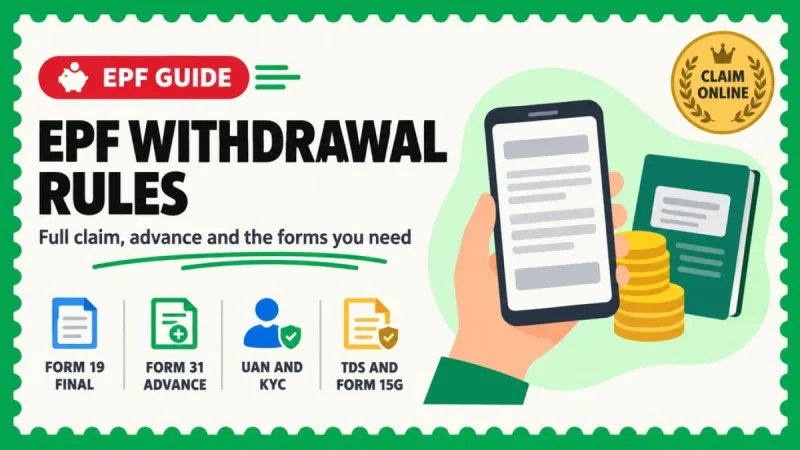
EPFO has merged 13 tangled partial-withdrawal provisions into three simple categories, set a single 12-month service requirement, and locked 25% of your balance away as a minimum retirement corpus. Here is what that means for your next claim.
Quick snapshot
- Thirteen partial withdrawal provisions are now merged into three: Essential Needs, Housing Needs and Special Circumstances.
- Minimum service for any partial withdrawal is uniformly 12 months, down from eligibility periods that ran up to seven years.
- Up to 75% of the eligible amount is withdrawable without documentation; 25% stays earmarked as minimum balance.
- Full withdrawal is allowed on retirement after 55, permanent disability, incapacity to work, retrenchment, VRS or permanently leaving India.
- The premature final settlement waiting period has been changed from 2 months to 12 months; pension withdrawal from 2 months to 36 months.
- Claims up to ₹5 lakh are processed through auto-settlement.
- EPF interest was declared at 8.25% for FY 2024-25; the CBT has recommended 8.25% for FY 2025-26, pending Government notification.
There are two distinct things people call "PF withdrawal". A partial withdrawal (advance) keeps your account alive and now requires only 12 months of service; you can take up to 75% of the eligible amount, which includes employer contribution and interest, while 25% stays locked as minimum balance. A final settlement closes the account and is permitted on retirement after 55, permanent disability or incapacity, retrenchment, voluntary retirement or permanent emigration. Where you are between jobs, the Central Board of Trustees has changed the waiting period for premature final settlement from the long-standing 2 months to 12 months, while allowing 75% of the balance to be withdrawn immediately on unemployment and the remaining 25% after one year.
1. Partial withdrawal vs final settlement: know which one you need
Almost every rejected claim starts here — the member applies for the wrong type of benefit.
Partial withdrawal (advance)
- Account stays open, UAN stays active
- Service requirement: 12 months
- Up to 75% of eligible amount; 25% earmarked as minimum balance
- Includes employer contribution and interest, not just your own share
- Repeatable within the category limits
- No documentation required under the simplified framework
Final settlement
- Account is closed and the full balance paid out
- Allowed on retirement after 55, permanent disability, incapacity, retrenchment, VRS or permanently leaving India
- Premature final settlement while unemployed has a waiting period
- EPS pension money is a separate claim
- Ends your membership and the related social security cover
EPFO's own numbers explain why the rules were tightened. At final settlement, 50% of members had less than ₹20,000 in their PF balance and 75% had less than ₹50,000 — the consequence of repeated withdrawals destroying the compounding that an 8.25% rate would otherwise deliver.
2. The simplified partial withdrawal framework
The Central Board of Trustees merged the old thirteen provisions into one unified rule with three categories.
| Category | What it covers | Key change |
|---|---|---|
| Essential Needs | Illness, education, marriage | Education withdrawals allowed up to 10 times and marriage up to 5 times, against a combined total of 3 earlier |
| Housing Needs | Purchase, construction, repair, loan repayment | Brought into a single simplified head |
| Special Circumstances | Previously natural calamity, lockout or closure, continuous unemployment, epidemic | You can now apply without assigning any reason, which removes a major cause of rejection |
Three structural changes matter more than the categories themselves.
The withdrawable base is larger. Earlier a member could withdraw only the employee contribution and interest, ranging from 50% to 100% depending on the provision. The withdrawable amount now also includes the employer contribution, so 75% of the eligible amount is materially more money than the old formulas produced.
The eligibility clock is shorter. Different provisions carried different minimum service periods, some as long as seven years. All of them are now uniformly 12 months.
Documentation is gone. Zero documentation for partial withdrawals is what makes 100% auto-settlement possible, and it removes the single biggest source of grievances.
The 25% minimum balance is not optional
A provision earmarks 25% of the contributions in your account as a minimum balance to be maintained at all times. It is designed to keep a base corpus compounding at the EPFO rate. You cannot draw this down through partial withdrawals — it is released only on a permitted full withdrawal event such as retirement.
3. Full withdrawal, unemployment and the 2-month rule
The old rule was simple and widely used: two months of unemployment and you could take everything out. That rule has been changed.
The CBT decided to move the period for availing premature final settlement from the existing 2 months to 12 months, and final pension withdrawal from 2 months to 36 months. The stated reason is to stop short job gaps from wiping out retirement savings.
Crucially, this does not mean your money is frozen for a year. In case of unemployment:
Immediately
75% of the PF balance — employer contribution, employee contribution and interest — can be withdrawn at once.
After one year
The remaining 25% can also be withdrawn.
On a qualifying event
The entire balance including the 25% minimum balance is payable on retirement after attaining 55 years, permanent disability, incapacity to work, retrenchment, voluntary retirement or leaving India permanently.
If you are simply changing jobs, the correct action is a transfer, not a withdrawal. Transferring preserves continuous service, which matters for both pension eligibility and the tax treatment discussed below.
4. EPS pension: withdrawal versus the scheme certificate
Your EPS money is not your EPF money, and treating them as one pot is an expensive mistake.
To qualify for a pension at retirement you must complete at least 10 years of EPS membership. EPFO's data shows about 75% of pension members withdraw their entire pension amount within four years of service — before crossing ten years — which ends their membership and makes them permanently ineligible for a future pension.
There is a second, less known loss. If the pension fund is not withdrawn, your family remains eligible for pension benefits for up to three years after contributions stop, in case of your death. Withdraw the money and that cover disappears.
Two reassurances from the official position: pension entitlement at age 58 is completely unaffected by the recent changes, and a member can still withdraw the pension accumulation before completing 10 years of service at any point within those ten years — now after a 36-month waiting period rather than two months.
5. Which form applies to your claim
| Form | Purpose | When you use it |
|---|---|---|
| Form 19 | Final settlement of the EPF account | Account is being closed on a permitted event |
| Form 10C | Withdrawal benefit or scheme certificate under EPS | Pension side, where EPS membership is under 10 years |
| Form 31 | Partial withdrawal (advance) | Essential Needs, Housing Needs or Special Circumstances |
| Form 10D | Monthly pension | Ten years of EPS membership completed and pensionable age reached |
| Composite Claim Form | Combined offline claim | Offline route; the Aadhaar version is self-attested, the non-Aadhaar version needs employer attestation |
Online, these are not separate paper forms at all. On the Member e-Sewa portal they appear as claim types inside a single Claim (Form-31, 19, 10C & 10D) menu, and you select which benefit you are claiming. The Composite Claim Form exists for the offline route; its whole purpose was to collapse several older forms into one, with the Aadhaar version requiring no employer attestation because your identity is already verified.
6. What must be in place before you click submit
Claims rarely fail because of the rules. They fail because the member's record is incomplete. Fix these before applying.
UAN activated
Your Universal Account Number must be activated and linked to the mobile number you currently use, because every step is OTP-driven.
Aadhaar seeded and verified
Aadhaar must be linked to the UAN and approved by the employer. EPFO has run a mission-mode KYC drive precisely because money sits locked in accounts with accessibility problems.
Bank account and IFSC verified
The bank account must be in your own name and seeded against the UAN. A closed account, a merged bank's old IFSC or a joint account in the wrong order is a guaranteed rejection.
PAN updated
Relevant where tax is deductible on the withdrawal. A missing PAN affects the rate at which tax is deducted.
Date of exit marked by the employer
For a final settlement, your previous employer must have updated the date of exit. Until that is on record, the system treats you as still employed and the claim cannot proceed.
Once these are clean, the online route is: log in to the Member e-Sewa portal with UAN and password, confirm the last four digits of your bank account, choose the claim type, enter the reason and amount, complete Aadhaar OTP verification and submit. Claims up to ₹5 lakh are now processed through auto-settlement, and EPFO has stated that the simplification of partial withdrawal provisions, with zero documentation, is intended to enable 100% auto-settlement of partial withdrawal claims.
7. Tax on EPF withdrawal and when Form 15G helps
The dividing line is five years of continuous service.
Where you have rendered five years or more of continuous service, the accumulated balance is exempt. Service with a previous employer counts if the balance was transferred rather than withdrawn — which is the single strongest argument for transferring your PF at every job change instead of closing it.
Where service is less than five years, Section 192A requires tax to be deducted at source on the taxable portion of the accumulated balance at the time of payment, at the rate of 10%, and no deduction is made where the payment is less than ₹50,000. If you do not furnish PAN, tax is deducted at the maximum marginal rate.
Form 15G is a declaration, not a loophole
A member whose total income for the year will be below the taxable limit can furnish Form 15G (Form 15H for senior citizens) so that no tax is deducted. Filing it when your income will in fact be taxable is a false declaration with penal consequences. Note also that TDS is not the final tax — even where tax is deducted, the withdrawal must be reported in your income tax return and the liability settled there.
8. Why claims get rejected, and how to fix each one
| Rejection reason | What is actually wrong | Fix |
|---|---|---|
| Date of birth mismatch | DOB in the EPFO record differs from Aadhaar | File an online joint declaration for correction of member details, with the employer's approval, before re-applying |
| Name mismatch | Initials, expanded surnames or a post-marriage name change | Same joint declaration route; make the EPFO record match Aadhaar exactly |
| Father's or spouse's name mismatch | Record created from an old employer's data | Correction through joint declaration |
| Bank or IFSC wrong | Closed account, bank merger changed the IFSC, or the account is not in your sole name | Update and re-verify KYC under Manage > KYC, wait for employer approval |
| Date of exit not updated | Previous employer never marked your exit | Ask the employer to update it; EPFO also allows a member to mark the date of exit after a gap from the last contribution |
| Service period not eligible | Less than 12 months of service for a partial withdrawal | Wait until the uniform 12-month requirement is met |
| Claim already settled or duplicate | An earlier claim for the same purpose is in process | Check the claim status before re-filing |
| Multiple UANs | A new UAN was generated at a later job | Get the UANs linked and past accumulations transferred into the active one |
One more thing to plan for. The 239th meeting of the Central Board of Trustees approved new EPF, EPS and EDLI Schemes aligned with the Code on Social Security, 2020, to replace the current schemes. Until those are brought into force, operate on the rules as they stand and confirm the position on the EPFO portal before you file.
Frequently asked questions
How much EPF can I withdraw as a partial advance?
Up to 75% of the eligible amount, which now includes the employer contribution and interest in addition to your own contribution. The remaining 25% of contributions is earmarked as a minimum balance that stays in the account until a permitted full withdrawal event.
How long must I work before I can take a PF advance?
Twelve months. Under the simplified framework, the minimum service requirement has been uniformly set at 12 months for all kinds of partial withdrawals, replacing earlier eligibility periods that ran up to seven years for some provisions.
Is the two-month unemployment rule for full PF withdrawal still valid?
The Central Board of Trustees decided to change the period for availing premature final settlement from the existing 2 months to 12 months, and final pension withdrawal from 2 months to 36 months. In the meantime, 75% of the PF balance can be withdrawn immediately on unemployment and the remaining 25% after one year. Confirm the position applicable to your claim on the EPFO portal before filing.
Which form do I use for PF withdrawal?
Form 19 for final settlement of the EPF account, Form 10C for the EPS withdrawal benefit or scheme certificate, Form 31 for a partial withdrawal and Form 10D for monthly pension. Online these appear as claim types in a single claim menu on the Member e-Sewa portal. The Composite Claim Form is the offline equivalent.
How fast is a PF claim settled now?
Claims up to ₹5 lakh are processed through auto-settlement. EPFO has said that removing documentation for partial withdrawals is intended to enable 100% auto-settlement of such claims. Claims that need manual verification, or where KYC is incomplete, take longer.
Will tax be deducted if I withdraw my PF before five years?
Yes. Where continuous service is less than five years, tax is deducted at source under Section 192A at 10% on the taxable portion, and no deduction is made where the payment is less than ₹50,000. If you do not furnish PAN, tax is deducted at the maximum marginal rate. Service with a previous employer counts towards the five years if the balance was transferred rather than withdrawn.
Why was my PF claim rejected for date of exit?
Because your previous employer has not marked your date of exit in the EPFO record, so the system still treats you as employed there. Ask the employer to update it. EPFO also allows a member to mark the date of exit after a gap from the last contribution, after which the claim can be filed afresh.
Should I withdraw my EPS pension money when I change jobs?
Usually not. A pension at retirement requires at least 10 years of EPS membership, and withdrawing ends that membership. If the pension fund is left untouched, your family remains eligible for pension benefits for up to three years even after contributions stop, in the event of your death. Once withdrawn, that benefit is lost.
Sources: PIB — 238th meeting of the Central Board of Trustees, EPF: simplification and liberalisation of EPF partial withdrawal provisions; PIB — EPFO clarification on the new withdrawal norms, 25% minimum balance and premature final settlement period; PIB — Ministry of Labour & Employment on auto-settlement up to ₹5 lakh and 75% withdrawals; PIB — 239th meeting of the Central Board of Trustees, EPF interest rate and new Schemes under the Code on Social Security, 2020; EPFO, Ministry of Labour & Employment; Income Tax Department — Section 192A and Form 15G.
Related guides on BeInCareer
- EPFO PF Claim Guide: Step-by-Step Online Process
- PPF Account Rules: Deposits, Lock-In, Loan and Maturity
- Section 80C Deductions List: Every Eligible Investment Explained
- NPS vs PPF vs EPF: Which Retirement Plan Works Best
- How to File Your ITR for the First Time
- Save Tax on Your First Salary: New vs Old Regime
- Probation Period Rules: Salary, Leave and Resignation
- Best Investment Plans for Salaried Employees in India
- Emergency Fund: FD vs RD vs Liquid Funds
- Atal Pension Yojana: Eligibility, Contribution and Pension Slabs