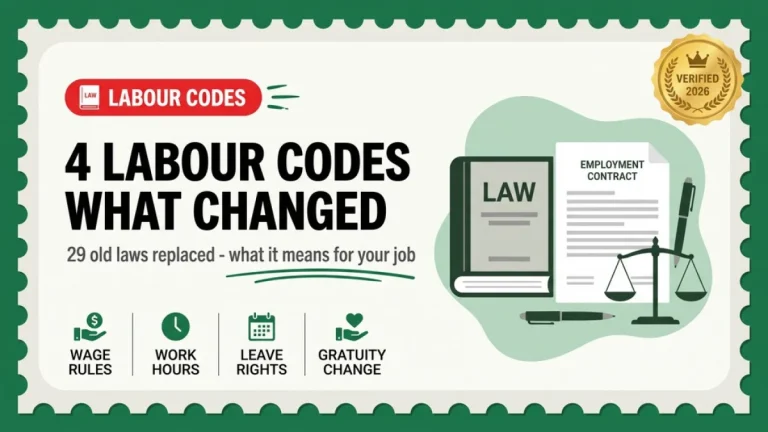


Under the Labour Codes in force since 21 November 2025, every worker is entitled to a formal appointment letter. That single change converts a verbal package figure into a document you can hold an employer to.
Quick snapshot
- Mandatory since: 21 November 2025, under the four Labour Codes.
- Why it matters: a verbal CTC figure binds nobody; a written annexure does.
- What to look for: basic pay and allowances shown separately, not one lump figure.
- Wage definition: allowances above 50% of total pay get added back into wages.
- Red flag: an employer who will not put terms in writing before you join.
- Keep it: it is the primary proof of service and wages for PF and gratuity claims later.
The Labour Codes make appointment letters compulsory, so you are entitled to your terms of employment in writing rather than as a spoken package figure. The letter and its annexure are what decide your provident fund base, your gratuity calculation and your notice obligations — not the number quoted in a phone call. If you have an offer but no written breakdown of basic pay, allowances, PF treatment and notice period, ask for it before you resign from anything else.
Why this change matters more than it sounds
For years the standard fresher experience was a verbal offer, a number, and a joining date. The written document arrived later, sometimes after joining, occasionally not at all. Everything that followed — what your PF was calculated on, what your notice period was, whether a bonus was guaranteed or discretionary — depended on a document nobody had read together.
Making the appointment letter mandatory flips the default. The terms exist in writing before the relationship starts, which is the only point at which you have any negotiating position.
The asymmetry is the whole point. Before you join, you can ask questions and walk away. After you join, you have resigned from something else, possibly relocated, and the same question becomes a confrontation. Everything in this guide is cheaper to do in the week before joining than in any week after.
What a useful appointment letter actually contains
| Item | Why it matters | Weak version to push back on |
|---|---|---|
| Basic pay and dearness allowance, shown separately | This is the base for provident fund and gratuity | A single "total compensation" number with no split |
| Each allowance listed individually | Lets you test the 50% wage rule yourself | "Other allowances" as one undifferentiated line |
| Employer PF contribution, marked as employer cost | It sits in CTC but never reaches your bank | Bundled into the headline figure without a label |
| Variable or performance pay, with conditions | Tells you what is guaranteed and what is not | A percentage with no payment trigger stated |
| Work location | Decides professional tax and applicable state rules | "As per business requirement" |
| Notice period, both directions | Notice comes from contract, not from the Codes | A long notice on you, a short one on them |
| Designation and reporting line | Matters for your next job's background check | A generic internal grade with no external meaning |
You are not looking for generous terms. You are looking for specific terms. A modest package written precisely is easier to live with than a large one written vaguely.
Read the annexure, not the headline
The letter usually states a designation and a CTC figure. The annexure is where the actual structure lives, and it is the part most people skim.
Under the Code on Wages, "wages" means basic pay, dearness allowance and retaining allowance. Where excluded pay-outs — HRA, conveyance, bonus, overtime, commission — together exceed 50% of total remuneration, the excess is added back into wages. That calculation runs on the annexure, so the annexure is what determines your statutory entitlements.
Add up basic plus dearness allowance.
Add up everything else in the annexure.
If the second figure is more than half the total, the add-back rule is relevant to you.
Subtract employer PF and the gratuity provision from the CTC headline — neither is monthly salary.
What remains, minus your own 12% PF and professional tax, is roughly your in-hand.
If the letter does not arrive
The entitlement exists, so the request is reasonable and does not need to be adversarial. Most delays are administrative rather than deliberate.
Ask by email, not on a call. You want a dated record of having asked.
Ask for the annexure specifically. "Offer letter" and "salary breakdown" are often different documents.
Do not resign from a current job on a verbal offer alone. This is the single most expensive mistake in the sequence.
If it still does not come, treat that as information. An employer who cannot produce its own standard document is showing you how the next dispute will go.
Keep it permanently, not just until you join. Years later, the appointment letter is what proves your service period and wage structure for a provident fund transfer or a gratuity claim. Those two facts are the only inputs that decide what you are owed, and your memory is not evidence.
What the appointment letter does not decide
| Question | Where the answer comes from |
|---|---|
| Maximum working hours | Statutory caps: 8 a day, 48 a week, with overtime at twice the rate |
| When annual leave starts | Statute: after 180 days of work in a calendar year |
| My PF contribution rate | Statute: 12% of wages, with the employer adding 8.33% to pension and 3.67% to PF |
| Gratuity eligibility | Statute: 5 years, or 1 year for fixed-term employees |
| Professional tax | Your state of posting |
A contract cannot write below the statutory floor. If your letter says something that contradicts the list above, the statutory position is the one that matters — but it is far easier to query it before signing than to argue it later.
Freshers: the three questions worth asking at offer stage
None of these put an offer at risk, and the answers are genuinely informative.
First, what proportion of the CTC is variable, when is it paid, and on what condition. Second, what is the work location, because it changes professional tax and your real cost of living. Third, does PF apply from the joining date, including through any training period — it should, because provident fund attaches to employment rather than to confirmation.
A company that answers these three clearly is a company whose paperwork is in order. That correlates with a lot of other things going right later.
The three documents that matter, and why people only keep one
An employment relationship produces three documents that you will need again. Most people keep the first, lose the second and never ask for the third.
| Document | When you get it | What it proves later |
|---|---|---|
| Appointment letter and annexure | Before joining | Your wage structure and the terms you agreed, which decide PF base and gratuity |
| Payslips | Every month | What was actually paid and deducted, as against what was promised |
| Relieving and experience letter | On exit | Your exact service dates, which decide gratuity eligibility and survive background checks |
The relieving letter is the one most often skipped, usually because the exit was rushed or slightly sour. It is also the one a future employer's background check will ask for, and the one that settles a gratuity argument years later. Ask for it before your last day, not after.
There is a simple test for whether your record is complete: could you, today, state your exact joining date, your exact last working day and your last drawn basic pay for every employer you have had, and produce a document for each? If not, the gap is worth closing now rather than at the point someone asks you to prove it.
Store all three somewhere that outlives a work laptop and a company email account. Both of those are switched off on the day you leave, frequently without warning, and a surprising number of people discover their entire employment record lived in an inbox they no longer control.
Is an appointment letter compulsory in India?
Yes. The four Labour Codes, in force since 21 November 2025, make appointment letters mandatory, so you are entitled to your terms of employment in writing.
What should my appointment letter contain?
Basic pay and dearness allowance shown separately, each allowance listed individually, the employer PF contribution marked as employer cost, variable pay with its conditions, work location, notice period for both sides, and your designation.
Why does the basic pay split matter so much?
Because basic plus dearness allowance is the base on which provident fund and gratuity are calculated. A package with a small basic and large allowances shrinks both, which is why the Code on Wages adds back allowances exceeding 50% of total remuneration.
Can I join on a verbal offer?
You can, but you should not resign from an existing job on one. A verbal figure binds nobody, and the entitlement to a written appointment letter means asking for it is a reasonable request, not an awkward one.
What if my employer refuses to give one?
Ask by email so there is a dated record, and ask for the annexure specifically. If it still does not come, treat that as meaningful information about how the employer handles its obligations.
Does the appointment letter set my working hours?
Only within the statutory limits. Normal hours are capped at 8 a day and 48 a week, with overtime requiring consent and paid at twice the normal rate. A contract cannot write below the statutory floor.
How long should I keep it?
Permanently. It is the primary proof of your service period and wage structure, which are the two inputs that decide a provident fund transfer or a gratuity claim years later.
Does my notice period come from the Labour Codes?
No. Notice period comes from your contract and the applicable standing orders. The Codes do not fix a single national notice period for all employees.
Sources: Press Information Bureau, Government makes the four Labour Codes effective · Press Information Bureau, Code on Wages, 2019 and the definition of wages · Press Information Bureau, Code on Social Security, 2020.
Related guides on BeInCareer
- The Four Labour Codes: What Changed for Employees
- Offer Letter Checklist Before Joining
- Working Hours and Overtime Rules India 2026
- Gratuity Rules India 2026
- CTC vs In-Hand Salary 2026
- Salary Slip Explained: Basic, HRA, DA, PF and PT
- Probation Period Explained
- After Campus Placement: Offer Letter to First Salary
- Freshers Document Checklist
- Infosys Fresher Salary 2026: CTC vs In-Hand