
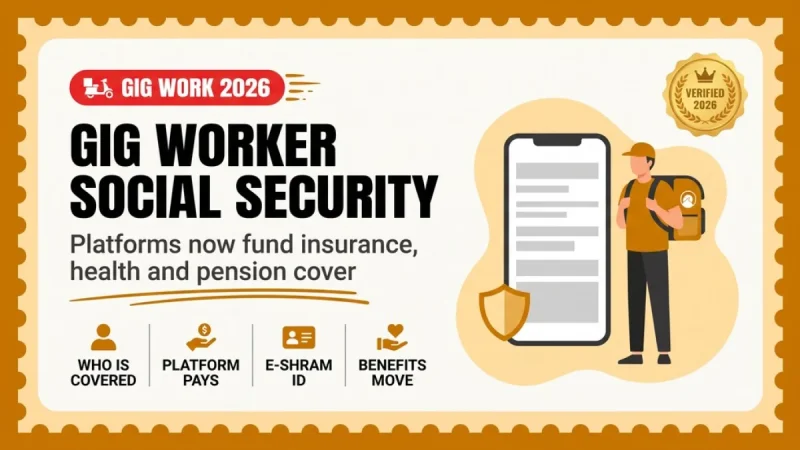
Delivery, ride-hailing and platform work used to generate no social security record at all. The Code on Social Security brings gig and platform workers inside a statutory framework, funded partly by the platforms themselves.
Quick snapshot
- Who is covered: gig workers and platform workers, defined in statute for the first time.
- Who pays: aggregators contribute 1–2% of annual turnover to a Social Security Fund.
- Cap on that: no more than 5% of what they pay out to gig and platform workers.
- What it funds: life and disability insurance, health, maternity benefit and pension.
- Your ID: an Aadhaar-linked number through e-Shram registration.
- Portability: the ID belongs to you, so benefits travel between platforms.
Under the Code on Social Security, gig and platform workers are recognised in law and brought within a social security framework. Aggregators — the digital marketplaces connecting a customer to a service provider — contribute between 1% and 2% of annual turnover to a Social Security Fund, capped at 5% of the amounts they pay to gig and platform workers. The Fund supports schemes covering life and disability insurance, health, maternity benefit and pension. Workers register through e-Shram and receive an Aadhaar-linked ID that makes the entitlement portable across platforms.
The three definitions that make this work
The framework depends on defining in law what had previously been a gap. Three definitions do the work.
| Term | Definition under the Code |
|---|---|
| Aggregator | A digital intermediary or marketplace that lets a buyer or user of a service connect with the seller or service provider |
| Gig worker | A person who performs work or participates in a work arrangement and earns from it outside a traditional employer-employee relationship |
| Platform worker | A person engaged in or undertaking platform work |
The phrase that matters is "outside of a traditional employer-employee relationship". That is precisely why none of the ordinary employment protections reached this work before. Rather than redefining gig workers as employees, the Code builds a separate funded route to social security for them.
This does not make you an employee. Gig and platform work remains outside the employer-employee relationship, so provident fund, gratuity, notice period and the working-hour caps do not apply in the way they do to a salaried job. What the Code creates is a parallel social security framework, not the same one.
How the Fund is paid for
The funding mechanism is the genuinely novel part. Aggregators contribute 1% to 2% of their annual turnover to a Social Security Fund, subject to a ceiling of 5% of the amounts paid or payable to gig and platform workers.
| Element | Position |
|---|---|
| Who contributes | The aggregator, not the worker |
| Rate | 1–2% of annual turnover |
| Ceiling | 5% of payments made or payable to gig and platform workers |
| Destination | A Social Security Fund |
| Purpose | Schemes for life and disability insurance, health, maternity and pension |
Two things follow. The contribution is on turnover rather than on each individual engagement, which means it does not depend on classifying any particular worker. And it is the platform that pays, not a deduction from your earnings.
e-Shram and why portability is the important word
Registration happens through e-Shram, which issues each worker a unique Aadhaar-linked ID. Because that ID is attached to the person rather than to the platform, entitlements are portable when the worker moves between apps.
Portability is what makes the framework usable in the real pattern of this work. Very few people deliver for a single platform exclusively for years. They switch, they run two apps at once, they do it seasonally between other jobs. A benefit tied to one platform would be worth almost nothing in that pattern. A benefit tied to the worker survives it.
Register on e-Shram and keep the ID. It is the thing that makes everything else reachable.
Make sure Aadhaar details match what the platform holds. Mismatched names and dates are the usual reason a record cannot be linked.
Keep your own earnings records from each platform, since you are not receiving payslips.
Re-check the registration when you switch platforms or change your phone number or bank account.
Where gig work fits in a career
A large share of first earnings in India now come from platform work: delivery between semesters, driving while job-hunting, freelance tasks alongside studies. That period used to be invisible. It produced income and no record of anything.
Recognising it in statute changes that in a modest but real way. The work now sits inside a framework that can accumulate something, and the e-Shram ID gives it a trace.
It is worth being clear-eyed about the limits. This is not equivalent to a salaried job with provident fund at 12%, employer contributions, gratuity accruing per year of service, and the statutory caps on working hours. Someone choosing between a platform-work income and a lower-paid salaried role is choosing between two genuinely different structures, not just two numbers. The salaried role builds a provident fund balance, a service record and pension eligibility; the platform income does not do those things in the same way.
The honest framing is that gig work is now covered rather than uncovered, which is a real improvement on nothing, and still different from employment.
What this does not give you
| Not covered | Why |
|---|---|
| Provident fund at 12% with employer match | That attaches to an employer-employee relationship |
| Gratuity after five years | Same — it is an employment entitlement |
| The 8-hour day and 48-hour week caps | Working-hour provisions apply to employees |
| Notice period | Comes from an employment contract |
| A guaranteed minimum per order or trip | Minimum wage provisions apply to employees |
Knowing the boundary is useful in both directions. It stops you expecting protections that are not there, and it stops you dismissing the ones that are.
Doing gig work between jobs: the practical checklist
A very common pattern in Andhra Pradesh and Telangana is platform work as a bridge — between graduation and a first salaried role, between two jobs, or alongside exam preparation. Treated carelessly it leaves no trace; treated with ten minutes of attention it does not have to.
Register on e-Shram at the start, not at the end. The ID is what connects you to anything the Social Security Fund supports, and registering while you are actively working is easier than reconstructing it later.
Keep your own earnings record. There are no payslips in platform work. Monthly totals per platform, saved somewhere permanent, are what you will need if you ever have to evidence your income — for a loan application, a rental agreement, or a tax question.
Keep the two income types separate in your head. If you move into a salaried job, provident fund starts from day one of that employment and builds on one UAN. Platform earnings before it do not feed into that balance. Knowing which period produced which record saves confusion later.
Do not treat the bridge as permanent by accident. Platform work is flexible and immediate, which makes it easy to stay in longer than intended. The structural difference is real: a salaried role accumulates a provident fund balance, a service record for gratuity and pension eligibility built on years of service. Gig work, even with the new framework, does not build those in the same way.
One more point is worth making for anyone doing this alongside study. Platform work is genuinely compatible with exam preparation in a way that shift work often is not, because you choose the hours. The risk is not the work itself but the drift: hours expand to fill the time, earnings become the thing you optimise, and the preparation quietly stops. Set the hours you will work in a week before the week starts, and treat that as the constraint rather than a target to beat.
Watch for the misleading comparison. A platform income can look larger than a fresher salary offer month to month, because the salary figure people quote is usually CTC while platform earnings are cash in hand before costs. Compare like with like: net of fuel, vehicle maintenance and your own time, against in-hand salary plus the employer's provident fund contribution and the gratuity accruing behind it.
Are gig workers covered by social security in India?
Yes. The Code on Social Security brings gig and platform workers within a statutory framework, funded by aggregator contributions to a Social Security Fund, covering life and disability insurance, health, maternity benefit and pension.
Who pays for it?
The aggregator. Platforms contribute between 1% and 2% of annual turnover to the Social Security Fund, capped at 5% of the amounts paid or payable to gig and platform workers. It is not deducted from your earnings.
What is an aggregator under the Code?
A digital intermediary or marketplace that lets a buyer or user of a service connect with the seller or service provider.
Does this make me an employee of the platform?
No. A gig worker earns from a work arrangement outside a traditional employer-employee relationship. The Code creates a parallel social security framework rather than converting gig work into employment.
How do I register?
Through e-Shram, which issues a unique Aadhaar-linked ID. Keep the ID and make sure your Aadhaar details match what the platform holds.
What happens if I switch platforms?
The ID is attached to you rather than to a platform, so entitlements are portable across platforms.
Do I get provident fund and gratuity from gig work?
No. Provident fund at 12% with an employer contribution, and gratuity after five years of service, attach to an employer-employee relationship. Gig work sits outside that.
Do working-hour limits apply to gig work?
The caps of 8 hours a day and 48 a week, and the overtime provisions, apply to employees. Gig and platform work is outside the employer-employee relationship.
Sources: Press Information Bureau, Labour reforms: formalising and safeguarding India's gig and platform workforce · Press Information Bureau, Code on Social Security, 2020 · Press Information Bureau, Government makes the four Labour Codes effective.
Related guides on BeInCareer
- The Four Labour Codes: What Changed for Employees
- Gig Economy Jobs India 2026: An Honest Guide
- e-Shram Card: How to Apply Online
- Minimum Wages and the Right to Be Paid on Time
- Working Hours and Overtime Rules India 2026
- UAN and PF Transfer When Changing Jobs
- Gratuity Rules India 2026
- Fixed-Term Employment India 2026
- Your Appointment Letter Is Now Mandatory
- How to Get a Remote Job in India 2026