
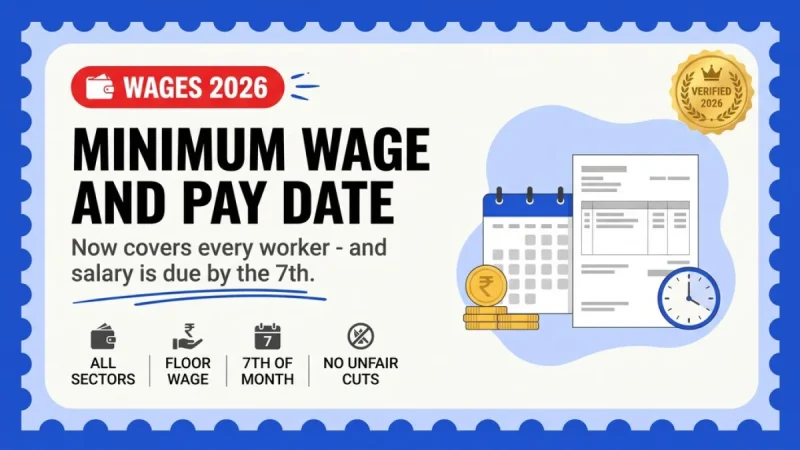
Minimum wages are now a statutory right for every employee in every sector, not just a listed few. Monthly salaries are due by the 7th of the following month. Both rules changed with the Code on Wages, and both are widely unknown.
Quick snapshot
- Coverage: minimum wages now apply to all employees, organised and unorganised.
- Before: only "scheduled employments" were covered — roughly 40% of the workforce.
- Floor wage: set by the Central Government; no state minimum may fall below it.
- Monthly pay: due by the 7th of the next month.
- Weekly pay: due on the last day of the week. Daily wagers: the same day.
- Deductions: unauthorised deductions are prohibited, with no wage ceiling on that protection.
Under the Code on Wages, a minimum wage is a statutory right for every employee regardless of sector or wage level. Previously the protection applied only to employments listed in a schedule, covering around 40% of the workforce; it now extends to the whole of it. Separately, the rules on timely payment apply to all employees: if you are paid monthly, your salary is due by the 7th of the following month. A national floor wage sets the base beneath which no state's minimum wage may fall.
From 40% of workers to all of them
The old Minimum Wages Act protected "scheduled employments" — a list of job categories, maintained separately by central and state governments. If your work was not on the list, the minimum wage simply did not apply to you.
The Code on Wages removes the schedule. Minimum wages become a statutory right for all employees in every sector, organised or unorganised. The stated intent is to take legislative protection from roughly 40% of the workforce to 100%.
Why this matters to someone with a salaried job. You may think minimum wage law is about manual or daily-wage work and has nothing to do with you. The coverage change is what makes the timely payment rules below apply universally too, and those rules are the ones a salaried employee is most likely to need.
The floor wage, and how it relates to your state's minimum
The Central Government determines a floor wage, based on the living standards of an employee — food, clothing and similar essentials — and revises it at intervals. Minimum rates of wages fixed by the appropriate government, whether centre or state, shall not be less than the floor wage.
| Layer | Who sets it | Relationship |
|---|---|---|
| Floor wage | Central Government | The national base, revised at intervals |
| Minimum wage | Centre or state, as applicable | May be higher, but never lower than the floor wage |
| Your actual wage | Your contract | May be higher, but never lower than the applicable minimum |
We do not publish a rupee figure for the floor wage or for any state minimum. Both are revised periodically and vary by state, category and skill level, and a stale number is worse than none when someone is deciding whether they are being underpaid.
The 7th of the month rule
The provisions on timely payment and on unauthorised deductions now apply to all employees, with no wage ceiling restricting who is protected. The payment deadlines depend on how you are paid.
| Pay cycle | Wages due |
|---|---|
| Monthly | By the 7th of the following month |
| Weekly | On the last day of the week |
| Daily | On the same day |
This is the single most practically useful line in the Code for a salaried employee, and almost nobody knows it. A salary that routinely lands on the 12th or the 15th is not simply an annoyance to be tolerated — there is a stated deadline.
If your salary is consistently late
Late salary is common in small firms, in start-ups between funding rounds, and in businesses whose own receivables are slow. It is also the problem employees are most reluctant to raise, because it feels like asking a favour rather than stating a term.
Record the pattern. Dates credited, for several months. One late month is an accident; a pattern is a fact.
Ask in writing, neutrally. A short email asking when salary will be credited creates a record without creating a confrontation.
Check your payslips are being issued and that PF is actually being deposited. Late salary and unpaid PF often travel together, and the second is the more serious of the two.
Keep your own copies of payslips and bank credits. If this ever becomes a formal dispute, those two records are the evidence.
Treat sustained non-payment as information. A company that cannot meet payroll on time is telling you about its finances, and that is worth acting on early.
The PF check matters more than the salary date. A delayed salary is eventually paid. Contributions that were deducted from your pay but never deposited are harder to recover, and you will only notice if you look. Your payslip is the proof the deduction happened.
Unauthorised deductions
The rules against unauthorised deductions now apply regardless of wage level. The important consequence is that deductions from your salary need a basis — they are not a matter of employer discretion.
Statutory and agreed deductions are normal: your 12% provident fund, professional tax where your state levies it, income tax where payable, and anything you have specifically authorised. What does not belong on a payslip is an unexplained reduction, a penalty applied without a stated basis, or a recovery you never agreed to.
If a line appears that you do not recognise, ask what it is and under what authority it was applied. That question is reasonable, and the answer should be straightforward.
What the Code on Wages also brought in
The Code consolidated four earlier laws: the Payment of Wages Act 1936, the Minimum Wages Act 1948, the Payment of Bonus Act 1965 and the Equal Remuneration Act 1976. Three other provisions follow from that consolidation.
First, a uniform definition of wages across all of them: basic pay, dearness allowance and retaining allowance, with excluded allowances exceeding 50% of total remuneration added back. That one definition is now used for provident fund, gratuity and leave benefits alike.
Second, equal remuneration provisions carry through, with prohibition of discrimination in recruitment, wages and conditions of work.
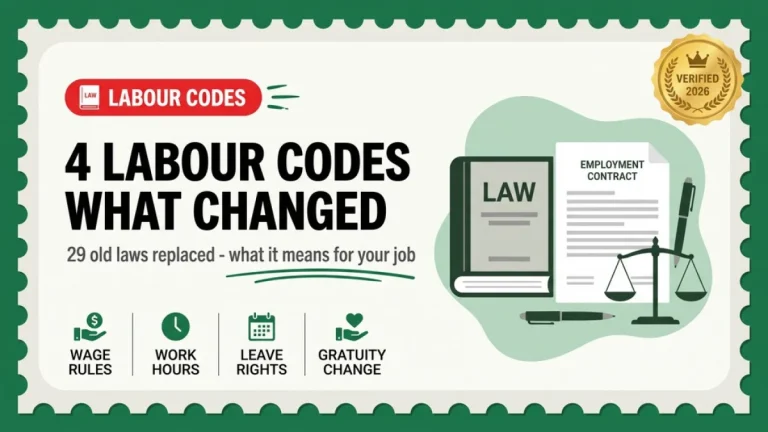
Third, the Code forms part of the four Labour Codes brought into force on 21 November 2025, which together rationalised 29 central labour laws. Advice written before that date may describe a position that no longer applies.
What this does not settle
| Question | Where the answer comes from |
|---|---|
| What my salary should be | The market and your contract. The minimum wage is a floor, not a benchmark. |
| The exact minimum for my state and role | Your state's notified rates, which vary by category and skill and are revised periodically. |
| Whether I can be paid in cash | The applicable rules on mode of payment, not covered here. |
| My appraisal or increment | Employer policy. Nothing in the Code requires a raise. |
| My notice period | Your contract and the applicable standing orders. |
The distinction worth keeping is between a floor and a target. These provisions establish what cannot lawfully happen to you. What you are actually worth is a separate negotiation.
Why freshers are the group this protects most
Minimum wage and payment-timing rules read like they are aimed at manual work, and that framing is why the people who most need them tend to ignore them.
A first job is where the risk actually concentrates. You have no prior employer to compare against, so you do not know what normal looks like. You are reluctant to raise anything in the first months because you want to be seen as easy to work with. You are often the least senior person in a small team, where payroll is handled informally by someone also doing three other jobs. And you may be on a stipend, a training allowance or an internship label that someone has quietly decided means the ordinary rules do not apply.
The coverage change matters precisely here. Because minimum wages and timely-payment rules now reach every employee in every sector rather than a listed subset, the question of whether your particular role was on a schedule no longer arises. If you are an employee, you are covered.
The practical habit is small: know the date your salary is supposed to arrive, keep your payslips, and check once a quarter that provident fund deducted from your pay actually appears. Three minutes of attention, and it is the difference between noticing a problem in month two and discovering it in year two.
When is my monthly salary legally due?
By the 7th of the following month for employees paid monthly. Weekly-paid workers are due on the last day of the week, and daily wagers on the same day.
Does minimum wage law apply to office jobs?
Yes. Under the Code on Wages, minimum wages are a statutory right for all employees in every sector, organised or unorganised. The earlier restriction to listed "scheduled employments" has gone.
What is the floor wage?
A base determined by the Central Government with reference to an employee's living standards, revised at intervals. Minimum wages fixed by the centre or a state cannot be set below it.
What can my employer deduct from my salary?
Statutory and authorised deductions such as provident fund, professional tax where levied, income tax where payable, and anything you specifically agreed to. Rules against unauthorised deductions apply to all employees regardless of wage level.
My salary is always late. What should I do?
Record the credit dates over several months, ask in writing so there is a neutral record, and check that payslips are being issued and provident fund actually deposited. Keep your own copies of payslips and bank credits.
Does the Code say what my salary should be?
No. It sets a floor, not a benchmark. What you are paid above the applicable minimum is a matter of the market and your contract.
Which laws did the Code on Wages replace?
The Payment of Wages Act 1936, the Minimum Wages Act 1948, the Payment of Bonus Act 1965 and the Equal Remuneration Act 1976.
Why do you not publish the minimum wage figure?
Because minimum wages vary by state, category and skill level and are revised periodically. A stale figure is worse than none when someone is working out whether they are underpaid. Check your state's current notified rates.
Sources: Press Information Bureau, Code on Wages, 2019 and the definition of wages · Press Information Bureau, India's labour reforms: simplification, security and sustainable growth · Press Information Bureau, Government makes the four Labour Codes effective.
Related guides on BeInCareer
- The Four Labour Codes: What Changed for Employees
- Working Hours and Overtime Rules India 2026
- Your Appointment Letter Is Now Mandatory
- Salary Slip Explained: Basic, HRA, DA, PF and PT
- UAN and PF Transfer When Changing Jobs
- CTC vs In-Hand Salary 2026
- Gratuity Rules India 2026
- Fixed-Term Employment India 2026
- Probation Period Explained
- Salary Account for Freshers 2026