
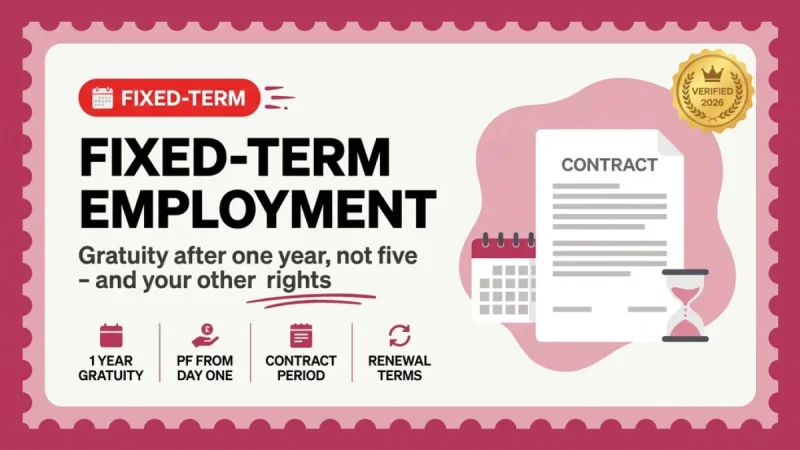
Fixed-term employment is now a recognised category with statutory benefits, not a grey zone. The headline change: a fixed-term employee earns gratuity after one year, where a permanent employee needs five.
Quick snapshot
- Gratuity: payable after one year, on completion of the contract period.
- Permanent comparison: five years of continuous service.
- Rate: 15 days' wages per completed year, same as permanent staff.
- Payment deadline: within 30 days of becoming payable.
- Provident fund: applies from day one, like any employee on the payroll.
- Not the same as: contractor or freelance work, where you are not an employee at all.
A fixed-term employee is a direct employee of the company hired for a defined period, rather than an open-ended one. Under the Code on Social Security, such an employee is entitled to gratuity on termination of the contract period after completing one year of service — a benefit that previously existed only for permanent staff at five years. Everything else that attaches to employment, including provident fund from day one and the statutory caps on working hours, applies in the normal way.
Fixed-term, contract and freelance are three different things
These terms get used interchangeably in job adverts, and the difference decides what you are owed.
| Fixed-term employee | Contract (third-party) worker | Freelance / independent | |
|---|---|---|---|
| Who employs you | The company directly | A staffing contractor | Nobody — you are engaged for a service |
| On whose payroll | The company's | The contractor's | Neither |
| Provident fund | Yes, from day one | Through the contractor | No |
| Gratuity | After 1 year, on contract completion | Via the contractor, on its own terms | No |
| Appointment letter | Yes | From the contractor | A service agreement instead |
If an offer says "contract role", ask one question before anything else: whose payroll are you on. The answer decides which column above you are in, and the three columns are not close to equivalent.
The gratuity change, and why it is genuinely significant
Gratuity normally requires five years of continuous service. The Code on Social Security provides that a fixed-term employee is paid gratuity on termination of the contract period after completing one year of service.
Before this, fixed-term staff accumulated nothing. A two-year contract ended with no gratuity, because two is less than five, and renewal often restarted the relationship on paper. The one-year rule removes that outcome.
| Service | Permanent employee | Fixed-term employee |
|---|---|---|
| 11 months | Nil | Nil |
| 1 year 2 months | Nil | 1 unit of 15 days' wages |
| 2 years | Nil | 2 units |
| 5 years 7 months | 6 units | 6 units |
The unit is fifteen days' wages for each completed year, with a part year over six months counted as a full year. We do not publish a rupee figure because it depends entirely on your own last drawn wages.
What else applies to you as a fixed-term employee
Being fixed-term does not put you outside the normal employment framework. You are an employee, so the standard provisions apply.
Appointment letter — mandatory, with your contract period stated.
Provident fund from day one — 12% of wages from you, with the employer adding 8.33% to pension and 3.67% to PF.
Working hour caps — 8 a day, 48 a week, with overtime requiring consent and paid at twice the rate.
Annual leave — available after 180 days of work in a calendar year.
The wage definition — allowances above 50% of total remuneration are added back into wages.
Watch the renewal structure. A contract that is repeatedly closed and reopened with short gaps is worth asking about, because continuity of service is what the gratuity calculation runs on. Get the contract period and any renewal terms in writing at the start.
Questions to ask before accepting a fixed-term offer
These are reasonable at offer stage and the answers tell you a lot about how the arrangement is actually run.
| Ask | Why it matters |
|---|---|
| Whose payroll am I on? | Decides whether you are a fixed-term employee or a third-party contract worker |
| What is the exact contract period? | Gratuity accrues from one year, so the end date is financially relevant |
| What happens at renewal? | Continuity of service affects what you accumulate |
| Is PF deducted from month one? | It should be — provident fund attaches to employment, not confirmation |
| Is the pay structure the same as permanent staff in the role? | Fixed-term status is about duration, not a separate pay scale |
| What notice applies on each side? | Notice comes from the contract, not from statute |
Why companies use fixed-term hiring, and what that means for you
Fixed-term hiring exists because demand is not always permanent: a project with an end date, a seasonal peak, a client contract of known length. Recognising the category in statute, with benefits attached, is intended to make that honest rather than pushing the same work through informal arrangements with no entitlements at all.
For a candidate, the practical reading is that a fixed-term role is a real job with real statutory benefits, and should be compared on its merits rather than dismissed. The things worth comparing are the pay structure, the contract length, what happens at the end, and whether the work builds something you can show a future employer.
What it is not is a reason to accept worse terms on the same work. Fixed-term status concerns the duration of employment, not a reduced category of employee.
At the end of the contract
If you completed a year or more, gratuity is payable on completion of the contract period.
The employer must pay within 30 days of it becoming payable.
Ask for your relieving and experience letter before the last day, with exact service dates.
Note your UAN so the provident fund balance can be transferred to the next employer rather than left stranded.
Keep the appointment letter, payslips and final settlement. They are the only proof of service period and wages.
How to judge a fixed-term offer against a permanent one
The instinct is to treat permanent as automatically better and fixed-term as a compromise. That is sometimes right and often lazy, and it leads people to turn down good work or accept bad work for the wrong reason.
A permanent contract is not a guarantee of tenure. It is an open-ended arrangement that either side can end under its notice terms, and in practice people leave or are let go from permanent roles constantly. What a permanent contract does give you is a path to five-year gratuity and, usually, a more settled position in how the organisation plans.
A fixed-term contract gives you a known end date. That is a real cost, because you will be job-hunting again on a schedule you did not choose. But it now carries statutory gratuity from one year, provident fund from day one, the same hour and leave protections, and an appointment letter that documents the work. The gap between the two categories is narrower than it was before the Codes recognised fixed-term employment.
The questions that actually decide it are about the work rather than the label. Does the role build a skill or a portfolio you can show someone else? Is the pay structure the same as a permanent person doing that job, or quietly worse? Is there a realistic pattern of fixed-term staff converting, and can anyone name examples? What is the market like for that skill when the contract ends?
A well-paid fixed-term role on interesting work, with a clear end date you can plan around, is frequently a better eighteen months than an underpaid permanent role doing something that teaches you nothing. The reverse is also true. The label alone does not settle it.
One thing that should settle it. If the offer is described as "contract" and nobody will tell you whose payroll you are on, treat that as the answer. The three categories carry very different entitlements, and vagueness on that specific point is rarely accidental.
Do fixed-term employees get gratuity in India?
Yes. Under the Code on Social Security, a fixed-term employee is entitled to gratuity on termination of the contract period after completing one year of service, instead of the five years required of permanent employees.
How much gratuity does a fixed-term employee get?
Fifteen days' wages for each completed year of service, based on wages last drawn, the same rate as permanent employees. A part of a year in excess of six months counts as a completed year.
Is fixed-term the same as a contract job?
No. A fixed-term employee is on the company's own payroll for a defined period. A third-party contract worker is employed by a staffing contractor. The difference decides who owes you provident fund, gratuity and an appointment letter.
Do I get provident fund as a fixed-term employee?
Yes, from day one. Provident fund attaches to employment rather than to confirmation, so it applies through any training or probation period too.
Can I be paid less than permanent staff doing the same work?
Fixed-term status concerns the duration of employment, not a separate category of employee. The Codes also prohibit discrimination and require equal pay for equal work.
What happens if my contract is renewed?
Get the renewal terms in writing. Continuity of service is what the gratuity calculation runs on, so repeated closing and reopening of a contract is worth clarifying at the start.
When must the gratuity be paid?
Within 30 days from the date it becomes payable.
Does a fixed-term role count as real experience?
Yes. You are a direct employee with an appointment letter and a documented service period. Ask for a relieving and experience letter with exact dates before your last day.
Sources: Press Information Bureau, Code on Social Security, 2020 · Press Information Bureau, Government makes the four Labour Codes effective · Press Information Bureau, Code on Wages, 2019 and the definition of wages.
Related guides on BeInCareer
- Gratuity Rules India 2026
- The Four Labour Codes: What Changed for Employees
- Your Appointment Letter Is Now Mandatory
- Working Hours and Overtime Rules India 2026
- Probation Period Explained
- EPFO PF Claim Guide 2026
- EPF Withdrawal Rules India 2026
- CTC vs In-Hand Salary 2026
- Offer Letter Checklist Before Joining
- How to Get a Remote Job in India 2026