
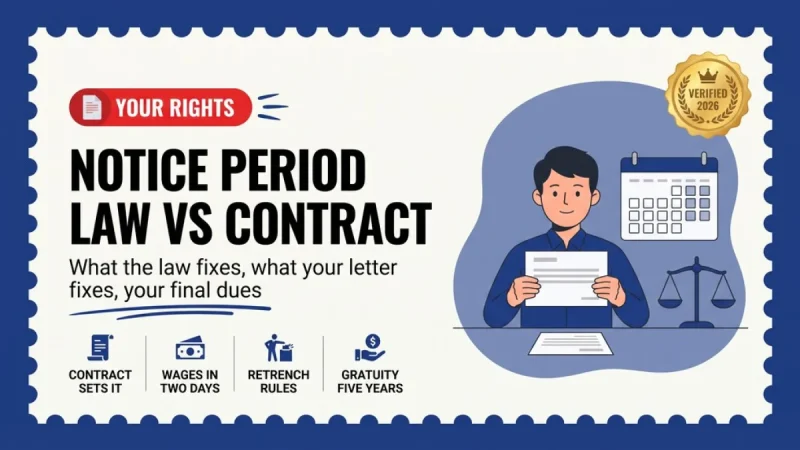
Most of what people believe about notice periods is contract, not law. The Labour Codes do not set how long an employee must serve after resigning — your appointment letter does. What the law does fix is how fast you must be paid when you leave, and what protection applies if the employer lets you go. This guide separates the two, using the Labour Ministry's own compliance handbook.
Quick snapshot
- No Labour Code sets a fixed resignation notice period for private employees. It comes from your appointment letter or the employer's standing orders.
- When you leave — by resignation, dismissal or termination — all due wages must be paid within two working days (Code on Wages, section 17).
- Before retrenching a worker, an employer must give one month's prior notice.
- Retrenchment compensation is 15 days' average pay for each completed year of continuous service.
- Gratuity on resignation needs five years of continuous service, and must be paid within 30 days of becoming payable.
- A fixed-term employee gets gratuity after one year of service on completing the contract.
- Every new recruit must be given an appointment letter — the document that should state your notice period.
In India, the notice period you must serve when you resign is set by your appointment letter or the employer's standing orders, not by a Labour Code. What the law does fix: when you leave for any reason, the employer must pay all wages due within two working days under section 17 of the Code on Wages. If the employer retrenches a worker, it must give one month's prior notice and pay retrenchment compensation of 15 days' average pay for every completed year of continuous service. Gratuity follows separately, after five years of service, within 30 days.
Law versus contract: the split that settles most arguments
Notice-period disputes usually start with one side quoting a rule that is not actually in the law. The quickest way to stay out of that trap is to know which document governs which question.
| Question | Where the answer comes from |
|---|---|
| How many days must I serve after resigning? | Your appointment letter, or the employer's standing orders where they apply |
| Can I pay instead of serving the notice (buyout)? | Your appointment letter and the employer's policy |
| Can the employer relieve me early? | Your appointment letter and the employer's policy |
| How fast must my final wages be paid? | Law — within two working days of leaving (Code on Wages, section 17) |
| How much notice must the employer give before retrenching a worker? | Law — one month's prior notice (Industrial Relations Code) |
| What compensation is due on retrenchment? | Law — 15 days' average pay per completed year of continuous service |
| When is gratuity due and how fast? | Law — after five years (one year for fixed-term), paid within 30 days (Code on Social Security) |
Read the table as a rule of thumb: anything about how long you must stay is contractual; anything about money owed when you go, or protection when the employer ends the job, is where the law steps in.
Why your appointment letter is the document that matters
Under the Occupational Safety, Health and Working Conditions Code, every employer must issue an appointment letter to every new recruit. The Labour Ministry's compliance handbook lists it as an event-based duty: issue an appointment letter to every new recruit.
That letter — or the service rules it refers to — is where your notice period should be written. Before you sign, check that it states:
- the notice period during probation and after confirmation, which are often different;
- whether notice can be bought out, and how the amount is worked out;
- whether unused leave can be set off against the notice period;
- what the employer must give you on exit — relieving letter, experience letter, full and final statement.
If the letter is silent on a point, ask for it in writing before joining. A clause you never saw is the hardest kind to argue about later.
"The law says 90 days" is not true for private jobs. No Labour Code fixes a 30, 60 or 90-day resignation notice period for a private employee. Long notice periods are common in IT services because they are written into appointment letters. If someone tells you a period is "statutory", ask which section — and check your own letter.
Standing orders: when the employer's own rules bind it
Under the Industrial Relations Code, the provisions on standing orders apply to industrial establishments employing 300 or more workers. The Central Government notifies Model Standing Orders, which an employer can adopt; otherwise it must prepare its own draft standing orders based on the model.
Standing orders are the establishment's certified rules on conditions of service. Where they apply, read them alongside your appointment letter as a source of your notice terms. In a smaller establishment, the appointment letter and the employer's written policies carry that weight on their own.
Your final dues: the two-working-day rule
This is the strongest protection an employee has on exit, and it applies whatever the reason for leaving. Section 17 of the Code on Wages requires that when an employee leaves an establishment — whether by resignation, dismissal or termination — the employer pays all due wages within two working days.
That rule is about wages that are due. It sits alongside the ordinary wage deadlines in the same section: wages paid monthly must be paid before the end of the seventh day of the following month.
Step 1 — Get your last working day in writing. The two-working-day clock runs from the day you leave, so the date has to be agreed and recorded.
Step 2 — Ask for the full and final statement. It should list salary for days worked, any leave encashment your policy provides, and every deduction made.
Step 3 — Check deductions against the contract. A notice-shortfall recovery is lawful only if your appointment letter provides for it. Ask for the clause.
Step 4 — Handle PF separately. Provident fund is transferred or withdrawn through your UAN; it is not part of the two-day wage payment.
Step 5 — Track gratuity separately. If you have five years of continuous service, gratuity is due within 30 days of becoming payable.
If the employer ends the job: retrenchment rules
When it is the employer that ends the job and lets a worker go — retrenchment — the Industrial Relations Code sets real obligations, as the Labour Ministry's handbook summarises them.
| Obligation | What the handbook states |
|---|---|
| Notice to the worker | One month's prior notice before retrenchment |
| Retrenchment compensation | 15 days' average pay for each completed year of continuous service |
| Re-skilling Fund | The employer contributes an amount equal to 15 days' wages for each retrenched employee to the Workers' Re-Skilling Fund |
| Larger establishments | Factories, mines and plantations with 300 or more workers need government permission before lay-off, retrenchment or closure |
Are you a "worker" under this Code?
These retrenchment protections attach to a "worker". The Code defines a worker as a person employed to do manual, unskilled, skilled, technical, operational, clerical or supervisory work for hire or reward. It excludes anyone employed mainly in a managerial or administrative capacity, and anyone in a supervisory capacity drawing wages above eighteen thousand rupees a month, or such amount as the Central Government notifies.
So a fresher doing technical or clerical work is generally inside the definition. A manager, or a supervisor above the wage limit, generally is not — and then the appointment letter becomes the main protection. Which side of the line a particular job falls on depends on what the person actually does, not on the job title.
Gratuity when you resign
Gratuity is often confused with notice-period money, but it is a separate entitlement under the Code on Social Security. It must be paid on termination of employment after at least five years of continuous service, and resignation is one of the listed events. A fixed-term employee is entitled to gratuity on completing the contract after one year of service.
It is calculated at 15 days' wages for each completed year of service, up to the maximum limit notified by the Central Government, and must be paid within 30 days of becoming payable. Leaving a few weeks before completing five years therefore has a real cost — check your joining date before you fix your last day.
Before you resign
Re-read the notice clause, note whether it differs for probation, check whether buyout or leave set-off is allowed, and work out where you stand on the five-year gratuity line.
On your last day
Get the relieving date in writing, ask for the full and final statement, confirm when wages will be paid, and note the contact for PF and gratuity follow-up.
Do not simply stop turning up. Leaving without serving or settling the notice your contract requires can lead to a recovery claim and to the employer declining to issue a relieving or experience letter, which later employers often ask for. If the notice period blocks a new offer, negotiate an early release or a buyout in writing instead.
Is there a legal notice period for resigning from a private job in India?
No Labour Code fixes a resignation notice period for private employees. The period you must serve comes from your appointment letter, or from the employer's standing orders where those apply.
How soon must my final salary be paid after I resign?
Within two working days. Section 17 of the Code on Wages requires all due wages to be paid within two working days when an employee leaves by resignation, dismissal or termination.
Can I pay to skip my notice period?
Only if your appointment letter or the employer's policy allows a buyout. It is a contractual arrangement, not a statutory right, so check the clause and agree the amount in writing.
How much notice must an employer give before laying someone off?
Before retrenching a worker, the employer must give one month's prior notice. It must also pay retrenchment compensation of 15 days' average pay for each completed year of continuous service.
Do retrenchment rules apply to IT employees?
They apply to a "worker" under the Industrial Relations Code, which includes technical, clerical and skilled work. It excludes people employed mainly in a managerial or administrative capacity, and supervisors drawing above eighteen thousand rupees a month or the notified amount. What you actually do decides it, not the title.
Will I get gratuity if I resign before five years?
Generally no. Gratuity on resignation requires at least five years of continuous service. The exception is a fixed-term employee, who is entitled to gratuity on completing the contract after one year of service.
How fast must gratuity be paid?
Within 30 days from the date it becomes payable, at 15 days' wages for each completed year of service, up to the maximum limit notified by the Central Government.
Where is my notice period written?
In your appointment letter or the service rules it refers to. Every employer must issue an appointment letter to every new recruit, so ask for one if you have not received it.
Sources: Ministry of Labour and Employment — Compliance Handbook for Employers Under the Four Labour Codes (Code on Wages section 17; Industrial Relations Code standing orders, retrenchment and the definition of worker; Code on Social Security gratuity, sections 53 and 56; appointment-letter duty); PIB — Code on Wages, 2019.
Related guides on BeInCareer
- Probation Period Rules: Salary, Leave and Resignation
- Appointment Letter Rights in India
- Offer Letter Checklist Before Joining
- Gratuity Rules in India
- Fixed-Term Employment in India
- Labour Codes: What Changed
- UAN and PF Transfer When Changing Jobs
- Salary Slip Components Explained
- Minimum Wages and Timely Payment
- Fake Job Offer Warning Signs