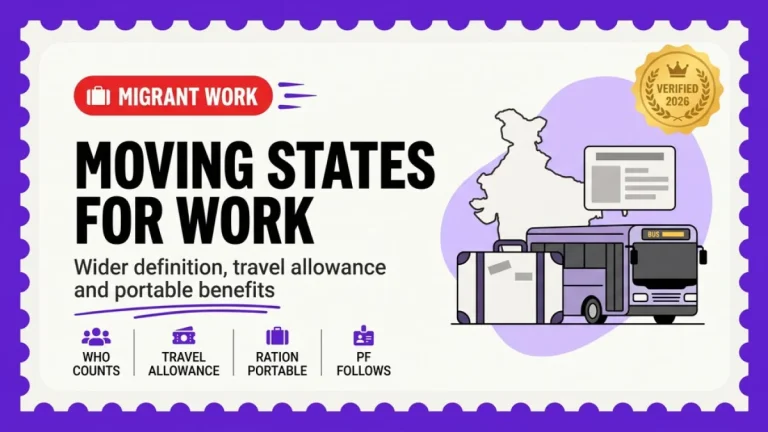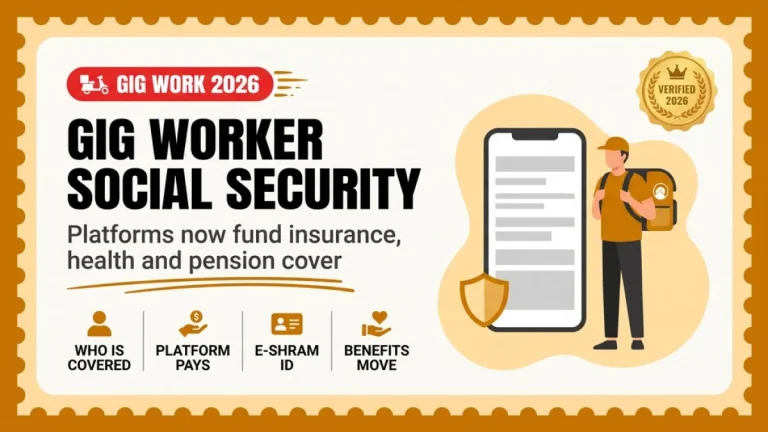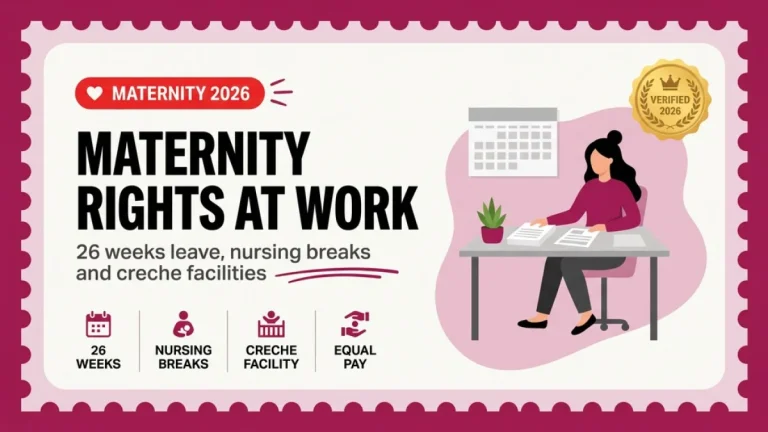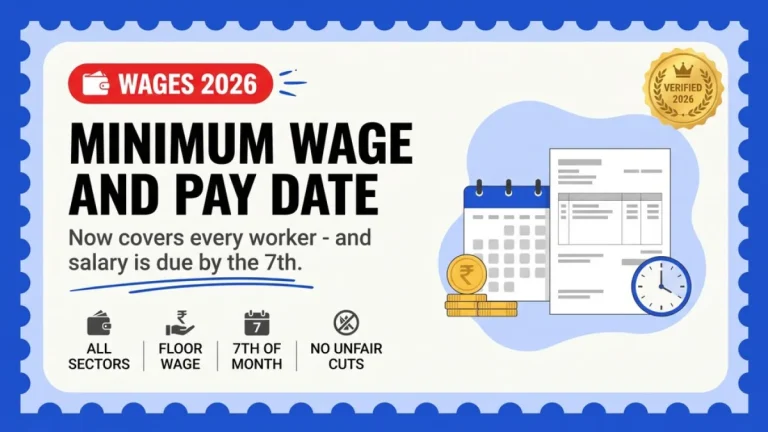

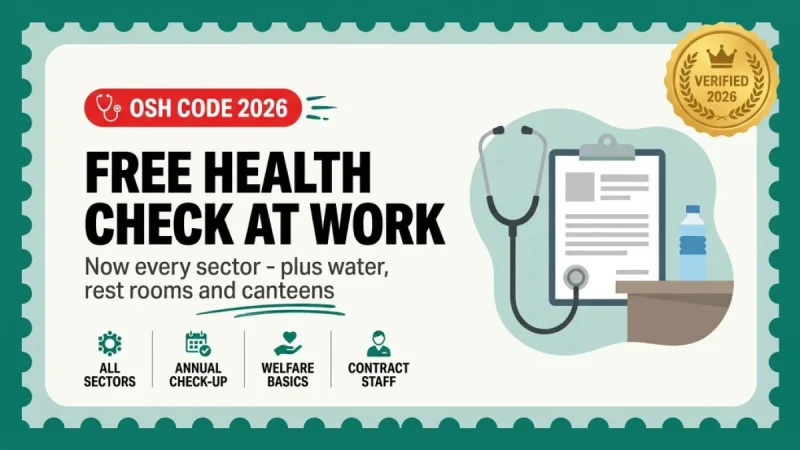
Safety and welfare rules used to cover seven sectors. The OSH Code extends them to workers in all sectors, and adds a free annual health check-up. Most employees have no idea either change happened.
Quick snapshot
- Coverage: health, safety and welfare now extend to workers in all sectors.
- Previously: limited to seven — factories, mines, plantations, beedi-cigar, dock workers, BOCW and motor transport.
- Health check-up: free annual check-up for employees above the specified age.
- Welfare facilities: cleanliness, drinking water, toilets and rest rooms, prescribed uniformly.
- Canteens: in establishments employing 100 or more workers.
- Rest rooms etc. in factories and mines: where 50 or more workers are employed.
The Occupational Safety, Health and Working Conditions Code extends health, safety and welfare obligations to workers in all sectors, where previously they reached only seven. Every employee becomes eligible for a free annual health check-up, with employers required to provide it free of cost for employees above a specified age. The Government prescribes uniform provisions for cleanliness, drinking water, toilets and rest rooms in factories and mines employing 50 or more workers, and canteens in establishments employing 100 or more, including for contract labour.
From seven sectors to all of them
The old framework was sectoral. Safety and welfare law applied if your workplace fell into one of seven categories, and simply did not if it fell outside.
| Previously covered | Now |
|---|---|
| Factories | Workers in all sectors |
| Mines | |
| Plantations | |
| Beedi and cigar | |
| Dock workers | |
| Building and other construction work | |
| Motor transport |
If you work in an office, a support centre, a retail store, a warehouse or a logistics hub, the previous framework largely passed you by. That is the gap the Code closes.
Why nobody told you. Safety law has a reputation as something for heavy industry, which is exactly what the seven-sector structure encouraged. Most people in an office have never thought of workplace welfare as a statutory matter at all, which is why these provisions go unclaimed rather than denied.
The free annual health check-up
Every employee is eligible for a free annual health check-up under the Code, with employers required to provide it free of cost for employees above the specified age.
This is the provision with the widest reach and the lowest awareness. It costs the employee nothing, it is annual, and it applies across sectors rather than only in hazardous work.
Ask HR whether the annual check-up is arranged, and if so when and how to book it.
Ask what it covers. A check-up that exists on paper and is never scheduled is a common pattern worth surfacing politely.
Keep your own copy of the results. Health records are yours, and they are more useful as a series over years than as a single snapshot.
Do not confuse it with insurance. A group medical policy pays for treatment; a check-up is screening. They are different things and you may have one without the other.
Welfare facilities, and the thresholds that trigger them
The Government prescribes uniform provisions for basic welfare, and two numbers decide what applies where.
| Facility | Where | Threshold |
|---|---|---|
| Cleanliness, drinking water, toilets, rest rooms | Factories and mines | 50 or more workers |
| Canteen | Establishments | 100 or more workers |
| Welfare responsibility generally | All, including contract labour | Cast on the principal employer |
The last row is the one that changes behaviour. Responsibility for welfare facilities is cast on the principal employer, and extends to contract labour. The old pattern, where a site used contract staff and treated their conditions as the contractor's problem, is what that provision is aimed at.
If you are on a contractor's payroll
A large number of first jobs in support centres, facilities, warehousing and manufacturing are through a staffing contractor rather than directly with the company whose name is on the building. That arrangement used to create a gap in exactly these protections.
Welfare facilities under the Code are the principal employer's responsibility, including for contract labour. So the question of whose payroll you are on, while it decides a great deal about provident fund, gratuity and your appointment letter, does not decide whether drinking water, toilets and rest facilities are provided at the place you actually work.
Still ask whose payroll you are on. It remains the single most important question about any "contract role", because it determines whether you are a fixed-term employee of the company with gratuity accruing from one year, or an employee of a staffing contractor on its terms. Welfare at the site is one protection; it is not the whole picture.
How this fits with the rest of the Codes
The OSH Code is one of four. It took effect alongside the others on 21 November 2025, when 29 earlier central labour laws were rationalised into the four Codes.
The same Code carries the working-hour provisions: normal hours capped at 8 a day and 48 a week, overtime requiring consent and paid at twice the normal rate, and annual leave with wages after 180 days of work in a calendar year. It also governs night work, where women may work before 6 a.m. and beyond 7 p.m. with their consent and with employer-provided safety and transport.
Reading them together is more useful than reading any one alone. Hours, leave, safety and welfare are a single framework governing what the working day actually looks like, while wages, provident fund and gratuity sit in the other two Codes and govern what you are paid for it.
What to check at a new workplace
| Check | Why |
|---|---|
| Is an annual health check-up arranged? | It is a statutory eligibility, not a perk, and is commonly unclaimed |
| Drinking water and toilets at your actual site | Prescribed uniformly; the principal employer is responsible |
| Rest facilities on long or night shifts | Particularly relevant where shifts run through the night |
| Transport arrangements for night shifts | A condition attached to asking someone to work those hours |
| Whose payroll you are on | Decides PF, gratuity and your appointment letter |
| How hours are recorded | Without a record, overtime cannot be evidenced |
None of these require confrontation. They are ordinary questions, and the ease with which an employer answers them tells you a good deal about how the workplace is run.
Why unclaimed entitlements stay unclaimed
There is a pattern across everything in this series, and it is worth naming because it explains why provisions like the annual health check-up go unused for years.
Statutory entitlements are not usually refused. They are simply never asked for. An employer with no process for something is not being obstructive; nobody has ever raised it, so no process exists. The first person to ask is doing the organisation a small favour, even if it does not feel that way at the time.
The reluctance is understandable. Asking feels like making a demand, particularly early in a career when you are still establishing that you are easy to work with. But there is a difference between negotiating for something extra and asking how an existing entitlement is administered. The second is an administrative question, and framing it that way removes most of the awkwardness: not "I want a health check-up" but "how do people here book the annual check-up?"
The same framing works across the set. How is maternity leave handled here. How are overtime hours recorded. When is salary credited. What transport is arranged for night shifts. Each one is a process question with a factual answer, and the answers are useful whether or not you need the entitlement today.
There is also a collective effect worth noting. Once one person asks how the annual check-up is booked, a process tends to appear, and it then exists for everyone who joins afterwards. Entitlements that nobody exercises quietly lapse into theory; the ones people routinely use become part of how a workplace runs.
Ask when it is boring. Every question in this guide is easy to raise in a quiet month and hard to raise in the week you actually need the answer. The best time to find out how something works is before it matters.
Am I entitled to a free health check-up at work?
Every employee is eligible for a free annual health check-up under the OSH Code, with employers required to provide it free of cost for employees above the specified age.
Which sectors does the OSH Code cover?
Workers in all sectors. Previously health, safety and welfare law was limited to seven: factories, mines, plantations, beedi-cigar, dock workers, building and other construction work, and motor transport.
What welfare facilities must be provided?
The Government prescribes uniform provisions for cleanliness, drinking water, toilets and rest rooms in factories and mines employing 50 or more workers, and canteens in establishments employing 100 or more workers, including for contract labour.
Do these protections apply if I am on a contractor's payroll?
Responsibility for welfare facilities is cast on the principal employer and covers contract labour. Whose payroll you are on still decides provident fund, gratuity and your appointment letter, so it remains worth asking.
Is a health check-up the same as medical insurance?
No. A group medical policy pays for treatment; an annual check-up is screening. You may have one without the other.
When did the OSH Code take effect?
21 November 2025, alongside the other three Labour Codes, when 29 earlier central labour laws were rationalised into four.
Does the OSH Code also cover working hours?
Yes. Normal hours are capped at 8 a day and 48 a week, overtime requires consent and is paid at twice the normal rate, and annual leave with wages is available after 180 days of work in a calendar year.
What about night shifts?
Women may work before 6 a.m. and beyond 7 p.m. with their consent, and the employer must make adequate arrangements for safety, facilities and transport.
Sources: Press Information Bureau, Occupational Safety, Health and Working Conditions (OSH) Code, 2020 · Press Information Bureau, Government makes the four Labour Codes effective · Press Information Bureau, new Labour Codes: women, safety and workplace flexibility.
Related guides on BeInCareer
- The Four Labour Codes: What Changed for Employees
- Working Hours and Overtime Rules India 2026
- Maternity Benefit Rules India 2026
- Fixed-Term Employment India 2026
- Minimum Wages and the Right to Be Paid on Time
- Your Appointment Letter Is Now Mandatory
- UAN and PF Transfer When Changing Jobs
- Gratuity Rules India 2026
- Is Employer Health Insurance Enough?
- Probation Period Explained