
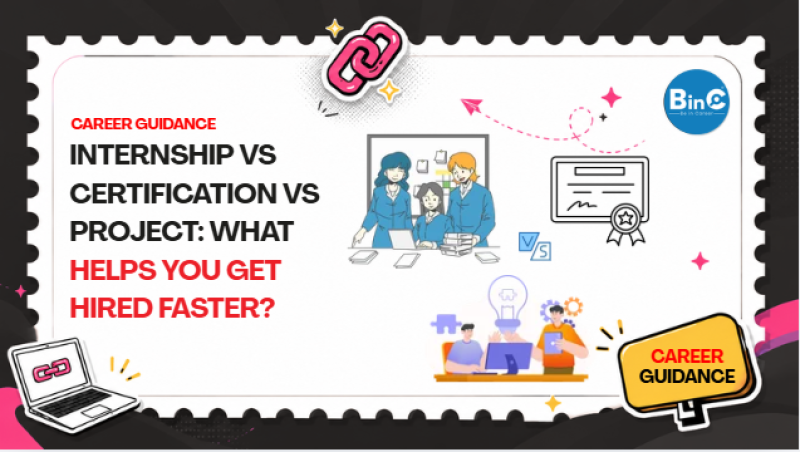
Three ways to fill an empty fresher resume — but recruiters don't value them equally. Here's what each one proves, how long it takes, and the order that works best.
An internship helps you get hired fastest because it is proof that a real company trusted you with real work. A project is the next strongest because it shows what you can build on your own. A certification is the quickest to earn but carries the least weight alone — it works best as a supporting signal that gets your resume past filters. The winning approach is to stack them: certification → project → internship.
🤔 Why This Question Matters for Freshers
Every fresher faces the same catch-22: companies want experience, but you need a job to get experience. Internships, certifications and projects are the three ways to break that loop. The problem is that most students pick one at random — usually the easiest — and then wonder why the calls don't come.
Recruiters scanning a fresher resume are asking one question: "Can this person do the work from day one?" Each of the three options answers that question with a different level of proof. Understanding that difference is how you spend your limited time well.
⚖️ Internship vs Certification vs Project — Side-by-Side
| Factor | Internship | Certification | Project |
|---|---|---|---|
| What it proves | You worked in a real team on real tasks | You know the concepts of a skill | You can apply a skill to build something |
| Time needed | 1–6 months | 15 minutes to a few weeks | 1–6 weeks per project |
| Cost | Usually free; some are paid (stipend) | Free to paid | Free |
| Recruiter weight | ★★★★★ Highest | ★★☆☆☆ Supporting | ★★★★☆ High |
| Easy to verify? | Yes — company & certificate | Yes, if it has a verification link | Yes — GitHub / live link / demo |
| Best for | Getting shortlisted for interviews | Passing ATS keyword filters | Talking confidently in interviews |
🏢 Internship — The Strongest Signal
An internship is the closest thing to work experience a student can have. It shows you can follow instructions, meet deadlines, work with a team and handle real tools. Many companies also convert good interns into full-time hires, which makes it the most direct route to a job.
🏅 Certification — The Fastest Booster
Certifications are the quickest way to add a skill keyword to your resume. They help most when an applicant tracking system (ATS) is scanning for words like Excel, Python, Tally or Digital Marketing. On their own, though, they only prove you understand a topic — not that you can use it.
The value of a certificate depends on two things: who issued it and whether an employer can verify it. A certificate with a unique ID and a public verification link is worth more than a PDF anyone could edit.
🛠️ Project — The Best Interview Weapon
A good project is proof you can take a skill from a course and turn it into something that works. It also gives you a story to tell in interviews: what problem you picked, what you built, what went wrong and how you fixed it. Interviewers remember stories far better than lists of skills.
| Your field | Project ideas that impress |
|---|---|
| CSE / IT / BCA | A job-tracker web app, a college-notice chatbot, a data dashboard on public datasets |
| Data / Analytics | Analyse AP or Telangana public data (rainfall, admissions) and publish insights in Power BI or Excel |
| Commerce / Accounts | Prepare GST-ready books for a mock business in Tally and document every step |
| Marketing | Grow an Instagram page for a local shop for 30 days and report the numbers |
| Mechanical / Civil / ECE | A small working model or simulation with a write-up and photos or video |
Put the code on GitHub or the work in a short Google Drive portfolio, and link it on your resume. A project nobody can open doesn't count.
🧭 Which One Should You Choose? Match Your Situation
| Your situation | Do this first | Why |
|---|---|---|
| Final year, no experience at all | Certification → 1 project | Fills the resume fast so you can apply for internships |
| Have time (2nd/3rd year) | Internship | The strongest proof — start early and the rest follows |
| Graduated, applying now | Project + targeted certification | Shows job-ready skill while you apply |
| Switching field (e.g. BCom → Data) | Certification → 2 projects | Proves the new skill with work, not just a course |
| Many applications, no calls | Fix resume + add a project link | Usually an ATS or proof problem, not a talent problem |
📅 The 90-Day Stacking Plan
By day 90, your resume shows a skill (certificate), proof you can use it (project) and, ideally, real-world experience (internship). That combination is what gets freshers shortlisted.
- Internships carry the most recruiter weight because they prove real workplace experience.
- Projects are the next strongest — they show applied skill and give you stories for interviews.
- Certifications are fastest to earn and help pass ATS filters, but are weakest alone.
- Best approach: stack them — certification, then project, then internship.
- Never pay a fee to get an internship or job.