
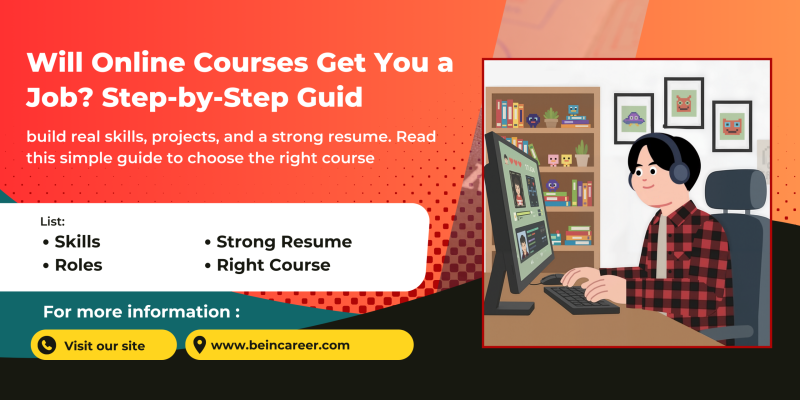
Online Course Chesthe Job Dorukutunda? (Will an Online Course Help You Get a Job?)
Updated: Jan 27, 2026 • Reading Time: ~10–12 mins • By BeInCareer
Why This Question Is So Common
Today, everyone is talking about online courses. You see ads everywhere—“learn in 30 days”, “get a certificate”, “high salary”, “work from home”. So it’s natural to ask: “If I complete an online course, will I surely get a job?”
Here is the honest answer in simple words: Online courses can open doors, but they don’t carry you inside. A certificate is not a job ticket. Your skills, your practice, your projects, and your job search approach decide the outcome.
- Course = roadmap
- Practice = real driving
- Projects = proof you can drive
- Interview = test drive
- Job = destination
Fact Box: Online Course + Job Reality
| Point | Reality (Simple) |
|---|---|
| Certificate alone | Not enough for most jobs. |
| Skills + Projects | Strong advantage in interviews. |
| Duration of course | Less important than what you can build/show. |
| Job guarantee ads | Often marketing—verify carefully. |
| Best result | Learn + practice daily + create portfolio + apply smartly. |
How Companies Actually Hire (Very Important)
Many people think hiring works like this: Course → Certificate → Job. But companies don’t hire that way.
In real hiring, recruiters ask one main question: “Can this person do the work?”
- Do you understand basics clearly?
- Did you build any practical projects?
- Can you explain your work in simple words?
- Do you have problem-solving ability?
- Can you learn and adapt fast?
So where does an online course fit in?
An online course is helpful because it gives you: structured learning, practice tasks, and a path. But the course can’t do the learning for you. That part is yours.
Why Some People Don’t Get Jobs After Online Courses
If you see people saying “I completed 2–3 courses but still no job”, it usually comes down to these reasons:
Freshers: Can Online Courses Help You Get Your First Job?
Yes, especially for freshers, online courses are useful because college education often gives theory, but jobs need practical skills. If you’re a fresher, your goal should be: Pick one skill → learn it properly → build small projects → show portfolio → apply.
Experienced People: Online Courses for Growth or Career Change
For working professionals, online courses are powerful for: upskilling, switching domains, promotions, and salary growth. But again, companies will ask: What did you build? What did you improve? What results did you achieve?
Which Online Courses Have Better Job Value?
The best online course is the one that matches: your interest + your background + market demand. Here are some skill areas that usually have good hiring demand:
| Category | Skills / Roles | Proof You Should Build |
|---|---|---|
| Tech | Python, Java, Web Dev, Testing, Cloud basics | Mini apps, GitHub projects, case studies |
| Data | Excel, Power BI, SQL, Data Analytics | Dashboards, analysis reports, datasets |
| Digital | Digital Marketing, SEO, Social Media, Ads | Campaign plan, audit report, sample creatives |
| Design | Graphic Design, UI/UX, Video Editing | Portfolio link, 5–10 quality works |
| HR / BPO | Recruitment basics, sourcing, communication | Sample hiring plan, calling scripts, process notes |
How to Choose the Right Online Course (Avoid Regrets)
Before you pay for any course, ask these simple questions:
- Does the course teach practical work or only theory?
- Are there assignments and projects?
- Can you build a portfolio by the end?
- Are the reviews real? (Check multiple sources)
- Do they promise “100% job guarantee”? (Be careful)
- “No need to learn skills, just certificate is enough”
- “Job in 7 days / 30 days guaranteed”
- They hide trainer profile or syllabus details
- No refund policy + too many fake testimonials
What You MUST Do After Finishing the Course
This part is where most people fail. Completing a course is not the finish line. It’s the starting line. Do these steps to actually convert learning into job results:
- Practice daily (even 60 minutes) — consistency beats intensity.
- Build 2–4 projects — small projects are okay, but they must be real.
- Create a portfolio — Google Drive / Behance / GitHub / LinkedIn featured section.
- Update resume — mention projects, tools, outcomes (not just “completed course”).
- Prepare interview answers — explain your project like a story.
- Apply smartly — targeted roles, customized resume, follow-ups.
Salary Reality (Simple Expectations)
Salary depends on role, city, company, and most importantly your skill level. Online course alone doesn’t set your salary. Your capability does.
| Level | Typical Range (Varies) | How to Increase |
|---|---|---|
| Beginner / Fresher | Entry-level package (depends on role and location) | Better projects + communication + consistency |
| 1–3 years | Improved growth with proof of work | Specialize + showcase measurable outcomes |
| Strong skilled profile | Higher range possible | Portfolio + interviews + networking |
Freelancing: Another Big Advantage of Online Courses
Online learning can also help you earn through freelancing and part-time projects. If you build skills in marketing, design, data, or tech, you can take client work. But freelancing also needs discipline: delivering on time, communicating properly, and building trust.
Final Answer (No Drama, Only Truth)
Yes, doing an online course can help you get a job. But the job comes when you do these 4 things:
- Learn properly (not just finish videos)
- Practice daily
- Build projects (proof of work)
- Apply smartly (resume + interview + consistency)
Simple Timeline Plan (4 Weeks)
Safety: Don’t Get Trapped by Fake “Job Guarantee” Promises
Be careful with training institutes or online platforms that promise quick jobs without skills. Always verify:
- Trainer profile and real experience
- Course syllabus and project support
- Refund policy and terms
- Student reviews (not only on their website)
- Placement claims (ask for proof, alumni profiles)
FAQ: Online Course & Job (Easy Answers)
1) Will companies accept online course certificates?
2) Which is better: online course or offline institute?
3) How many courses should I do to get a job?
4) I finished the course but I’m still not confident. What to do?
5) Can online course help for work-from-home jobs?
About BeInCareer
BeInCareer is a trusted career and recruitment platform that connects job seekers and employers across key locations. We share job updates, career guidance, and practical resources to help you move forward with clarity.
Interlinking Articles
Popular Posts
| Join on WhatsApp | Follow on Instagram |