
INTERVIEW GUIDE · 30 OCT 2026
“Tell Me About Yourself”: the 60-Second Self-Introduction That Works for Freshers
Every interview, every walk-in, every HR round starts with the same five words — and most freshers answer with their tenth-class marks and their father’s occupation. The first sixty seconds set the interviewer’s opinion before a single technical question. This page gives the structure, the content rules and the rehearsal method.
ADVERTISEMENT
❗The problem this page is trying to fix
“Tell me about yourself” is not a biography request. It is the interviewer asking: give me a reason to be interested in you, in one minute, in your own words. Most freshers fail it in three standard ways: they recite the resume the interviewer is already holding, they narrate family history nobody asked for, or they memorise a paragraph from the internet and deliver it like a recorded message.
The failure is structural, not linguistic. Students with average English who follow a clean structure outperform fluent speakers who ramble. And because the question is guaranteed in every interview, it is the single highest-return minute a fresher can rehearse.
Below: the 60-second structure, what each block must contain, the cut list, and a rehearsal method that removes the recorded-message effect.
🔍The question, decoded honestly
What the interviewer wants
Three things: can you communicate, do you know what is relevant about yourself, and do you connect yourself to this role. Marks and family details answer none of these.
The 60-second rule
Aim for 45–75 seconds. Shorter reads as unprepared; longer loses the room. One minute, structured, is the professional length — interviewers will ask follow-ups for anything they want more of.
Resume vs introduction
The resume lists facts; the introduction selects and connects them. Never recite what they can read — add the why behind two or three chosen facts instead.
The language question
Clean simple English beats decorated English. Short sentences, concrete nouns, no memorised vocabulary. If a word does not come, a simpler word is always waiting.
The memorisation trap
Memorise the structure and the first sentence only. Word-for-word scripts collapse under one interruption and sound recorded. Bullet-rehearsal, explained below, fixes this.
Who this page is for
Freshers facing campus drives, walk-ins and HR rounds — any stream, any degree, including students whose spoken English is still a work in progress.
📋The structure, block by block
Three columns: the four blocks of the minute, the content that belongs in each, and the things to cut ruthlessly.
⏱️ The four blocks (in order)
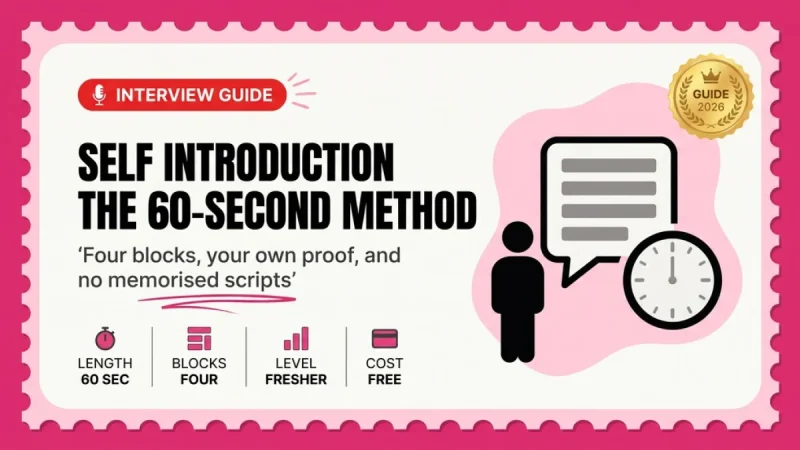
Block 1 — Who: name, degree, college city (10 sec)Block 2 — Proof: 2–3 things you did (25 sec)Block 3 — Fit: why this role/company (15 sec)Block 4 — Close: one forward-looking line (10 sec)First sentence memorised word-perfectEverything else from bullets, not scriptEnd on your line, not a trailing “that’s all”Smile at the start; it changes the voice
💪 What counts as proof
A project — what it did, your exact partAn internship or part-time work, any fieldA certification plus what you built with itLeadership of anything real (event, club, team)A skill with evidence (portfolio, code, designs)Consistent academics, one line maximumA difficulty you worked through, stated plainlyNumbers where honest ones exist
✂️ The cut list
Tenth and twelfth percentages (unless asked)Family members and their occupationsDate of birth, address, hobbies filler“Hardworking, passionate, dedicated” adjective chainsAnything already obvious from the resumeApologies about English or nervousnessLong college history — one line is enoughMemorised quotes and taglines
ADVERTISEMENT
✨What changed — and why old templates fail now
Interviewers have heard every template. The internet paragraph — “I am a quick learner and a team player” — is recognised in four seconds and discounted to zero. Specifics are the only differentiator left.
Video and phone rounds raised the bar. Recorded video introductions and phone screens are now common first filters — the same sixty seconds, delivered to a camera, with no interviewer to rescue you from rambling.
Proof moved ahead of polish. Hiring teams increasingly probe one concrete claim — “tell me more about that project” — so every line of your minute must survive a follow-up question honestly.
AI-written introductions flooded in. Perfectly worded, identical-sounding intros made interviewers value natural, specific, slightly imperfect delivery more than ever. Your own words, structured, beat borrowed ones.
The question expanded its forms. “Walk me through your profile”, “introduce yourself briefly”, “why should we hire you” — all are the same question wearing different clothes; one prepared structure answers them all.
🎓Build your minute this week, at zero cost
One hour of honest work produces a minute you will reuse in every interview for years.
Write your proof inventory first: every project, internship, certification, event and skill on one page. Pick the strongest two or three — chosen for the role, not for pride.
Draft Block 1 and Block 4 word-perfect — the opening sentence and the closing line. These two anchor the minute; everything between flows from bullets.
Reduce Blocks 2 and 3 to five bullet words on a card — e.g. “college project — attendance app — my part: database”. Rehearse from bullets so the wording stays alive.
Record yourself on the phone camera three times. Watch for speed (nerves double it), eye line and the trailing mumble. The camera is the cheapest honest coach available.
Do one interruption drill: have a friend cut in with “tell me more about that” mid-minute. If the structure survives interruption, it is ready; scripts never survive it.
If spoken English itself is the bottleneck, pair this with our 60-day English plan linked below — the introduction improves automatically as sentence construction does.
🗺On the day, step by step
1
Re-aim Block 3 at this company
The night before, rewrite the fit line for the specific role: what the company does, and the one honest reason you want in. A generic fit line is the most audible shortcut in any interview.
2
Open with the memorised first sentence
A word-perfect opening removes the hardest moment — starting. After the first sentence lands, the bullets carry you; nerves drop once the mouth is moving.
3
Watch the interviewer, not the ceiling
Eye contact in the normal human amount — look at the person, glance away to think, return. In video rounds, look at the camera lens for key lines.
4
Land the close and stop
Deliver Block 4 — the forward-looking line — and stop speaking. Resist the trailing “yeah... so... that’s about me”. Silence after a clean close reads as confidence.
5
Expect the follow-up probe
A good introduction invites “tell me more about that project”. That is success, not pressure — you chose the proof, so you own the details. Answer in the same plain, specific style.
ADVERTISEMENT
⚠️ What this page deliberately does NOT give you
No copy-paste scripts. A borrowed paragraph is recognised instantly and collapses under one follow-up. The structure above plus your own facts is the entire method — there is no shortcut version.
No company-specific answer banks. What each company’s interviewers prefer is not published in our source, and answer banks age badly. The four-block structure is company-independent by design.
No English fluency shortcuts. Spoken English improves with the daily reps our 60-day plan describes, not with memorised introductions. This page assumes your current English and structures it.
No personality rewrites. Quiet candidates should not perform extroversion — interviewers read acting easily. Structure makes a calm delivery land; it does not require a louder one.
💬Frequently Asked Questions
What is the ideal length for a self-introduction?
Forty-five to seventy-five seconds. Under thirty seconds reads as unprepared; past ninety the interviewer stops listening. One structured minute with two or three concrete proofs is the professional standard.
Should I mention my family in the introduction?
No — unless the interviewer explicitly asks. The minute belongs to your proof and your fit for the role. Family details answer a question that was not asked and spend seconds you need elsewhere.
My English is weak. Will the structure still work?
Yes — structure compensates for language more than language compensates for structure. Short simple sentences in the four-block order consistently beat fluent rambling. Pair it with daily spoken practice and both improve together.
Should I say my tenth and twelfth percentages?
Not in the introduction — they are on the resume and the interviewer will ask if they matter. Spend those seconds on a project or skill instead; one line on consistent academics is the maximum useful dose.
How is this different for walk-in interviews?
The structure is identical but the delivery is faster and often standing, with noise around. Walk-ins reward the memorised first sentence even more — recruiters decide in the first thirty seconds whether to continue.
What if the interviewer interrupts my introduction?
That is normal and usually positive — they heard something worth probing. Answer the follow-up fully, and do not try to return and finish the script. The structure already did its job: it produced the interruption.
📚Read Next on BeInCareer
Daily job & course updates, free
Walk-in drives, admission dates and new government courses — the day they are announced.
Source: This is interview guidance written by the BeInCareer editorial team on 30 October 2026, describing a four-block structure for the fresher self-introduction with rehearsal and delivery method. It deliberately contains no copy-paste scripts and no company-specific answer banks, because what individual interviewers prefer is not published in our source. Adapt the structure to your own verified facts.