
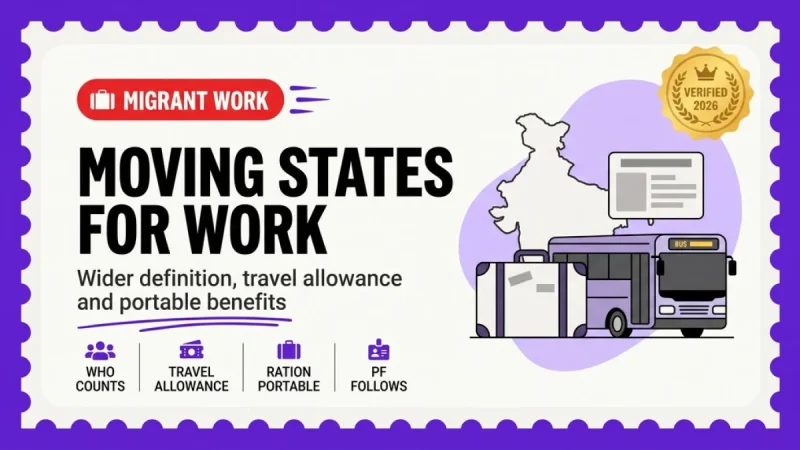
The definition of an inter-state migrant worker has been widened to include people who migrate on their own, not just those brought by a contractor. With it come an annual travel allowance and portable benefits, including ration.
Quick snapshot
- Who counts now: workers employed directly, through a contractor, or who migrate on their own.
- Previously: the definition turned on being brought by a contractor.
- Travel: an annual lump-sum travel allowance.
- Portability: benefits and public distribution system entitlements travel with the worker.
- Also covered: migrant construction workers.
- In force since: 21 November 2025, under the OSH Code.
The OSH Code widens the definition of an inter-state migrant worker to cover those employed directly, those engaged through a contractor, and — the significant addition — those who migrate on their own. Workers in that category are provided an annual lump-sum travel allowance, and portability of benefits and of public distribution system entitlements. The old definition effectively required that someone had been recruited and brought across a state border by a contractor, which excluded most people who simply moved for work themselves.
The definition change, and why it is the whole story
Most protective law for migrant workers historically assumed a particular route: a contractor recruits people in one state and transports them to work in another. That describes a real pattern, but it describes a minority of actual movement.
The far commoner pattern is a person deciding for themselves to go where the work is — from a district town to Hyderabad, Bengaluru, Chennai or Pune — finding a job on arrival, and having no contractor anywhere in the story. Under the old definition, that person was often not an inter-state migrant worker in law at all.
| Route into another state | Old position | Now |
|---|---|---|
| Recruited and brought by a contractor | Covered | Covered |
| Employed directly by an establishment in the other state | Often outside the definition | Covered |
| Migrated on your own and found work there | Generally outside | Covered |
This is directly relevant in Andhra Pradesh and Telangana. A very large share of young people from these states move for work — to Hyderabad, Bengaluru, Chennai, Pune and the Gulf-facing recruitment corridors — overwhelmingly under their own steam rather than through a labour contractor. That is exactly the group the widened definition brings in.
What the entitlements are
| Entitlement | What it means |
|---|---|
| Annual lump-sum travel allowance | A payment towards travel, recognising that migrant workers return home periodically |
| Portability of benefits | Entitlements follow the worker rather than being tied to the home state |
| Portability of PDS | Ration entitlements usable where you are working, not only where you are registered |
| Coverage of construction workers | Migrant construction workers are included in the portability provisions |
Ration portability is the provision with the most immediate practical effect. The historic problem was simple and severe: an entitlement registered in your home district was unusable in the city where you actually lived, so the people with the least margin lost access to it precisely when they moved for work.
What also applies to you, because you are an employee
Migrant status is additional to ordinary employment rights, not a substitute for them. If you are working as an employee in another state, the rest of the framework applies in the normal way.
An appointment letter is mandatory. Terms in writing matter more, not less, when you are far from home and have no local network to fall back on.
Provident fund applies from day one at 12% of wages, on a single UAN that follows you across states and employers.
Minimum wages and timely payment now cover every employee in every sector; monthly salary is due by the 7th of the following month.
Working hours are capped at 8 a day and 48 a week, with overtime requiring consent and paid at twice the rate.
Welfare facilities and a free annual health check-up apply across all sectors, with the principal employer responsible including for contract labour.
Professional tax changes when you move. It is levied by the state, so the same job in a different state can produce a different deduction. Some states do not levy it at all. If your payslip changes after a transfer and nothing else did, this is usually why.
Practical steps when you move states for work
Moving for work creates an administrative gap that is easy to leave open for years. Closing it takes an afternoon.
Carry your UAN, not just your PF passbook. One Universal Account Number covers your whole career. Give it to the new employer so they link their member ID to it rather than creating a second number, which is the commonest cause of a stuck transfer later.
Check that Aadhaar, PAN and bank details are seeded against the UAN and match what the employer holds. Name spellings that differ between documents will hold up a claim indefinitely, and they are trivial to fix before anything depends on them.
Keep the appointment letter and payslips from every state you work in. Service period and wages are the only inputs that decide provident fund transfers and gratuity, and reconstructing them across several employers in several cities is genuinely difficult.
Sort out ration portability before you need it, not during a month when money is short.
What this does not do
| Question | Position |
|---|---|
| Does it guarantee housing? | No. The provisions summarised here concern travel allowance and portability of benefits. |
| Does it set my wage? | No. Minimum wage provisions set a floor; what you are paid is contract and market. |
| Does it cover moving abroad for work? | No. These are inter-state provisions within India. |
| Does it change my notice period? | No. Notice comes from your contract and the applicable standing orders. |
| Exact allowance amounts and procedure | Set through rules that vary and are revised; check current rules for your state. |
As with every provision in this series, the Code sets a floor and the detail sits in rules framed by central and state governments. We do not publish a rupee figure for the travel allowance, because it is set through rules that change and vary, and a stale number is worse than none.
The first month in a new city
Moving state for a job is mostly a logistics problem, and the parts people get wrong are predictable. Four of them recur.
A second provident fund account. You give the new employer your bank details and Aadhaar but not your UAN, and a fresh Universal Account Number gets created. Now you have two records for one person, and merging them is slower than simply having handed over the right number on day one. Ask specifically whether they are linking to your existing UAN.
Address and documents drifting apart. Your Aadhaar still shows a home district address, your bank statement shows a new city, and your employer records show something else again. Each mismatch is harmless alone and collectively they hold up claims. Decide which address is your current one and make the records agree.
Assuming the old payslip pattern carries over. Professional tax is a state levy, so the deduction can change or disappear entirely. The provident fund base may also shift if the salary structure differs. Read the first payslip in the new state line by line against the annexure rather than glancing at the credited figure.
Losing the paper trail from the previous job. The relieving letter, the final settlement and the last payslip from the state you left are the proof of that service period. They are much harder to obtain once you are several hundred kilometres away and no longer have a working relationship with anyone there.
Do this in the first month. All four are ten-minute tasks while you are settling in, and multi-week problems when you discover them during a transfer or a claim. The moment you are least able to deal with paperwork is the moment you most need it to already be correct.
Who counts as an inter-state migrant worker now?
The definition has been widened to include workers employed directly, those engaged through a contractor, and workers who migrate on their own. The last category is the significant addition, because it covers people who move for work themselves rather than being brought by a contractor.
What is the travel allowance?
Inter-state migrant workers are provided an annual lump-sum travel allowance. The amount and procedure are set through rules, so check the current position for your state.
Can I use my ration card in another state?
Portability of benefits and of public distribution system entitlements is provided for inter-state migrant workers and migrant construction workers, so entitlements follow the worker rather than remaining tied to the home state.
Do I still get provident fund if I work in another state?
Yes. Provident fund applies from day one of employment at 12% of wages, on a single UAN that follows you across employers and states. Give the new employer your existing UAN rather than letting a second one be created.
Why did my salary change after moving states?
Professional tax is levied by the state, so the same job in a different state can produce a different deduction, and some states do not levy it at all.
Does this apply if I move abroad for work?
No. These are inter-state provisions within India.
Do ordinary employment rights still apply to me?
Yes. A mandatory appointment letter, minimum wages and timely payment, the 8-hour day and 48-hour week, overtime at twice the rate, welfare facilities and a free annual health check-up all apply as they do to any employee.
When did these provisions take effect?
21 November 2025, when the four Labour Codes were brought into force and 29 earlier central labour laws were rationalised.
Sources: Press Information Bureau, Occupational Safety, Health and Working Conditions (OSH) Code, 2020 · Press Information Bureau, Government makes the four Labour Codes effective · Press Information Bureau, Code on Social Security, 2020.
Related guides on BeInCareer
- The Four Labour Codes: What Changed for Employees
- Free Annual Health Check-Ups and Workplace Welfare
- Minimum Wages and the Right to Be Paid on Time
- UAN and PF Transfer When Changing Jobs
- Working Hours and Overtime Rules India 2026
- Your Appointment Letter Is Now Mandatory
- Social Security for Gig and Platform Workers
- Fixed-Term Employment India 2026
- Gratuity Rules India 2026
- GCC Jobs in Hyderabad 2026