
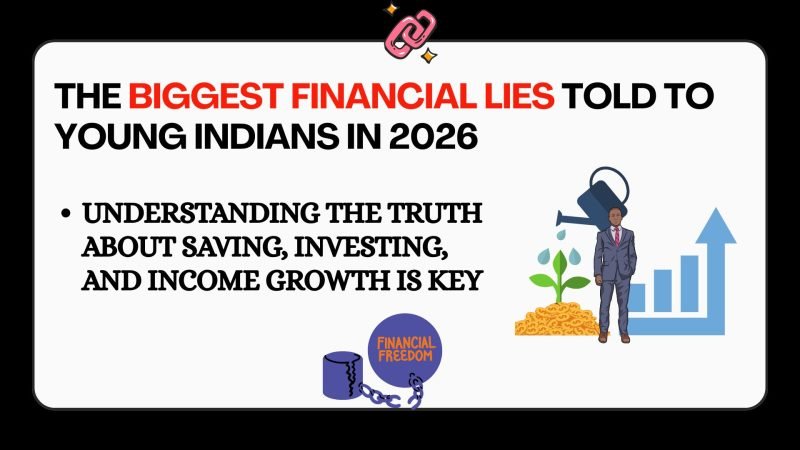
The Biggest Financial Lies Told to Young Indians
Myths from Parents · Banks · Schools · Society — Debunked With Real Numbers · What You Were Never Taught · What to Do Instead
Some of the people who love you most have been giving you financial advice that is quietly making you poorer. Not out of malice — out of outdated beliefs, limited knowledge, and a world that changed faster than the advice did. This article exposes the ten biggest financial myths that young Indians have been fed since childhood, with the real numbers behind each one and exactly what to believe instead.
Financial advice in India travels through three primary channels: family wisdom passed down through generations, formal education that barely touches personal finance, and financial institutions whose advice is shaped by what earns them commission. Also, each of these channels has systematically given young Indians information that was either never true, was true for a different era, or was designed to serve someone else's interests. Furthermore, the result is a generation of educated, hardworking Indians who save diligently, work hard, and still find themselves financially stuck — not because they are irresponsible, but because the rules they were given do not work in 2026's economic reality.
This article is not about disrespecting your parents or dismissing tradition. Also, most of these lies were told by people who genuinely believed them and wanted the best for you. Furthermore, but believing a false map does not make the territory match the map — it just means you arrive at the wrong destination. Also, here are the ten biggest financial lies young Indians have been told, with the real numbers behind each one and exactly what to do differently. Furthermore, reading this alone will not change your financial situation — but acting on it will.
"FD is the Safest Way to Grow Your Money"
This is the lie Indian parents have told their children most consistently across every economic class — and it feels true because FDs never go to zero, the principal is protected, and the interest arrives predictably. Also, FDs feel safe because they are safe in one very specific sense: you will not lose the nominal number you put in. Furthermore, what your parents' generation did not need to calculate — because inflation was lower and expectations were different — is whether FDs are safe from inflation. Also, and they are not.
A 7% FD in a 6% inflation environment delivers a 1% real return. Also, this means ₹1 lakh in an FD for 20 years grows to approximately ₹3.87 lakh nominally — which sounds impressive. Furthermore, but with 6% compounding inflation over 20 years, ₹3.87 lakh in 2046 buys the equivalent of only ₹1.21 lakh in today's purchasing power. Also, your real gain after 20 years of disciplined FD saving: ₹21,000 in real terms, from ₹1 lakh of original capital. Furthermore, that is a 1% real return — barely ahead of treading water. Also, compare this to ₹1 lakh in a Nifty 50 index fund at 12% CAGR for 20 years: approximately ₹9.65 lakh nominally, or ₹3.01 lakh in real 2026 purchasing power. Furthermore, the FD is safe from volatility. It is not safe from the one thing that matters: purchasing power erosion. Also, FDs protect your number. They do not protect your wealth.
"Real Estate is Always the Best Investment"
In your parents' generation, this was largely true — and their experience proves it in a visceral way. Also, the apartment your father bought in 1990 for ₹3 lakh is worth ₹80 lakh today. Furthermore, that 26-fold increase over 34 years is impressive — approximately 11% CAGR, comparable to the stock market. Also, but there are four things the "real estate always wins" story forgets. Furthermore, first: your father bought at a time when Indian urban real estate was severely underpriced. That specific opportunity does not exist across all geographies today. Also, second: the return calculation almost never includes maintenance costs, property taxes, periods of vacancy (for rental properties), broker commissions on purchase and sale (2–3%), registration and stamp duty (5–7%), renovation costs, and the opportunity cost of the capital locked up. Furthermore, third: real estate in India is an intensely location-specific and liquidity-constrained asset. A property in a tier-2 city that "should" have appreciated may have actually lost real value over 15 years if the city did not develop as expected. Also, fourth: in the 2016 to 2024 period across most Indian cities, residential real estate has significantly underperformed the Nifty 50 index after accounting for all costs — despite the prevailing belief that it is the superior investment.
The "real estate always wins" myth also pushes young Indians into buying property before they are financially ready — stretching into EMIs that consume 40 to 50% of their income, eliminating any capacity to invest in equity, and creating massive financial stress that compounds over a 20-year loan tenure. Also, a young person who takes a ₹50 lakh home loan at age 28 to buy a house because "property is safe" will pay approximately ₹95 to ₹1 lakh in total EMIs over 20 years — for an asset that may appreciate at 5 to 8% CAGR — while having no capacity to invest in equity during their most powerful compounding years.
"Insurance is an Investment" — The ULIP and Endowment Policy Myth
Walk into any Indian bank or meet any insurance agent in India and within 10 minutes you will hear about a "savings plan" or "wealth creation plan" or "child education plan" that provides insurance cover AND builds a corpus AND saves on taxes. Also, this product — variously called a ULIP, endowment policy, money-back policy, or whole life plan — is one of the most effectively marketed and most financially destructive products sold to Indian households. Furthermore, the pitch is compelling: you get life cover, you accumulate savings, and you get tax benefits. Also, the reality is mathematically brutal.
A typical endowment policy asks you to pay ₹20,000 per year for 20 years (total ₹4 lakh) and promises a maturity amount of approximately ₹7 to ₹8 lakh — an apparent doubling that sounds attractive. Also, but ₹4 lakh invested at 12% CAGR in a Nifty 50 index SIP for 20 years grows to approximately ₹30 lakh — four times more than the endowment policy returns, from the same money. Furthermore, the insurance cover you get from an endowment policy of ₹20,000 per year is typically ₹5 to ₹8 lakh — which is dangerously inadequate for anyone with dependents. Also, a pure term insurance policy providing ₹1 crore of life cover for the same age costs approximately ₹8,000 to ₹12,000 per year — leaving ₹8,000 to ₹12,000 from your ₹20,000 budget to invest in an index fund, where it will build real wealth. Furthermore, the agents earn 20 to 50% commission on first-year ULIP and endowment premiums — the single highest commission structure in India's retail financial products. Also, this commission incentive is why these products are pushed so aggressively at every bank counter, insurance office, and trusted family advisor.
"You Should Not Invest Until You Have 'Enough' Money"
This lie is told with good intentions — usually by parents who do not want you to "waste" your small amounts of money on something uncertain. Also, "Wait until you have at least ₹50,000 saved before investing." "Don't bother with mutual funds on such a small salary." "Start properly when you get a better job." Furthermore, these instructions, combined with the perfectly natural human tendency to wait for the "right time," result in people reaching their 30s with no investment habit whatsoever — and then scrambling to make up for the lost decade.
The mathematics of waiting is devastating and rarely calculated. Also, consider two people — both invest ₹3,000 per month in a Nifty 50 index fund at 12% CAGR. Furthermore, Person A starts at age 22. Person B waits until age 30 to "have enough." Also, at age 55, Person A has approximately ₹1.58 crore. Person B has approximately ₹61 lakh. Furthermore, Person A invested for 33 years; Person B for 25 years. Also, the 8-year difference in starting date — 8 years of ₹3,000 SIPs totalling ₹2.88 lakh in additional contributions — created an additional ₹97 lakh in wealth for Person A. Furthermore, a ₹2.88 lakh difference in contributions created a ₹97 lakh difference in outcomes. Also, that is the compound interest penalty of waiting — and it grows with every passing year of delay. Furthermore, Groww allows SIPs from ₹100. The minimum viable investment is not ₹50,000 saved — it is ₹100 per month and 5 minutes to set it up.
"Your Job is Your Security — Focus on One Stable Career"
The Indian education system and most Indian families are built around a single, powerful goal: get a stable job with a stable salary, ideally government or a large private firm, and maintain it. Also, this advice was rational for the economy of 1985 — where AI did not exist, globalisation had not yet disrupted Indian manufacturing, and a government job genuinely meant lifetime financial security. Furthermore, it is dangerous advice for 2026 — where 60,106 tech layoffs happened globally in just the first quarter, Amazon cut 16,000 positions, and AI automation is systematically eliminating categories of jobs that were considered safe just five years ago.
Also, the idea of "job security" has fundamentally changed. Furthermore, a government job still offers security in India — but the number of government jobs available relative to the population of applicants makes this an increasingly lottery-like outcome for most people. Also, private sector "stable" jobs at large IT companies were considered safe until they were not — TCS, Infosys, Wipro, and Cognizant have all conducted significant workforce restructuring in the past three years. Furthermore, the new security in 2026 is not job security — it is skill security. Also, a person with a skill set that multiple industries need — data analytics, AI literacy, cloud computing, digital marketing, content creation — is far more financially secure than a person with a single company's employment contract, regardless of how prestigious that company is. Furthermore, additionally, the single-income-stream model is inherently fragile. Also, 73% of Indian households that face a sudden income disruption are back in financial stress within 2 months because they have no emergency fund and no secondary income.
"Stock Market is Just Gambling" — The Lie That Kept a Generation Out of Equity
This is perhaps the most financially costly lie told to Indians who came of age before the internet democratised financial education. Also, the "stock market is gambling" belief is rooted in real experience — many people from previous generations lost money in the market through poorly timed individual stock picks, fraudulent penny stocks, or by investing in IPOs of companies that were pumped and dumped. Furthermore, these are genuine risks of speculative stock picking — and they create real, personal, emotionally charged stories that travel through families as cautionary tales.
But there is a critical distinction that the "stock market is gambling" warning completely ignores: the difference between speculative stock picking and systematic index fund investing. Also, buying individual stocks based on tips, hot sectors, or prediction is genuinely similar to gambling — it involves significant skill, information advantages, and luck to succeed consistently. Furthermore, buying a Nifty 50 index fund and holding it through a monthly SIP for 10 or more years is the opposite of gambling. Also, it is the most mathematically reliable wealth-building instrument available to ordinary Indians. Furthermore, the Nifty 50 has never delivered negative returns over any rolling 10-year period in its history. Also, over every 15-year period, it has delivered real returns (above inflation) consistently. Furthermore, calling a Nifty 50 SIP "gambling" is like calling a systematic savings plan "theft" — it misapplies a legitimate warning about one thing to a completely different thing.
The cost of this belief to Indian households has been staggering. Also, India has approximately 950 million adults. Furthermore, only about 120 million have any equity investment exposure through mutual funds or direct stocks. Also, the remaining 830 million — the overwhelming majority — have kept their savings in bank accounts, FDs, gold, and real estate while equity markets have compounded at 12 to 14% CAGR for 30 years. Furthermore, an Indian who invested ₹1 lakh in the Nifty 50 in 1994 and never added another rupee has approximately ₹38 lakh today. The person who kept ₹1 lakh in rolling FDs over the same period has approximately ₹7.5 to ₹8 lakh. Also, the "gambling" belief cost that family ₹30 lakh from a single ₹1 lakh decision made — or not made — three decades ago.
"Debt is Always Bad — Never Borrow Money"
The "never borrow money" lesson is taught with genuine love and comes from the very real pain of watching families destroyed by unmanageable debt — whether from a moneylender's extortionate interest rates, an agricultural loan that could not be repaid after a failed crop, or a personal loan spiral that consumed years of income. Also, in that historical context, "avoid debt" was protective advice. Furthermore, applied universally in 2026 without nuance, it is one of the most financially limiting beliefs an educated young Indian can carry.
The truth about debt is that it exists on a spectrum from deeply destructive to genuinely wealth-building. Also, at one end: credit card debt at 36 to 42% annual interest — genuinely toxic, to be avoided and cleared as fast as possible. Furthermore, personal loans for gadgets, fashion, and lifestyle — destructive because they fund depreciating consumption. Also, at the other end: education loans at 8 to 10% that finance a qualification increasing your annual income by ₹5 to ₹10 lakh — a powerful positive leverage. Furthermore, a home loan at 8.5% to buy a property in a growth corridor at a fair valuation — using modest leverage to acquire a real asset that appreciates, while maintaining tax benefits and building equity. Also, a business loan to purchase equipment that generates revenue exceeding the loan cost — the foundation of virtually every successful Indian entrepreneur's story. Furthermore, the distinction is not between "debt" and "no debt" — it is between debt that funds assets or income and debt that funds consumption.
"Gold is the Ultimate Wealth Protector and Investment"
No financial asset in India has more emotional, cultural, and religious significance than gold — and no asset is more consistently misrepresented as an investment. Also, gold in India is simultaneously jewellery, store of value, wedding tradition, and supposed investment — and these roles constantly blur in ways that damage household finances. Furthermore, when families buy physical gold jewellery as "investment," they overlook making charges of 10 to 25% that are immediately lost (they are a cost, not value), storage costs and insurance, difficulty of partial sale, and the risk of theft or loss.
Also, let us look at gold as a pure investment over the long term. Furthermore, gold has returned approximately 9 to 10% CAGR in India over the past 20 years in rupee terms — which sounds competitive. Also, but this comparison is incomplete because India's rupee has depreciated significantly against the dollar over this period, which mechanically inflates gold's rupee return since gold is priced in dollars globally. Furthermore, in real purchasing power terms — after adjusting for both inflation and rupee depreciation — gold's long-term returns are considerably less impressive than headline numbers suggest. Also, over any 20-year period in India, the Nifty 50 has outperformed gold by a significant margin. Furthermore, over the past 5 years specifically, gold has performed well — driven by global uncertainty including COVID, Russia-Ukraine, and the Iran war. Also, but 5-year gold performance does not represent the 20 to 30-year wealth-building reality.
"Your Bank Manager / CA Knows Best — Trust Professionals Blindly"
Indian culture has deep respect for professional expertise — doctors, lawyers, CAs, and bank managers are trusted implicitly. Also, this trust is largely appropriate in domains where the professional's interests align with yours: a good doctor wants you healthy, a good lawyer wants you legally protected. Furthermore, it becomes systematically dangerous in finance — because the interests of many financial professionals in India are structurally misaligned with yours in ways that are legal, common, and rarely disclosed. Also, your bank relationship manager earns commission and performance targets for selling you ULIPs, endowment policies, credit cards, personal loans, and premium bank products. Furthermore, a mutual fund distributor earns trail commission on the funds they recommend — creating a structural incentive to recommend regular funds (higher commission) over direct funds (zero commission, but significantly better returns for you). Also, an insurance agent earns 20 to 50% of your first-year ULIP or endowment premium — making them the highest-commission retail financial product salesperson in India.
Also, this does not mean all financial professionals are dishonest — many are genuinely trying to help. Furthermore, but the structure of their compensation creates a systematic bias toward recommending products that earn them more, not products that serve you best. Also, the solution is financial literacy sufficient to evaluate advice independently — not cynicism toward all professionals, but informed engagement where you understand the incentive structure behind every recommendation.
"Talking About Money is Vulgar — Keep Financial Matters Private"
Of all the financial lies told to young Indians, this one is the most insidious because it is not about a specific product or strategy — it is about preventing the conversations that would expose all the other lies. Also, Indian culture has a deep-seated discomfort with open discussion of money — salaries, savings, investments, debts, and wealth are all considered inappropriate topics for honest conversation. Furthermore, this norm has several roots: caste and class anxiety around revealing financial status, cultural modesty about demonstrating wealth, and a genuine historical association between discussing money and inviting envy, conflict, or exploitation.
Also, the consequence is that young Indians make critical financial decisions in information vacuums. Furthermore, they do not know what their colleagues earn, so they cannot negotiate their salary effectively. Also, they do not know what investment returns their peers are getting, so they cannot benchmark whether their own strategy is working. Furthermore, they do not discuss money in families, so financial mistakes are made repeatedly across generations without being corrected. Also, they do not ask for help with financial decisions because "we don't talk about such things" — and the silence creates the perfect environment for the other nine lies to go unchallenged. Furthermore, the countries with the highest rates of retirement security and investment participation — the Netherlands, Sweden, Singapore — are also the countries where financial transparency and education are normalised from a young age, not hidden as shameful.
Now That You Know the Lies — The 5 Truths to Build Your Financial Life On
Knowing what is false is only useful if it leads to knowing what is true and doing something about it. Also, here are the five financial truths that replace the ten lies — each directly actionable for a young Indian in 2026.
Open Groww today. Set up a ₹500 Nifty 50 SIP. Schedule it for 2 days after your salary date. Increase by ₹500 every income increase. This is the single most valuable financial action available to any young Indian right now. Also, do not wait for the right time, enough money, or more knowledge. The cost of waiting is measured in lakh of rupees of future wealth foregone.
Buy ₹1 crore term life insurance from LIC, HDFC Life, or Max Life (₹700–₹900/month at age 25). Get health insurance — either your employer's or a personal Niva Bupa or Star Health policy above ₹5 lakh cover. Invest in index funds and PPF separately. Never mix insurance and investment — the combination always costs you more and delivers less of both.
Invest in skills that increase your earning power with the same seriousness you invest in index funds. Also, a ₹15,000 certification that earns a ₹3 lakh salary increase delivers 2,000% ROI in year one — no financial market can match it. Furthermore, build one second income stream from your skills — even ₹3,000/month from freelancing invested for 20 years adds ₹30 lakh to your wealth.
Before accepting any financial recommendation, ask: how does this person earn money from this advice? Also, if they earn commission, evaluate the recommendation with that knowledge. Furthermore, for advice with no commercial incentive — financial literacy content, SEBI's investor education resources, AMFI's mutual fund awareness campaigns, or a SEBI-registered RIA who charges you a fee — trust it proportionally more.
Three months of expenses in a high-interest savings account (Fi Money at 7%, or a liquid mutual fund) before any investment. Also, this is the foundation without which all other financial structures are fragile. Furthermore, without an emergency fund, any unexpected expense forces you to break FDs early, sell SIPs during market lows, or take high-interest debt — all of which are significantly more expensive than the lost investment return from building the emergency fund first.
💬 Most Asked Questions
My parents are hurt that I'm questioning their financial advice. How do I handle this?
With love and patience — and without framing it as "you were wrong." Also, your parents gave you the best advice they knew. Furthermore, their financial world was genuinely different: lower inflation, different investment options, different risks, different opportunities. Also, instead of debating whose advice is right, show them your approach with real numbers: "I started a ₹1,000 SIP three months ago. Also, here is what it looks like on my phone. What do you think?" Furthermore, most Indian parents, when they see their child taking responsible, system-based financial action, respond with curiosity and even pride — not conflict. Also, the key is showing, not arguing. Actions that produce visible results are more persuasive than any financial argument you can make.
Is it really safe to invest in mutual funds on apps like Groww?
Yes — Groww is SEBI-registered, RBI-compliant, and the mutual funds available on it are managed by SEBI-regulated Asset Management Companies (AMCs) including UTI, Nippon, HDFC, SBI, and Mirae Asset. Also, your investment in a mutual fund on Groww is not held by Groww — it is held directly by the AMC under your PAN and Folio number. Furthermore, if Groww were to shut down tomorrow, your investments would remain intact and accessible through CAMS or KFintech (the official registrar and transfer agents for Indian mutual funds) or directly through the AMC's website. Also, this is fundamentally different from money in a bank account — mutual fund assets are legally ring-fenced from the platform operator. Furthermore, the mutual fund NAV (Net Asset Value) and your folio details are tracked independently of any platform, making them extremely difficult to fraudulently compromise.
I already have an LIC endowment policy that my parents bought. Should I surrender it?
Do not decide without calculating first. Also, the answer depends entirely on the specific policy, how many years it has been running, the surrender value today, and how many years remain to maturity. Furthermore, LIC endowment policies in their early years (first 3 to 5 years) have very low surrender values — sometimes as low as 30 to 40% of premiums paid. Also, surrendering early locks in a significant loss. Furthermore, policies that are 7 to 10 years into their 20-year term often have surrender values close enough to the remaining premium payments that the decision is more nuanced. Also, get the surrender value figure from your LIC branch or the LIC portal, calculate the total remaining premiums, estimate the maturity benefit, and compare the implicit return to what that same money would earn in an index fund or PPF. Furthermore, for most LIC endowment policies running for more than 10 years, completing them to maturity is financially wiser than surrendering — the loss from early surrender typically exceeds the opportunity cost of the remaining premium years.
What one financial book should every young Indian read?
For India-specific personal finance that is honest, practical, and culturally grounded, "Let's Talk Money" by Monika Halan is the single best book for a young Indian beginning their financial education. Also, Monika Halan is a veteran financial journalist who writes specifically for Indian households with India-specific examples, India-specific products, and India-specific cultural context. Furthermore, the book covers insurance, investments, budgeting, and the entire financial lifecycle in plain language without academic jargon. Also, for investment philosophy — understanding why long-term index fund investing works — "The Psychology of Money" by Morgan Housel translates the emotional and behavioural aspects of investing into the most accessible language available. Furthermore, both books are available for under ₹400 on Amazon. Also, the return on reading them — measured in better financial decisions over a lifetime — is incalculable.
All return projections use historical averages — Nifty 50 at 12% CAGR (30-year historical), FD at 7% (average), gold at 10% (20-year India rupee return). Past returns do not guarantee future results. ULIP and endowment return estimates are based on IRDAI-published industry averages and independent analyses — individual policies vary. LIC endowment surrender value calculations depend on specific policy terms. Commission structures mentioned are industry-standard ranges; individual agent and distributor compensation varies. This article is for financial education only and does not constitute investment advice. For personalised guidance consult a SEBI-registered Investment Adviser (RIA).