
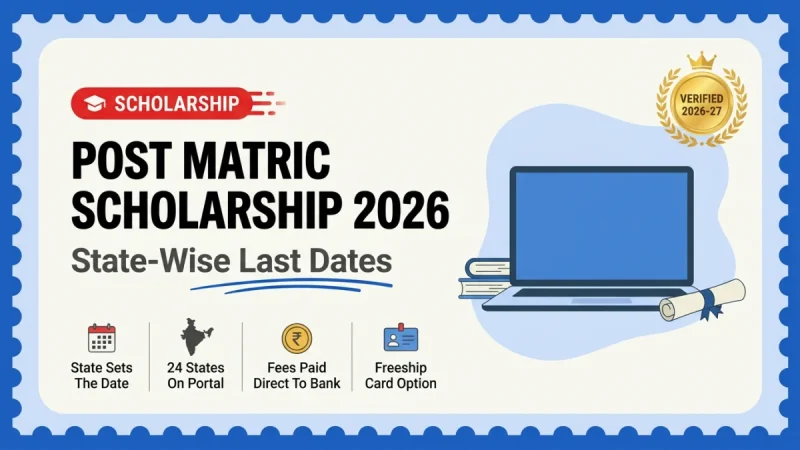
The Post Matric Scholarship (PMS) last date is set by your own state government, not by Delhi. We read the official portal state by state on 21 October 2026: the verified 2026-27 closing dates run from 30 September 2026 to 15 February 2027. Twelve big states, including Telangana and Andhra Pradesh, are not on the national portal at all.
Quick Snapshot
- One national last date? No. PMS for SC, ST and OBC/EBC/DNT is Centrally Sponsored — the state awards it and sets the date.
- Verified 2026-27 range: 30 September 2026 (Assam, OBC) to 15 February 2027 (Delhi).
- Income limit: ₹2,50,000 a year for SC, ST and OBC/EBC/DNT alike.
- SC: full non-refundable fees plus ₹13,500 / ₹9,500 / ₹6,000 / ₹4,000 per year (hostellers).
- ST: fees plus ₹1,200 / ₹820 / ₹570 / ₹380 per month for hostellers — different unit, different period.
- OBC/EBC/DNT: ₹10,000 to ₹5,000 per year, plus tuition capped at ₹10,000 per year.
- Freeship Card: admission without pre-paying tuition or hostel fee, and registration is open all year.
What This Guide Covers
- Post Matric Scholarship Last Date 2026 — The Honest Answer
- State-Wise Last Dates for 2026-27 (Verified Table)
- If Your State Is Not In That Table
- Your Application Is Not Finished When You Submit It
- What the Post Matric Scholarship Actually Is
- Post Matric Scholarship Eligibility 2026
- PMS Amount for SC Students — A Yearly Academic Allowance
- PMS Amount for ST Students — A Monthly Maintenance Allowance
- PMS Amount for OBC, EBC and DNT Students
- The Freeship Card — Admission Without Paying Fees First
- Documents Required and How to Apply
- When the Scholarship Money Reaches Your Account
- Renewal, Attendance and What Happens If You Fail
- Post Matric Scholarship 2026 — Frequently Asked Questions
Post Matric Scholarship Last Date 2026 — The Honest Answer
There is no single national last date for the Post Matric Scholarship. The deadline is fixed by your own state government, because PMS is a Centrally Sponsored scheme that the state awards. On the official portal on 21 October 2026, verified 2026-27 student deadlines ran from 30 September 2026 to 15 February 2027, and they differ by category inside one state. Find your state in the next table — and if it is not there, your date is on your own state portal.
If a page gave you one confident national date, it was guessing. The portal sorts schemes into three groups — Central Sector, Centrally Sponsored and State Schemes — and that split decides who sets your deadline.
A Central Sector scheme is funded and run one hundred per cent by a central ministry. There are 31 of them, and only two have Post Matric in the name: one for students with disabilities, one for the wards of beedi, cine, IOMC and LSDM workers. Both had a single national deadline of 31 October 2026. The schemes almost everyone is searching for — PMS for SC, for ST, and the post-matric component for OBC, EBC and DNT — are Centrally Sponsored: funded jointly by Centre and state, and awarded by the state the student belongs to. There is no central switch.
| Question | Verified answer (21 October 2026) |
|---|---|
| One all-India PMS last date? | No. The scheme is state-awarded. Only 24 states and UTs are listed on the portal. |
| Earliest / latest 2026-27 close | 30-09-2026 (Assam, OBC) / 15-02-2027 (Delhi) |
| Categories differ inside one state? | Yes. Assam: OBC 30-09, ST 06-10, SC 15-10-2026. |
| Does 31 October 2026 apply to all? | No. It is the date for several states and the two central-sector schemes, not a national PMS deadline. |
That last row is where students lose a year. 31 October 2026 is genuinely correct for several states, so it gets copied everywhere as the national date — but an SC student in Jammu and Kashmir had until 31 December 2026, and an OBC student in Assam was finished on 30 September.
State-Wise Last Dates for 2026-27 (Verified Table)
Every row below was read from the portal's own state pages on 21 October 2026, for academic year 2026-27. Where it said an application was closed on a date, that window has shut; where it said not yet opened, we report that and nothing more.
| State / UT | Scheme(s) listed | Student application closes |
|---|---|---|
| Andaman & Nicobar | OBC | 31-10-2026 |
| Andaman & Nicobar | ST | 31-12-2026 |
| Andaman & Nicobar | Dr Ambedkar EBC | Not yet opened |
| Arunachal Pradesh | ST | 06-11-2026 |
| Assam | OBC | Closed on 30-09-2026 |
| Assam | ST | Closed on 06-10-2026 |
| Assam | SC | Closed on 15-10-2026 |
| Chandigarh | SC; OBC, EBC, DNT; Transgender students | 30-11-2026 |
| Dadra & Nagar Haveli and Daman & Diu | SC, ST, OBC, EBC | 31-10-2026 |
| Delhi | SC; OBC/EBC/DNT | 15-02-2027 (latest) |
| Goa | SC; ST | 30-11-2026 |
| Haryana | SC; OBC/EBC/DNT | 31-01-2027 |
| Himachal Pradesh | SC, ST, OBC/EBC/DNT | 31-10-2026 |
| Jammu & Kashmir | OBC/EBC/DNT | 31-10-2026 |
| Jammu & Kashmir | ST | 10-11-2026 |
| Jammu & Kashmir | SC | 31-12-2026 |
| Ladakh | ST | 10-11-2026 |
| Maharashtra | OBC/EBC/DNT | 30-11-2026 |
| Manipur | ST | 30-10-2026 |
| Manipur | SC; OBC | 31-10-2026 |
| Meghalaya | SC | 30-10-2026 |
| Meghalaya | ST | 30-11-2026 |
| Mizoram | ST | Closed on 17-10-2026 |
| Nagaland | ST | 27-10-2026 |
| Puducherry | OBC | 30-10-2026 |
| Puducherry | SC; ST | 31-10-2026 |
| Punjab | SC | 15-11-2026 |
| Punjab | OBC/EBC/DNT | 20-11-2026 |
| Sikkim | SC, ST, OBC/EBC/DNT | 31-10-2026 |
| Tripura | ST | 31-10-2026 |
| Tripura | SC | 10-01-2027 |
| Tripura | Dr Ambedkar EBC | Not yet opened |
| Uttarakhand | SC, ST, OBC, EBC | 30-11-2026 |
| West Bengal | SC | Not yet opened |
| Chhattisgarh | Listed, but no Post Matric scheme appears | — |
| Lakshadweep | Listed, but no Post Matric scheme appears | — |
Thirty-six verified entries, with three different dates inside Assam alone. Match your category, not just your state; and match the state that awards you, not the one you study in. The award comes from the state where you are permanently settled, which is why a residence or domicile certificate matters — it proves which state must pay you.
If your date has already passed
We have no honest workaround to offer. The portal publishes no reopening date and no late route for closed windows, and we will not invent one. Do two things instead. Check your own state page, because only the state can reopen a window. And register for a Freeship Card — that stays open all year, and it decides whether your next admission needs cash up front.
If Your State Is Not In That Table
The state list on the national portal contains only 24 states and union territories. It does not include twelve of the largest student populations in the country:
Not on the national portal
- Telangana
- Andhra Pradesh
- Uttar Pradesh
- Bihar
- Karnataka
- Tamil Nadu
Also not listed
- Kerala
- Madhya Pradesh
- Rajasthan
- Gujarat
- Odisha
- Jharkhand
If you belong to any of them, the national portal is not your application route. You apply on your own state's portal, and your deadline is published there. Every year students register nationally, cannot find their state, and conclude they are ineligible — they were simply on the wrong website.
| State | Official state portal | Status on 21-10-2026 | Application window |
|---|---|---|---|
| Telangana | tgepass.cgg.gov.in | Responded normally | Not verified by us — read the date there |
| Andhra Pradesh | jnanabhumi.ap.gov.in | Responded normally | Not verified by us — read the date there |
We confirmed only that those two portals are live; we did not verify their windows, amounts or rules, so we print no date for either. Telangana students should start with our guide to the state scholarship portal for Telangana. The same applies to the other ten: your scheme exists, it is funded the same way, and the date is on your own portal.
Your Application Is Not Finished When You Submit It
For every scheme on the portal, four dates are published, not one, and the student deadline is only the first. These were the four stages for the two central-sector Post Matric schemes in 2026-27:
| Stage | Who must act | Date (AY 2026-27) |
|---|---|---|
| Student application closes | You | 31-10-2026 |
| Defective application verification closes | You, if your form was flagged | 15-11-2026 |
| Institute verification closes | Your Institute Nodal Officer | 15-11-2026 |
| District / State / Ministry nodal officer verification closes | Government officials | 30-11-2026 |
Why it matters: an application that is not verified at the institute level and the nodal officer level is officially treated as invalid. You can submit a perfect form on time and receive nothing because nobody at your college clicked approve. This is the most common way students lose money they were entitled to.
So your job ends when institute verification closes, not when you submit. Go to your college scholarship section, ask for the Institute Nodal Officer by that title, and have them show you on screen that your application reads verified, not submitted. Watch the defective-application window too — students who never log in again never see the flag, and that second chance closes silently. We cover the central scholarship portal, its one-time registration and status tracking separately.
What the Post Matric Scholarship Actually Is
PMS means Post Matric Scholarship — support for students who have passed Class 10 and are continuing: Classes 11 and 12, ITI and polytechnic diplomas, degrees, professional courses and research degrees. It is a family of schemes organised by category, all for studies in India only.
| Scheme | Type | Who awards it | Funding |
|---|---|---|---|
| PMS for SC students (PMS-SC) | Centrally Sponsored | Your state / UT | 60:40 Centre to state; 90:10 for North Eastern states |
| PMS for ST students (PMS-ST) | Centrally Sponsored | Your state / UT | 100% central assistance over and above the state's committed liability |
| PMS for OBC, EBC and DNT students | Centrally Sponsored | Your state / UT | Centre and state |
Each is awarded by the state or UT the applicant belongs to, and that one design decision is the source of every deadline question on this page. The scale is large: in 2025-26, up to 30 November 2025, ₹7,210.80 crore reached 61.71 lakh Scheduled Caste beneficiaries, and ₹759.98 crore was released under the OBC/EBC/DNT Post Matric Scholarship between 1 January and 30 November 2025 for FY 2024-25.
One clarification that saves hours of searching: PMS is not PMSS — PMSS is the Prime Minister's Scholarship Scheme, a different programme, covered in our guide to the Prime Minister's Scholarship Scheme and related central awards. The OBC, EBC and DNT component sits inside a larger umbrella programme; for the rest of it see our guide to the wider scheme for OBC, EBC and DNT students.
Other Post Matric Schemes That Also Exist
| Scheme | Run by | Status on 21-10-2026 |
|---|---|---|
| PMS for Students With Disabilities | Dept of Empowerment of Persons with Disabilities | Closes 31-10-2026 |
| Wards of Beedi / Cine / IOMC / LSDM workers — Post Matric | Ministry of Labour & Employment | Closes 31-10-2026 |
| Post Matric Scholarship Schemes for Minorities | Ministry of Minority Affairs | Status read NOT YET OPENED |
| Dr. Ambedkar Post Matric Scholarship for EBC students | Andaman & Nicobar, Tripura | NOT YET OPENED in both |
| Post Matric Scholarship Scheme for Transgender Students | Chandigarh | Closes 30-11-2026 |
On the minorities scheme and the Dr. Ambedkar EBC scheme we quote the portal's words and stop: not discontinued, not promised. The first two rows have a genuine single national date because one ministry funds and runs them — we cover those fully centrally funded schemes and their 31 October window separately.
Post Matric Scholarship Eligibility 2026
The family income limit is ₹2,50,000 per year — for SC, for ST, and for OBC, EBC and DNT students alike. It is the parents' or guardians' income from all sources in the last financial year. If you have read that the OBC limit is ₹1.5 lakh or the EBC limit ₹1 lakh, that is out of date: the post-matric ceiling was raised to ₹2.50 lakh.
Beyond income: you must be a national of India, belong to the category as notified for your state or UT, and for the SC scheme have passed Matriculation, Higher Secondary or any higher examination of a recognised University or Board. The age limit is left to the institution, not fixed by the scheme.
Two rules are worth money. The income certificate is needed once only, at admission, for courses longer than one year. And all children of the same parent or guardian are eligible — there is no two-child cap, so an elder sibling's scholarship does not block yours.
What Disqualifies You
- Holding any other scholarship or stipend. If awarded another, choose the more beneficial one and inform the awarding authority through the Head of your Institution. Free lodging or an ad-hoc book grant is still allowed on top.
- Repeating the same stage in a different subject — the guidelines' own examples are B.Com after B.A. and an M.A. after an M.A.
- Correspondence and online study, for the allowance only. SC students get non-refundable fees but no academic allowance; OBC, EBC and DNT students get no academic allowance, but their tuition fee is still paid.
- ST students: Aircraft Maintenance Engineer's and Private Pilot Licence courses are excluded, all others covered. An ST student coached at a pre-examination training centre with government assistance is not eligible, and the same bar applies to OBC, EBC and DNT students.
The management quota trap — this one costs families lakhs
In identical words in the SC guidelines and the OBC, EBC and DNT guidelines: “All seats filled through arbitrary and non-transparent processes (including management quota, NRI quota, spot admissions etc.) without following the merit criteria as decided by the State Government are not eligible for these scholarships. The fees claimed against management quota seats, spot admission seat in any Institution/University will not be reimbursed.”
One qualification works in your favour: a seat is not management quota if the admission process had no arbitrariness or discretion and the fee is fixed by the state's Fee Fixation Committee. Ask the college in writing before you accept a seat.
PMS Amount for SC Students — A Yearly Academic Allowance
One honest note first. The published scheme guidelines state a period running to 2025-26. The 2026-27 application windows are open on the portal, but the Department has not published revised rates, so treat the amounts below as the current published rates and confirm on your state portal.
The SC scholarship has two parts. Part one is the compulsory non-refundable fees, including tuition as fixed by the state's Fee Fixation Committee — enrolment, tuition, games, Union, library, magazine, medical examination and other fees compulsorily payable to the institution. Refundable deposits such as caution money are excluded, and no rupee cap appears for this part. Part two is an academic allowance, paid per year.
| Course group | Hostellers (₹ per year) | Day scholars (₹ per year) |
|---|---|---|
| Group 1 — degree and PG professional courses | 13,500 per year | 7,000 per year |
| Group 2 — other professional courses leading to degree, diploma or certificate | 9,500 per year | 6,500 per year |
| Group 3 — graduate and PG courses not in Group 1 or 2 | 6,000 per year | 3,000 per year |
| Group 4 — all post-matriculation non-degree courses | 4,000 per year | 2,500 per year |
- Ten per cent extra allowance for Divyang (disabled) students.
- C.A., I.C.W.A., C.S. and I.C.F.A. students count as day scholars; correspondence and online students receive no academic allowance.
- These rates applied from 2021-22 and are linked to the Consumer Price Index for Industrial Workers, with an annual increment from April.
- States may top up the allowance from their own resources, so your credited amount can be higher than the table.
Every figure above is rupees per year. If you see these four numbers presented as a monthly allowance, that page has merged two schemes — the monthly figures belong to the ST scheme and are different numbers.
Which course group am I in? The four groups, defined
The SC and the OBC, EBC and DNT schemes use the same four groups, and the guidelines call the list indicative, with States and UTs free to add courses. The ST scheme groups courses differently.
Group 1 — Medicine, Engineering, Technology, Architecture, Agriculture, Veterinary, Management, Computer Science; C.A., C.S.; M.Phil., Ph.D.; LL.B and LL.M. Group 2 — other professional courses with 10+2 entry, such as Pharmacy, Nursing, paramedical, Mass Communication and Hotel Management. Group 3 — everything else, such as B.A., B.Sc., B.Com, M.A., M.Sc. Group 4 — Classes XI and XII, ITI and Polytechnic diplomas.
PMS Amount for ST Students — A Monthly Maintenance Allowance
The ST scheme is separate, with its own guideline document and payment structure. It pays a monthly maintenance allowance, not a yearly academic allowance, so these figures are not comparable line by line with the SC table above.
| Course group | Hostellers (₹ per month) | Day scholars (₹ per month) |
|---|---|---|
| Group I — degree and PG in Medicine, Engineering, Technology, Architecture, Agriculture, Veterinary, Management, Computer Science; Commercial Pilot Licence; C.A., C.S.; M.Phil., Ph.D.; LL.M | 1,200 per month | 550 per month |
| Group II — Pharmacy, Nursing, LLB, paramedical, Mass Communication, Hotel Management with 10+2 entry; and PG courses not in Group I, such as M.A., M.Sc., M.Com. | 820 per month | 530 per month |
| Group III — all other graduate degrees, for example B.A., B.Sc., B.Com | 570 per month | 300 per month |
| Group IV — non-degree courses with Class X entry: Classes XI and XII, ITI, Polytechnic diplomas | 380 per month | 230 per month |
The ST grouping is not identical to the SC and OBC grouping — LLB sits in Group II here, and M.A., M.Sc. and M.Com. sit in Group II rather than in a separate graduate group. Read ST groups from the ST table only.
On top of the monthly allowance, ST students receive the fees compulsorily payable to the institution, plus study tour charges up to ₹1,600 per annum, thesis typing and printing up to ₹1,600 for research scholars, ₹1,200 a year for prescribed books, and extra allowances for ST students with disabilities.
The Book Bank money almost nobody claims
The ST scheme also funds Book Banks through central assistance to States and UTs: a maximum of ₹7,500 for a set of books for two students on degree courses, and ₹5,000 per student for post-graduate courses. This builds a lending stock at the institution rather than landing in your account, so ask your department whether a set exists. If not, the scheme provides for one.
PMS Amount for OBC, EBC and DNT Students
This component is awarded by the state or UT the student permanently belongs to, on the same ₹2.50 lakh income limit and the same four course groups as the SC scheme. The structure differs: a yearly academic allowance plus a capped tuition fee, and no hosteller or day scholar split.
| Course group | Academic allowance | Tuition fee | Total |
|---|---|---|---|
| Group 1 — degree and PG professional courses | ₹10,000 per year | ₹10,000 per year | ₹20,000 per year |
| Group 2 — other professional courses leading to degree, diploma or certificate | ₹8,000 per year | ₹5,000 per year | ₹13,000 per year |
| Group 3 — graduate and PG courses not in Group 1 or 2 | ₹6,000 per year | ₹2,000 per year | ₹8,000 per year |
| Group 4 — all post-matriculation non-degree courses | ₹5,000 per year | nil | ₹5,000 per year |
C.A., I.C.W.A., C.S. and I.C.F.A. students count as day scholars; correspondence and online students receive no academic allowance, but their tuition fee is still paid; and states may top up from their own resources.
SC and OBC/EBC/DNT on the Same Seat — The Fee Rule Compared
| Fee element | SC scheme (PMS-SC) | OBC / EBC / DNT scheme |
|---|---|---|
| What the fee component covers | Full compulsory non-refundable fees, including tuition, as fixed by the state's Fee Fixation Committee | A tuition component with a fixed rupee ceiling per group |
| Rupee cap | No rupee cap in the guidelines | ₹10,000 per year (Group 1); ₹5,000 per year (Group 2); ₹2,000 per year (Group 3); nil (Group 4) |
| Other allowance | ₹13,500 to ₹4,000 per year for hostellers; separate day scholar rates | ₹10,000 to ₹5,000 per year, no hosteller split |
| Refundable deposits | Excluded | Not part of the capped tuition component |
Read plainly: an SC student's fee component follows the fee the state committee actually fixed, while an OBC, EBC or DNT student's tuition component stops at ₹10,000 per year even on a Group 1 professional course. Two students on the same engineering seat do not receive the same amount. State top-ups can change the final figure, which is why the credited amount is a question for your state portal.
The Freeship Card — Admission Without Paying Fees First
This solves the problem that defeats more poor students than any deadline: the college wants the full fee at admission, the scholarship arrives months later, and the family does not have the money in between. Official definition: a card issued by the State Government or UT Administration that entitles an eligible student to take admission without pre-payment of tuition fee and hostel fee. The SC and OBC, EBC and DNT guidelines carry it in identical words.
| Question | What the guidelines say |
|---|---|
| When can I register? | Portals stay open all year for Freeship Card registration, unlike the scholarship window |
| When should I register? | Well before the expected date of admission |
| How fast must the state act? | Verification completed and card issued within 30 days of the request |
| How do I get it? | Downloadable from the portal and digitally signed; generated immediately once all certificates are digitised |
| Validity | One year from the date of issue, for the purpose of admission |
| Do renewal students register again? | No. A card once issued is valid for the whole duration of the course |
| What do I owe in return? | Pay the institution's charges within 7 working days of the scholarship money reaching your account |
| Can a college refuse it? | No. Institutions are required to honour the card and admit you without pre-payment of college, tuition or hostel fee |
Three things follow. The thirty-day rule is a deadline on the government, not on you. The card is open even when the scholarship window is shut, so register before you have a seat. And it creates a same-day duty: institutions must ensure every admitted card holder applies on the portal on the day of admission.
If a college refuses to admit you on a Freeship Card
We verified no helpline or escalation office for this, so we will not invent one. What we can give you is the written rule, which is what you need in the room: participating institutions are required to honour the card and admit the student without pre-payment of college, tuition or hostel fee. Carry a printout of the digitally signed card, ask for the refusal in writing, and take it to the department that issued it.
Documents Required and How to Apply
Your route depends on one thing: whether your state is in the verified table above. If it is, you apply on the national portal; if it is not, you apply on your own state portal, and nothing about the national portal applies to you except the scheme rules.
Register for the Freeship Card first
On your state scholarship portal, before admission. Open all year.
Take admission on a merit seat
At an institution with an AISHE or UDISE code. Management quota and spot admission fees are not reimbursed.
Apply on the day of admission
The rule for Freeship Card holders. Otherwise apply inside your state's published window.
Chase both verification stages
Your institution confirms you are a bona fide student; then the nodal officer clears it. Stop only when the portal reads verified.
Verification of income, caste and merit is meant to become automatic from linked databases, with eventually no upload of any document. Until then, scanned documents may be uploaded, and the list the guidelines name is short.
| Document | Note |
|---|---|
| Passport-size photograph | Scanned upload |
| Certificates of all examinations passed | Establishes that you passed Matriculation or higher |
| Caste certificate | Signed by the authorised officer; the caste must be notified for your State or UT |
| Valid income certificate | From the competent authority. Needed once only, at admission, for courses longer than one year |
| Aadhaar | A notified identity document for all scholarship schemes of the Ministry of Social Justice & Empowerment with effect from 16 February 2017 |
| Bank account details | Aadhaar-linked account preferred, because payment runs through the Aadhaar Payment Bridge |
Two honest notes. If a list elsewhere tells you to upload a ration card, no such requirement appears in any guideline we read. And on minimum marks, we found no minimum percentage stated either way — so we will not tell you there is one and we will not tell you there is none. Your state notification is the authority.
When the Scholarship Money Reaches Your Account
The entire amount — central and state share, tuition fee and allowances — is paid directly into the student's own account, only through DBT, preferably through the Aadhaar Payment Bridge, from 2021-22. States release through PFMS, and the central share follows once the state has released its share. Nothing routes through the college. Disbursal is in one instalment, on this published schedule.
| If the application is received | State share released by | Central share released by |
|---|---|---|
| 1 April – 31 July | 15 August | 30 August |
| 1 August – 30 November | 30 December | 26 January |
| 1 December – 31 January | 28 February | 15 March |
| 1 February – 31 March | Within 75 days of application | Within 90 days of application |
For the last two rows the portal stays open only for courses with admission after November. Treat this table as the government's own promise on timing: if your payment is well past the date for your window, escalate rather than wait.
Renewal, Attendance and What Happens If You Fail
Once awarded, the scholarship is payable until the course is completed, subject to satisfactory academic performance and 75 per cent attendance in every academic year, verified through an Aadhaar-based attendance system. Renewal students are auto-renewed on attendance and the institution's confirmation that they were promoted and rejoined the same course. Aadhaar authentication is compulsory at renewal if it was not given at admission, and a card holder does not re-register for the Freeship Card.
| Situation | What the guidelines say |
|---|---|
| Could not sit the annual examination because of illness | The award may still be renewed on a medical certificate from the prescribed authority |
| Promoted without actually passing, under university regulations | You still get the scholarship for the class you are promoted to |
| Failed and rejoined the same class as a regular student | Eligible for one additional year only, or the actual period, whichever is lower |
| Attendance below 75 per cent in a year | Renewal is conditional on that 75 per cent, so protect it |
Notice what is not in that table: any requirement to have cleared every backlog. The verified renewal conditions are satisfactory academic performance and 75 per cent attendance, and the three clauses above work in the opposite direction. Handling varies by state, and Telangana students can follow our guide to renewing a Telangana state scholarship in 2026.
Post Matric Scholarship 2026 — Frequently Asked Questions
What is the Post Matric Scholarship last date for 2026-27?
There is no single national last date. The Post Matric Scholarship is Centrally Sponsored and awarded by your own state or union territory, so each state sets its own closing date. In the 2026-27 windows we read on the official portal on 21 October 2026, the earliest close was 30 September 2026 (Assam, OBC) and the latest 15 February 2027 (Delhi). Find your state and category in the table above.
Is the Post Matric Scholarship last date the same for SC, ST and OBC students?
No. The portal shows different closing dates for different categories in the same state. Assam closed OBC on 30 September 2026, ST on 6 October 2026 and SC on 15 October 2026, and Jammu and Kashmir showed 31 October 2026 for OBC, EBC and DNT but 31 December 2026 for SC. Read the date for your own category.
What is the Post Matric Scholarship last date in Telangana and Andhra Pradesh?
We did not verify a date for either state and will not print one. Telangana and Andhra Pradesh are not in the state list that carries Post Matric schemes on the national portal, so their students apply on their own state portals. We confirmed on 21 October 2026 that tgepass.cgg.gov.in and jnanabhumi.ap.gov.in were live, and the date published there governs your application.
What should I do if my state Post Matric Scholarship last date has already passed?
Confirm first that the closed date applies to your own category, because categories close on different days in the same state. Then register for a Freeship Card, because portals stay open all year for that even when the scholarship window is shut. Beyond that, only the state government can reopen a window, and the state notification is the authority on whether it has.
How much money does the Post Matric Scholarship pay?
It depends on your category. SC students get the compulsory non-refundable fees fixed by the state Fee Fixation Committee, plus an academic allowance of ₹13,500 per year, ₹9,500 per year, ₹6,000 per year or ₹4,000 per year for hostellers. ST students get fees plus a maintenance allowance of ₹1,200 per month, ₹820 per month, ₹570 per month or ₹380 per month for hostellers. OBC, EBC and DNT students get ₹10,000 down to ₹5,000 per year, plus tuition capped at ₹10,000 per year.
What is the income limit for the Post Matric Scholarship?
The parents' or guardians' income from all sources must not exceed ₹2,50,000 during the last financial year. The same ₹2.50 lakh ceiling applies to the SC, ST and OBC, EBC and DNT schemes. For employed OBC, EBC and DNT students, their own income plus their parents' must stay within that ceiling. For courses longer than one year, the income certificate is required once only, at admission.
Is submitting the application before the last date enough?
No, and this is the most common reason students lose the money. After you submit, your application must be verified by your institution and then by the district, state or ministry nodal officer. An application not verified at both levels is officially treated as invalid. On the two central sector Post Matric schemes for 2026-27 the student window closed on 31 October 2026, institute verification on 15 November and nodal officer verification on 30 November 2026.
How this page was prepared. Every date, amount and rule above was read on 21 October 2026 from the official portal's scheme and state pages and from the published scheme guideline documents. Where we could not verify something — including the windows of the twelve states not on the national portal — we said so rather than fill the gap. Your own state's notification is the final authority.