
CAREER GUIDE · 30 OCT 2026
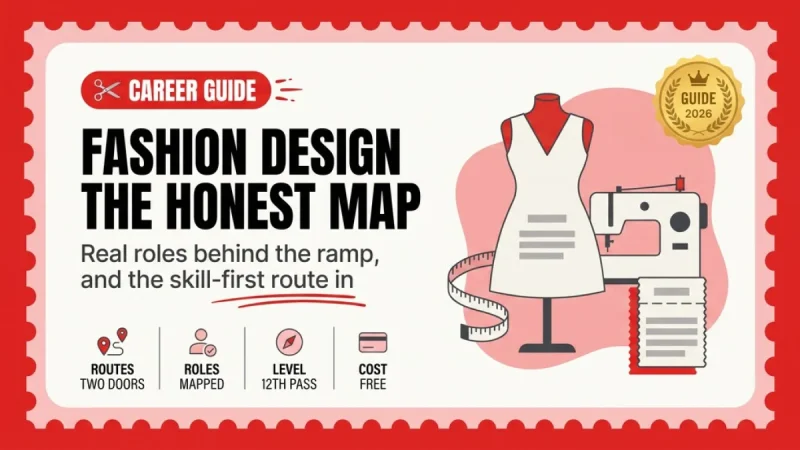
Fashion Design as a Career: the Routes, the Real Roles and What the Glamour Story Hides
Fashion design is sold to students as ramps and celebrity labels. The working industry is mostly something else: production houses, export units, e-commerce brands and boutiques that need trained people who can take a design from sketch to stitched garment on a deadline. That industry hires steadily — and this page maps the honest way in.
ADVERTISEMENT
❗The problem this page is trying to fix
Two stories dominate fashion-career conversations at home. The glamour story — designer labels, fashion weeks, fame — which describes a tiny sliver of the field. And the dismissal story — “tailoring with a fancy name” — which misses an industry of brands, exporters and e-commerce players that employs designers, merchandisers and technical specialists in volume.
Between the two stories, students make badly informed choices: paying heavily for private fashion courses without checking what jobs exist, or abandoning genuine design talent because nobody at home can name a stable role in the field.
Below: the role families that actually employ people, the entrance-exam route versus the skill-first route, and the zero-cost tests to run before any fee is paid.
🔍The field, stated honestly
Where the jobs actually are
Mostly behind the ramp: apparel brands, export houses, e-commerce fashion, uniform and ethnic-wear producers, boutiques. Celebrity couture is the shop window, not the industry.
Design vs merchandising vs technical
The field splits into creative roles (designer, stylist), business roles (merchandiser, buyer) and technical roles (pattern maker, garment technologist). All three hire; only the first is ever advertised to students.
The NIFT-style route
National-level design institutes admit through entrance exams after 12th — a structured, competitive route with strong campus access. Check current eligibility and dates only on the official exam notification.
The skill-first route
Pattern making, garment construction, draping and CAD tools can be learned and proven without an elite institute — a stitched portfolio of real garments opens boutique, export and brand doors.
What we do not quote
We do not quote salaries, institute fees or placement rates — current verified figures are not published in our source. Private institute brochures quoting them deserve the same scepticism everywhere.
Who this page is for
Students of any stream who are drawn to garments and styling — and parents trying to judge whether the interest is a career or a costly detour.
📋Roles, skills and employers
Three columns: the role families, the skill stack in learning order, and the employers behind the glamour curtain.
👗 Role families
Fashion designer (apparel lines)Pattern maker / garment technologistFashion merchandiser (the business side)Textile and print designerFashion stylist (shoots, personal, e-commerce)Production and quality roles in apparel unitsFashion illustrator and CAD designerCostume design (film and TV lane)
🧵 Skill stack, in order
Sketching and illustration basicsFabric knowledge — by touch, not theoryGarment construction and stitchingPattern making and drapingCAD tools for fashion (digital patterns)A stitched-garment portfolioBasic costing and production vocabularyTrend research as a weekly habit
🏢 Who employs in this field
Apparel brands and retail chainsExport houses (large-volume hirers)E-commerce fashion platformsBoutiques and designer studiosTextile mills and print housesFilm, TV and OTT costume departmentsUniform and institutional-wear producersYour own label — later, not first
ADVERTISEMENT
✨What changed — and why the old advice is stale
E-commerce rewrote entry hiring. Online fashion brands need catalogue styling, size-set grading and fast design cycles continuously — a steady hiring lane that did not exist for earlier generations.
Regional demand grew up. Ethnic wear, bridal and boutique culture in cities like Hyderabad sustains real local employment — the field is no longer Mumbai-or-nothing.
Digital tools entered the studio. CAD pattern tools and digital illustration are now standard in export and brand houses — students who combine stitching knowledge with digital tools clear technical interviews faster.
Sustainability became a hiring word. Brands talk fabric sourcing and waste reduction; candidates who understand fabric genuinely — not as a slogan — stand out in interviews.
Social media became the portfolio rack. A public feed of stitched garments and styling work now functions as a living portfolio — boutiques and brands do scout from it.
🎓What you can do this week, at zero cost
Fashion has a cheap and honest entrance test: make something wearable. Start before any fee discussion.
Take one existing garment at home and alter it deliberately — fit, hem, detail. If the process absorbs you, that is signal; if it bores you, that is cheaper signal than any course fee.
Learn fabric by touch: handle cotton, silk-mix, synthetics at any cloth shop and learn to name them blind. Fabric sense is the field’s core literacy and it is free.
Sketch one design a day in a dedicated book — garments you would actually make, not fantasy couture. Thirty pages of dated sketches is an interview artefact.
Read the current official NIFT-style entrance notification end to end if the institute route tempts you — eligibility, pattern, dates — from the official site only, before any coaching conversation.
Follow three working designers or brands (not celebrities) and study how often they produce, what sells and what repeats. The business rhythm is the part the glamour story hides.
If the visual side pulls more than the garment side, read our graphic design guide below — styling, print and visual design overlap heavily.
🗺The route in, step by step
1
Run the making test first
Alter, stitch, drape — anything physical — for a month before committing money. Fashion careers are built on making; the taste for it cannot be purchased later.
2
Choose the route: entrance exam or skill-first
Strong academics and family support for a campus? Prepare for the official entrance cycle. Otherwise build the skill-first lane: construction, pattern making, a stitched portfolio — employers accept both doors.
3
Build a portfolio of finished garments
Five completed, wearable pieces photographed honestly beat fifty sketches. Document the process — fabric choice, pattern, fitting rounds — because interviews probe process.
4
Enter through production, merchandising or assistant roles
Export houses, brands and boutiques hire assistants and technical trainees steadily. The title is modest; the learning — costing, deadlines, fit corrections — is the actual fashion education.
5
Delay the own-label dream deliberately
A label needs production knowledge, supplier relationships and costing discipline — all learned inside the industry first. Work three years, then decide; the dream survives the delay if it is real.
ADVERTISEMENT
⚠️ What this page deliberately does NOT tell you
No salary figures. Pay varies by role family, city and employer type, and current verified figures are not published in our source — so we print none.
No institute rankings or fees. Private fashion-course fees vary wildly and verified placement data is not published in our source. Judge institutes by graduates’ actual work and employers, not brochures.
No entrance exam dates. Exam calendars are published fresh each cycle by the conducting bodies. Read the current official notification — never a coaching centre’s summary of it.
No boutique-economics promises. Whether an own label or boutique sustains depends on costing and clientele — variables no guide can verify for you. Industry employment first is the lower-risk sequence.
💬Frequently Asked Questions
Is fashion design a stable career or a glamour trap?
The glamour is a sliver; the industry behind it — brands, exporters, e-commerce, boutiques — employs designers, merchandisers and technical specialists steadily. Stability comes from employable skills: construction, pattern making, CAD and fabric sense.
Do I need NIFT or can I enter without it?
Both doors are real. Elite institutes offer structure and campus placement access via their official entrance exams; the skill-first route — construction skills plus a stitched portfolio — enters through brands, export houses and boutiques. Portfolios decide more than nameplates over time.
Which stream in Intermediate suits fashion design?
Any stream. Design entrances and skill-first hiring are open regardless of MPC, BiPC, CEC or arts. What matters is the making habit — sketching, stitching, fabric sense — built alongside whatever you study.
Is tailoring knowledge necessary for a designer?
Construction knowledge separates employable designers from sketchers. You need not become a production tailor, but a designer who cannot judge a seam, a fit or a fabric’s behaviour cannot correct one either — and interviews test exactly that.
Can boys build fashion careers, or is it a girls’ field?
The industry employs everyone — many leading designers, pattern masters and merchandisers are men. Export houses and brands hire on skill and portfolio; the stereotype exists at home, not in the hiring room.
Why does this page not name the best fashion institutes?
Because verified, current placement data is not published in our source, and institute quality shifts batch to batch. The honest test is public: look at what an institute’s recent graduates actually make and where they work — then decide.
📚Read Next on BeInCareer
Daily job & course updates, free
Walk-in drives, admission dates and new government courses — the day they are announced.
Source: This is career guidance written by the BeInCareer editorial team on 30 October 2026, mapping the fashion industry’s role families, the entrance-exam and skill-first routes, and the employers behind the glamour narrative. It deliberately contains no salary figures, no institute fees and no placement statistics, because current verified figures are not published in our source. Verify entrance details on official exam notifications only.