
CAREER GUIDE · 29 OCT 2026
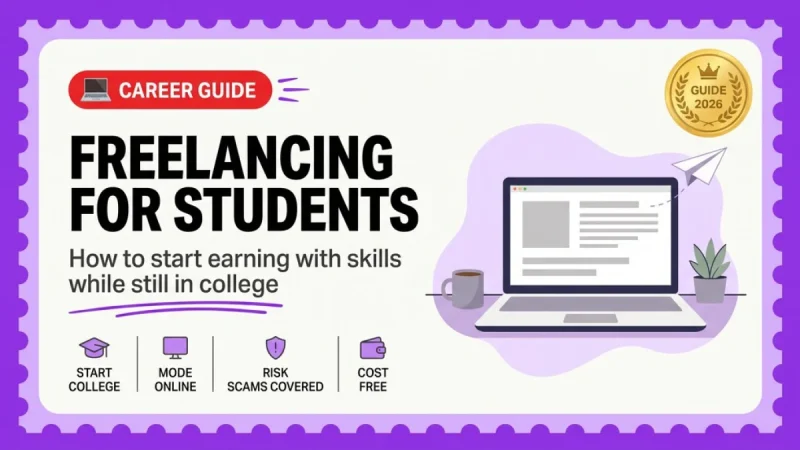
Freelancing for Students: How to Actually Start, and How to Not Get Scammed on the Way
Every student has seen the reels: “I earn in dollars from my hostel room”. Some of it is real. Most of what is sold around it is not. This is the unglamorous working version — what sells, how the first client actually happens, and the traps set specifically for students.
ADVERTISEMENT
❗The problem this page is trying to fix
Freelancing advice for students comes in two dishonest flavours. The first is the income-screenshot reel, which skips the eighteen months of unpaid skill-building behind the screenshot. The second is the “freelancing course” that charges you to learn how to earn — sold hardest to the students who can least afford it.
The truth in between: freelancing genuinely works for a minority of students who treat it as a skill business, and it quietly produces the single most valuable thing a fresher can own — verifiable work done for a real stranger who paid for it. That artefact outperforms most certificates in a placement interview.
So this page is honest about both halves: the slow mechanics of starting, and the scams that are waiting for you while you do.
🔍What student freelancing actually looks like
The honest timeline
Months of skill-building and samples before the first paid work. The reels skip this part; your plan should not.
What a client buys
A finished deliverable with zero hand-holding. Clients do not buy potential, effort or enthusiasm — they buy outcomes with deadlines.
The first-client problem
Nobody hires a freelancer with no work history — so your first 2-3 pieces are samples you make for yourself, or small jobs at small prices that buy you reviews.
Time reality
Freelancing alongside a degree is a 1-2 hour daily commitment at minimum. If attendance and backlogs are already a fire, fix those first.
Payment basics
A bank account (UPI-enabled), clear scope agreed in writing before starting, and part-payment in advance for anything non-trivial. Screenshots of agreement count as writing.
What it builds
A portfolio, client communication skill, and proof a stranger paid for your work — all three transfer directly into placement interviews later.
📋What sells, what to prepare, what to run from
Pick ONE skill from the first group. The multi-skill “I do everything” profile earns nothing.
✅ Skills students genuinely sell
Content writing (English or Telugu)Video editingGraphic / poster designWeb development (small sites)Social media page managementThumbnail designSubtitling and transcriptionOnline tutoringSpreadsheet / data clean-up workVoice-over (Telugu)
💼 What you need before the first client
2-3 finished samples made for yourselfOne page describing what you deliverA UPI-enabled bank accountA fixed daily time slotA simple rate you can say out loud without flinching
🚨 Run from these immediately
Any site charging a registration or joining fee“Data entry jobs” demanding a security depositClients asking work via personal payment apps only“Complete 50 free tasks to unlock payment”Courses that teach freelancing but show no client workAnyone paying you to recruit more studentsJobs requiring your bank OTP or screen share
ADVERTISEMENT
✨The mechanics nobody explains
Your first three clients come from proximity, not platforms. Local businesses, seniors with startups, coaching centres, temple and function committees, shop owners who need posters — people who can see you are real. Platforms work later, after you have reviews.
Price the first jobs to buy proof, not profit. The first few deliveries are purchasing testimonials and portfolio pieces. Charge something — free work is not respected — but optimise for a finished, praised delivery.
Scope in writing, every single time. One message: what you will deliver, by when, for how much, with how many revisions. Students skip this and then do five free revisions. The message takes two minutes.
Advance payment is normal, not rude. 30-50% before starting is standard practice. A client who refuses any advance on a non-trivial job has told you something — listen.
One niche beats five skills. “I edit wedding and event reels” gets hired. “I do editing, design, writing and coding” does not. Narrow until it feels uncomfortable, then start.
🎓What you can do this week, at zero cost
Starting costs nothing but time. Anyone telling you otherwise is the trap this page warns about.
Pick the one skill you will sell and write it as a single sentence: “I make ___ for ___”.
Make the first sample this week — a poster for an imaginary shop, an edited reel, a rewritten college-fest announcement. Finished, not perfect.
List ten local, reachable people or businesses who plausibly need that deliverable. Proximity list, not dream-client list.
Set up the boring infrastructure: UPI bank account, a folder for samples, a message template for scope-price-deadline.
Strengthen the skill itself with the free certifications we have verified — content writing and UI/UX design are linked below.
Read our fake-job warning signs guide (below) once, properly — students are the top target demographic for work scams.
🗺From first client to something real
1
Weeks 1-2: samples and the proximity list
Three finished samples, ten reachable prospects, one scope message template. Do not touch global platforms yet — a profile with zero reviews converts nowhere.
2
Weeks 3-6: the first paid deliveries
Offer the deliverable to the proximity list at a modest fixed price. The goals are a completed job, a testimonial you can screenshot, and one referral. Profit comes later.
3
Months 2-4: raise price, collect proof
Each delivery adds a portfolio piece. Raise the rate gently as proof accumulates. Start a simple public portfolio — even a well-organised drive folder or an Instagram page works.
4
Month 4+: platforms, now with ammunition
With reviews and a portfolio, platform profiles start converting. Expect slow weeks; freelancing income is lumpy by nature, which is why it pairs well with studies rather than replacing them.
5
Throughout: protect the degree and yourself
The degree finishes; most student freelancing careers evolve into better placements, not platform empires — and that is a win. And the iron rule holds everywhere: money flows from client to you. Never the reverse, never a “joining fee”, never a deposit.
ADVERTISEMENT
⚠️ What this page deliberately does NOT tell you
No income figures. Student freelance earnings vary from pocket money to rare outliers, and no verifiable source publishes a real distribution — not published in our source, so we print none. Reel screenshots are not data.
No platform rankings. Platform fees, rules and payout mechanics change frequently; check each platform’s current terms yourself before relying on it.
No tax advice. Income tax and GST treatment of freelance income depends on amounts and circumstances we cannot know; consult the official rules or a professional once your income is real.
No “quit college” romance. Nothing here supports dropping a degree for freelancing. The degree plus a paid-work portfolio is the strong position; either alone is weaker.
💬Frequently Asked Questions
Can a college student really earn by freelancing in India?
Yes, modestly and slowly, if one skill is built properly and the first clients are found locally. The honest pattern is months of skill and sample building, then small paid jobs that buy testimonials, then gradually better rates. The overnight version in reels is marketing.
Which freelancing skill is best for a student?
The one you can practise daily and finish deliverables in: content writing, video editing, poster design, small web projects, tutoring, subtitling. Pick exactly one and go narrow — a specific niche gets hired, a generalist student profile does not.
How do I get my first client with no experience?
Make 2-3 samples for yourself first, then offer the deliverable to people who can verify you are real: local businesses, seniors, coaching centres, event organisers. Platforms come later, after reviews exist. First clients come from proximity, not from profiles.
Is a registration fee for a freelancing site normal?
No. A legitimate client or platform does not charge you a joining fee, security deposit or “task unlock” payment. Students are the prime target for exactly this scam. Money flows from client to freelancer — any reversal of that direction is the signal to leave.
Will freelancing affect my placements?
Done sanely, it helps: paid work for a real stranger is stronger interview evidence than most certificates, and it builds the communication skill interviews actually test. It hurts only when it eats attendance and backlogs — the degree stays the priority.
Should I pay for a course that teaches freelancing?
Almost never. The mechanics — samples, local clients, scope messages, advance payment — are fully learnable free, including on this page. If someone sells a freelancing course, ask to see their own client work first. Teaching freelancing is very often the seller’s only freelance income.
📚Read Next on BeInCareer
Daily job & course updates, free
Walk-in drives, admission dates and new government courses — the day they are announced.
Source: This is practical guidance written by the BeInCareer editorial team on 29 October 2026, based on how student freelancing commonly works and the scam patterns commonly reported around it. It deliberately contains no income figures, no platform rankings and no tax advice, because verifiable current figures are not published in our source. Platform terms and fees change; check each platform’s own current pages.