
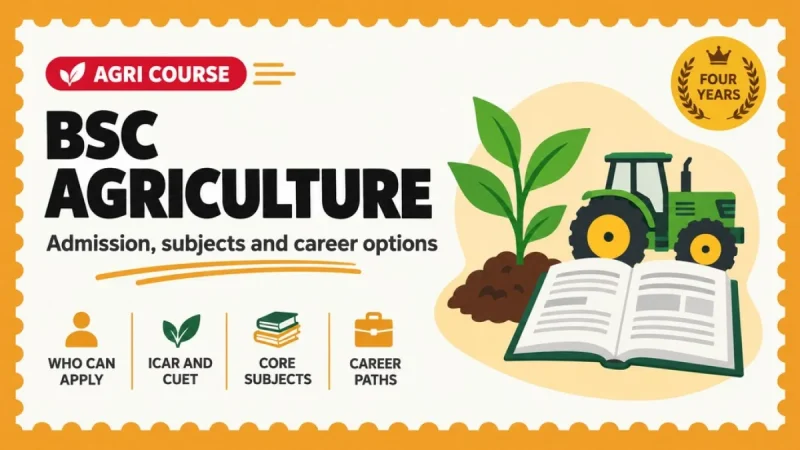
BSc (Hons) Agriculture is a four-year professional degree. Admission to the ICAR seat quota runs through CUET (ICAR-UG) conducted by NTA, and the fourth year is a rural work-experience programme, not classroom teaching. Here are the exact eligibility rules and the real career routes.
Quick snapshot
- B.Sc. (Hons.) Agriculture is a four-year programme. ICAR has declared all undergraduate agricultural science degrees to be professional degrees.
- For the ICAR quota, admission is through CUET (ICAR-UG), conducted by the National Testing Agency, which ICAR entrusted with the examination from 2019.
- Eligibility: 12th pass with at least three subjects from Physics, Chemistry, Mathematics, Biology and Agriculture as core courses.
- Minimum aggregate: 50% for General/OBC-NCL/EWS and 40% for SC/ST/Third Gender/PwBD, with no rounding off — 49.99% is not 50%.
- Minimum age is 16 years as on 31 August of the admission year, with no relaxation for any category.
- ICAR's quota is 20% of university seats in participating state agricultural universities, and 100% in six named central institutions.
- The fourth year is Student READY, including RAWE — Rural Agricultural Work Experience — worth 18 to 20 credits at most SAUs.
B.Sc. (Hons.) Agriculture is a four-year professional degree offered by state agricultural universities, ICAR deemed universities and central agricultural universities. For the ICAR seat quota you must qualify CUET (ICAR-UG), conducted by the NTA. You need a 12th pass with at least three of Physics, Chemistry, Mathematics, Biology and Agriculture as core subjects, a minimum aggregate of 50% (40% for SC/ST/Third Gender/PwBD) computed without rounding off, and a minimum age of 16 years as on 31 August of the admission year, with no relaxation.
Many states also run their own agricultural university entrance tests or admit through CUET UG for the state quota, so you usually apply through two routes in parallel. The degree leads to Agriculture Officer and Agriculture Development Officer posts in state departments, the IBPS Specialist Officer Agricultural Field Officer route in public sector banks, the ICAR Agricultural Research Service via ASRB after a Master's, and roles in seed, fertiliser, agrochemical and agri-fintech companies.
1. Eligibility for BSc Agriculture, as ICAR writes it
The ICAR Information Bulletin for CUET (ICAR-UG) sets the conditions for the ICAR quota. State universities may set slightly different conditions for their own state quota, so read both. The ICAR conditions are:
| Condition | Requirement |
|---|---|
| Qualifying exam | 12th standard pass or appearing, from a recognised board |
| Subjects | At least three subjects from Physics, Chemistry, Mathematics, Biology and Agriculture (or Inter-Agriculture) as core courses |
| Minimum aggregate — General, OBC-NCL, UPS, EWS | 50% |
| Minimum aggregate — SC, ST, Third Gender, PwBD | 40% |
| Rounding off | Expressly not permitted. 49.99% does not count as 50% |
| Minimum age | 16 years as on 31 August of the admission year, no relaxation for any category |
| Reservation | 15% SC and 7.5% ST, interchangeable between the two if seats remain unfilled |
| Diploma or vocational course | A diploma or vocational course taken after matriculation is not accepted as the qualifying examination |
| Medium of instruction | English |
Three of those lines reject more candidates than anything else. The no rounding off rule is applied literally. The three core subjects rule means a student who took Agriculture plus Biology plus one more qualifies, but a student with only two of the listed subjects as core does not. And the diploma exclusion catches students who did a two-year agriculture polytechnic after class 10 and assumed it substituted for 12th.
There is no nomination route, and we are not quoting fees
The ICAR bulletin states plainly that there is no provision of direct nomination for admission through ICAR without qualifying in CUET (ICAR-UG). If anyone offers you an "ICAR management quota" seat without the entrance test, it is not an ICAR seat.
We are also deliberately not quoting course fees, hostel charges or the RAWE stipend. Fees are fixed by each agricultural university and differ between state quota and ICAR quota, and the stipend paid during rural work experience varies by university and year. Take all of these from the admitting university's current fee notification and the official information bulletin. We are likewise not publishing starting salary ranges for private agri-sector jobs, because no official source compiles them.
2. The admission routes: ICAR quota, state quota, CUET UG
The Indian agricultural education system is large and layered. ICAR's own figures describe an ICAR-Agricultural Universities system of 74 agricultural universities — 63 state agricultural universities, 4 ICAR deemed-to-be universities, 3 central agricultural universities and 4 central universities with an agriculture faculty — admitting more than 28,000 undergraduate and more than 17,500 postgraduate and doctoral students a year.
ICAR quota through CUET (ICAR-UG)
ICAR entrusted the examination to the NTA from 2019. It covers 13 four-year Bachelor degree programmes, including B.Sc. (Hons.) Agriculture, Horticulture, Forestry, Community Science, Food Nutrition & Dietetics, Sericulture, Natural Farming and Agribusiness Management, plus B.F.Sc. and the B.Tech. streams in Agricultural Engineering, Dairy Technology, Food Technology and Biotechnology.
Understand what the ICAR quota actually is
ICAR reserves 20% of university seats in participating state agricultural universities. The quota is 100% at six institutions: Rani Lakshmi Bai Central Agricultural University Jhansi, Dr Rajendra Prasad Central Agricultural University Pusa, ICAR-NDRI Karnal, ICAR-IARI Assam, ICAR-IARI Jharkhand and ICAR-IVRI Izatnagar. Total seats offered through the examination are published afresh each cycle in the information bulletin.
State quota, in parallel
The remaining 80% of seats at a state agricultural university are filled by the state's own process — a state agricultural entrance test, the state engineering/agriculture common entrance test, or CUET UG, depending on the state. Apply to both the ICAR route and your state route in the same cycle; they are separate applications with separate deadlines.
Verify the university, not the college brochure
Agricultural degrees from institutions outside the ICAR-AU system are sometimes advertised aggressively. Since the degrees are professional degrees and recruitment rules for Agriculture Officer posts often reference a recognised agricultural university, confirm the awarding university's standing before you accept a seat.
3. What you actually study: the subject areas
The curriculum is set by ICAR's Deans' Committee. The Sixth Deans' Committee, constituted on 17 August 2021, restructured the curriculum and credit framework for 13 undergraduate disciplines, including two new ones — Natural Farming and Agribusiness Management. It also added a two-week induction programme, Deeksharambh, in the first semester, and new-age courses covering artificial intelligence, robotics and machine learning applied to agriculture.
The subject areas in a B.Sc. (Ag) programme, following ICAR's own classification, are:
Crop and plant sciences
- Crop Science — Principles of Agronomy, crop production, Weed Management, Seed Technology
- Plant Pathology — plant pathogens and principles of plant pathology
- Entomology — insect pests and their management
- Horticulture — fruit, vegetable, flower and plantation crops
- Biochemistry and Biotechnology
- Forestry and agroforestry
Resources, economics and allied
- Natural Resource Management — Fundamentals of Soil Science, soil chemistry and fertility, Agricultural Meteorology, water management, organic farming
- Agricultural Economics and Marketing
- Agricultural Extension — transfer of technology to farmers
- Agricultural Engineering — farm machinery, irrigation structures
- Statistics and Computer Application
- Animal Husbandry and Fisheries
The spread is deliberately wide. A B.Sc. (Ag) graduate is expected to be able to diagnose a field problem across soil, water, nutrient, pest and disease causes, and then advise on the economics of the fix. That breadth is exactly what the bank Agricultural Field Officer and state Agriculture Officer roles test.
4. Student READY and RAWE: the fourth year explained
Student READY stands for Rural Entrepreneurship Awareness Development Yojana. ICAR introduced it from the academic year 2016-17 to give undergraduate students hands-on, work-based learning rather than only classroom instruction. It has five components:
| Component | What it involves |
|---|---|
| Experiential Learning with business mode | Students run a small production or processing unit as a commercial activity, handling inputs, output and accounts |
| Hands-on training / skill development | Structured skill modules in the university's farms, labs and units |
| RAWE — Rural Agricultural Work Experience | Placement in villages, working directly with farm families and the extension system. Carried in the fourth year and worth 18 to 20 credits at most state agricultural universities |
| Internship / in-plant training / industrial attachment | Industry placement. In Dairy Technology, Food Technology and Agricultural Engineering, in-plant training replaces RAWE |
| Students Projects | A supervised project component |
Practically, your final year is spent off campus. RAWE means living and working in a village cluster, running diagnostic surveys, laying out demonstrations and reporting back. It is the single most employment-relevant year of the degree, because every extension, field-officer and agri-input job you will later apply for is a field job. Universities do pay a stipend during this period, but the amount is set by the university and the year, so take it from your university's circular rather than from a figure quoted online.
5. Career paths after BSc Agriculture
Government and public sector
- Agriculture Officer / Agriculture Development Officer / Agriculture Extension Officer in state departments of agriculture, recruited through state public service commissions and state subordinate service commissions.
- Agricultural Field Officer (Scale I) in public sector banks, through the IBPS Common Recruitment Process for Specialist Officers. The educational qualification for this post is a four-year degree (graduation) in Agriculture or an allied specialisation listed in the notification. This is the single most direct bank-job route a B.Sc. (Ag) graduate has, and it is one reason the four-year structure matters: three-year science degrees do not satisfy it.
- Agricultural Research Service (ARS), recruited by the Agricultural Scientists Recruitment Board. ARS and the ASRB NET both require a Master's degree in the relevant discipline, so this is a post-M.Sc. route, not an immediate one.
- Krishi Vigyan Kendra and state extension system positions; posts in agricultural marketing boards, warehousing corporations, seed certification agencies and cooperative federations.
We are not listing age limits, vacancy counts, application fees or pay levels for any of these, because each is set afresh in the individual recruitment advertisement and changes between cycles. Read the notification on the recruiting body's own website.
Private sector and self-employment
Corporate agri roles
- Seed companies — production, quality, breeding support, territory sales
- Fertiliser and agrochemical companies — field development, technical advisory, product management
- Food processing and commodity procurement
- Agri-fintech, farm advisory platforms and precision agriculture firms
- Farm equipment and irrigation companies
Own venture and further study
- Seed production, nursery, protected cultivation, food processing or input retail as a business
- Farmer Producer Organisation management and agri-advisory services
- M.Sc. (Ag.) in your chosen discipline, then Ph.D. — the required route for ARS, NET and academia
- MBA in Agribusiness Management for the corporate and management track
- Agricultural journalism, policy research and development-sector programme roles
6. Is BSc Agriculture a good choice? An honest read
The honest answer depends on what you want from it.
| Consideration | Where BSc Agriculture is strong | Where to be careful |
|---|---|---|
| Government job access | A genuinely wide set of state and bank posts specify an agriculture degree, which narrows the competition compared with a general graduate pool | Vacancy cycles in state agriculture departments are irregular; do not plan on a single exam |
| Four-year structure | Satisfies the four-year-degree condition for the IBPS Agricultural Field Officer post | It is a year longer than a general B.Sc., so factor in the opportunity cost |
| Practical training | Student READY and RAWE build real field competence that employers can test | The final year is off campus and physically demanding; it is not a light year |
| Research track | A well-defined ladder: M.Sc., then ASRB NET or ARS, then institutional research | ARS and NET both need a Master's, so the research route is at least two more years |
| Private sector | Seed, input, processing and agri-tech hiring is spread across the country, not just metros | Many entry roles are field sales with travel; confirm the job content before accepting |
| Where you study | The ICAR-AU system of state, central and deemed universities is well defined | Degrees from institutions outside that system can create problems at recruitment verification |
One planning point. Because the ICAR quota is 20% of seats at most participating universities, and because the examination has no nomination route, your realistic strategy is to prepare for CUET (ICAR-UG) and your state's agriculture admission route together. Both draw on the same class 11 and 12 Physics, Chemistry, Biology, Mathematics and Agriculture syllabus, so the preparation overlaps heavily. Check the current information bulletin for the subject-group options and the exact pattern, which are revised from cycle to cycle.
Frequently asked questions
What is the eligibility for BSc Agriculture?
For the ICAR quota through CUET (ICAR-UG) you need a 12th pass with at least three subjects from Physics, Chemistry, Mathematics, Biology and Agriculture as core courses. The minimum aggregate is 50 per cent for General, OBC-NCL, UPS and EWS candidates and 40 per cent for SC, ST, Third Gender and PwBD candidates, and rounding off is expressly not allowed. The minimum age is 16 years as on 31 August of the admission year with no relaxation for any category. State quota conditions at individual agricultural universities may differ, so read the state brochure as well.
Is CUET ICAR-UG compulsory for BSc Agriculture?
It is compulsory for the ICAR seat quota. The ICAR information bulletin states there is no provision of direct nomination for admission through ICAR without qualifying in CUET (ICAR-UG). The remaining seats at a state agricultural university are filled through the state's own admission process, which may be a state agricultural entrance test or CUET UG depending on the state. Most candidates apply through both routes in the same cycle.
How many seats does the ICAR quota cover?
ICAR reserves 20 per cent of university seats in participating state agricultural universities, and 100 per cent of seats at six institutions: Rani Lakshmi Bai Central Agricultural University Jhansi, Dr Rajendra Prasad Central Agricultural University Pusa, ICAR-NDRI Karnal, ICAR-IARI Assam, ICAR-IARI Jharkhand and ICAR-IVRI Izatnagar. The total number of seats offered is published fresh in the information bulletin each cycle, since universities confirm their intake annually.
What is RAWE in BSc Agriculture?
RAWE stands for Rural Agricultural Work Experience. It is one of the five components of ICAR's Student READY programme, which stands for Rural Entrepreneurship Awareness Development Yojana and was introduced from the academic year 2016-17. RAWE is carried out in the fourth year and is worth 18 to 20 credits at most state agricultural universities. Students are placed in villages to work with farm families and the extension system. In Dairy Technology, Food Technology and Agricultural Engineering programmes, in-plant training replaces RAWE.
Can I become a bank officer after BSc Agriculture?
Yes. Public sector banks recruit Agricultural Field Officers in Scale I through the IBPS Common Recruitment Process for Specialist Officers, and the educational qualification is a four-year degree in Agriculture or an allied specialisation listed in the notification. Because B.Sc. (Hons.) Agriculture is a four-year professional degree, it satisfies this condition, while a three-year general science degree does not. Age limits, vacancies and fees are set in each year's notification, so read it on the IBPS site.
Can I apply for ICAR ARS right after BSc Agriculture?
No. The Agricultural Research Service and the ASRB NET, both conducted by the Agricultural Scientists Recruitment Board, require a Master's degree in the relevant discipline. After B.Sc. (Ag.) you first complete M.Sc. (Ag.) in your chosen specialisation and then appear. Plan the research track as a postgraduate route rather than an immediate one.
Is a diploma in agriculture accepted for BSc Agriculture admission?
Not for the ICAR quota. The ICAR information bulletin states that a diploma or vocational course taken after matriculation is not accepted as the qualifying examination. You need a 12th pass from a recognised board with the required core subjects. Some state agricultural universities operate separate lateral entry or diploma-holder schemes under their own rules, so check the specific university's admission notification if that applies to you.
What are the fees for BSc Agriculture?
There is no single national figure and we will not guess one. Fees are fixed by each agricultural university and can differ between the ICAR quota seat and the state quota seat at the same university. Take the number from the admitting university's official fee notification and the current information bulletin, and budget hostel, mess and examination charges separately. The stipend paid during rural work experience also varies by university and year, so confirm it from the university circular.
Sources: Indian Council of Agricultural Research — agricultural education, Deans' Committee and Student READY; ICAR Education Division — undergraduate programmes and the ICAR-AU system; National Testing Agency — CUET (ICAR-UG) Information Bulletin, eligibility, age, reservation and seat matrix; NTA — CUET (ICAR-UG) official examination portal; Agricultural Scientists Recruitment Board — ARS and NET qualification requirements; IBPS — CRP Specialist Officers, Agricultural Field Officer educational qualification.
Related guides on BeInCareer
- BSc Nursing course guide: eligibility, entrance and careers
- B.Pharm vs D.Pharm: which pharmacy qualification to pick
- Agriculture business ideas in India
- BiPC career guide: courses, colleges and options
- Career options after Intermediate
- IBPS PO notification and eligibility
- Best books for bank exams
- Government exams you can write after graduation
- Courses and work areas across Indian states
- UGC guidelines on degrees and exams