
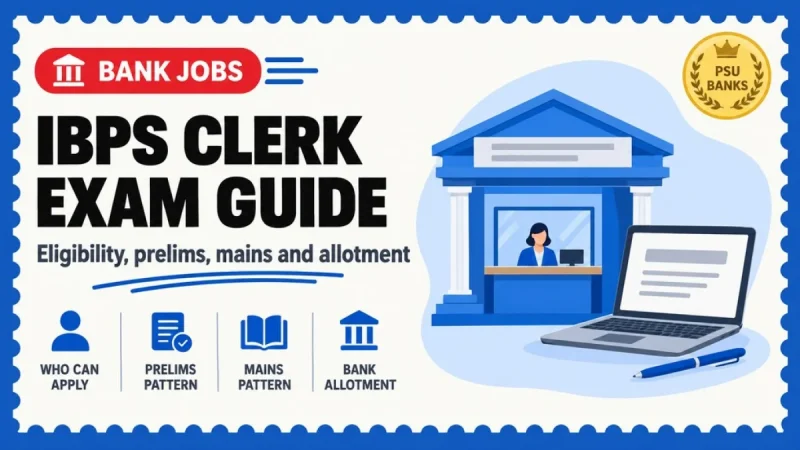
The IBPS Clerk post is now advertised as Customer Service Associate (CSA) — the same clerical cadre job, the same two-tier online exam, and still no interview. Here is the eligibility, the sectional timing, the local-language rule that disqualifies candidates after selection, and how state-wise allotment works.
Quick snapshot
- IBPS now calls the Clerk post Customer Service Associate (CSA). The notification describes it as a clerical cadre post in Participating Public Sector Banks.
- Eleven participating banks in CRP CSA-XVI: Bank of Baroda, Bank of India, Bank of Maharashtra, Canara Bank, Central Bank of India, Indian Bank, Indian Overseas Bank, Punjab National Bank, Punjab & Sind Bank, UCO Bank and Union Bank of India.
- Qualification: a degree in any discipline from a university recognised by the Government of India, plus mandatory computer literacy.
- Age band in CRP CSA-XVI: minimum 20, maximum 28 years as on 01.08.2026, with 5 years relaxation for SC/ST, 3 for OBC (NCL) and 10 for PwBD.
- Prelims: 100 questions, 100 marks, 60 minutes, three separately timed sections of 20 minutes each.
- Mains: 160 questions, 200 marks, 125 minutes, four separately timed sections. Main exam marks alone decide the final merit list.
- There is no interview — but there is a compulsory, qualifying Local Language Proficiency Test (LLPT) before you join.
IBPS Clerk — advertised as Customer Service Associate under the Common Recruitment Process (CRP CSA) — is a two-tier online objective exam for clerical cadre posts in participating public sector banks, open to any graduate. The Preliminary exam has three sections: English Language (30 questions, 30 marks), Numerical Ability (35 questions, 35 marks) and Reasoning Ability (35 questions, 35 marks) — 100 questions for 100 marks in 60 minutes, with a separate 20-minute timer on each section.
The Main exam has four separately timed sections: General/Financial Awareness (40 questions, 50 marks, 20 minutes), General English (40 questions, 40 marks, 35 minutes), Reasoning Ability (40 questions, 60 marks, 35 minutes) and Quantitative Aptitude (40 questions, 50 marks, 35 minutes) — 160 questions for 200 marks in 125 minutes. In both phases, one-fourth (0.25) of the marks assigned to a question is deducted for a wrong answer. There is no interview. Main exam marks alone decide the merit list, after which candidates are provisionally allotted to one bank on a merit-cum-preference basis and must clear a qualifying local language test before joining.
1. What a bank Clerk actually does, day to day
The rename from Clerk to Customer Service Associate describes the job as it now exists. A CSA sits at the counter or at a desk in a branch and is the first bank employee a customer deals with. The work is cash, documents, data entry and conversation, in proportions that change with the branch.
- Single window operations — cash and cheque deposits, payments, passing vouchers within your authority limit, balancing cash at day end.
- Account opening and KYC — verifying identity and address documents, entering customer data into the core banking system, re-KYC follow-ups, Aadhaar and PAN linking.
- Clearing and remittances — cheque clearing entries, NEFT and RTGS requests, DD issue, stop-payment instructions.
- Deposits and lockers — opening and closing FDs and RDs, interest certificates, nominations, locker records.
- Government scheme work and customer handling — account seeding for direct benefit transfers, social security enrolments, pension entries, counter-level complaints, and routing cases to the officer cadre.
Two things candidates underestimate. This is a public-facing, transferable job within the state or region you are recruited for, and rural and semi-urban postings are normal early on. It is also a promotion ladder, not a dead end: clerical cadre staff are eligible for internal promotion to the officer cadre through tests and interviews run by their own bank. The years of service required and the number of channels are fixed by each bank's own promotion policy, not by IBPS.
2. Eligibility: graduation, computer literacy and the local language rule
The bar is low on paper and strict in practice. As per the CRP CSA-XVI notification:
| Requirement | What the notification says |
|---|---|
| Educational qualification | A Degree (Graduation) in any discipline from a University recognised by the Govt. of India, or an equivalent qualification recognised as such by the Central Government. No minimum percentage is prescribed, but you must declare your graduation percentage while registering. |
| Result date | You must already be a graduate on the day you register, holding a valid mark-sheet or degree certificate, with the final result declared on or before the cut-off date in the notification. Final-year students awaiting results are not eligible. |
| Computer literacy | Mandatory. A certificate, diploma or degree in computer operations or language, or having studied Computer/Information Technology as a subject in high school, college or institute. |
| Local language | Candidates applying for a particular State/UT must be proficient in reading, writing, speaking and understanding the specified local language of that State/UT, chosen from the notification's list. |
| Nationality | Citizen of India, or a subject of Nepal or Bhutan, or a Tibetan refugee who came to India before 1 January 1962, or a person of Indian origin who migrated from specified countries — the last four need a certificate of eligibility from the Government of India. |
| Ex-servicemen route | Matriculate ex-servicemen holding the Army Special Certificate of Education or its Navy/Air Force equivalent, after not less than 15 years of service, may qualify without the civil degree. |
How the local-language rule is enforced. You choose one language at application time from the list prescribed for your State/UT. Produce a 10th standard or higher mark-sheet showing you studied that language and you are exempt. Otherwise you sit the Local Language Proficiency Test (LLPT) — marks-based, qualifying, conducted by an independent body or the bank, after the Main result or provisional allotment but before you join. Candidates who fail are not offered appointment and are disqualified.
| State/UT | Specified local language(s) for LLPT |
|---|---|
| Andhra Pradesh / Telangana | Telugu / Urdu |
| Tamil Nadu, Puducherry | Tamil |
| Karnataka | Kannada |
| Kerala, Lakshadweep | Malayalam |
| Maharashtra | Marathi |
| Odisha | Odia |
| West Bengal | Bengali / Nepali |
| Uttar Pradesh, Bihar | Hindi / Urdu |
| Delhi, Madhya Pradesh, Rajasthan, Chhattisgarh, Himachal Pradesh, Uttarakhand | Hindi |
| Gujarat, and Dadra & Nagar Haveli and Daman & Diu | Gujarati |
The medium of the exam is a separate choice from the LLPT language. For Andhra Pradesh the Numerical, Reasoning and awareness papers are offered in English, Hindi and Telugu; for Telangana in English, Hindi, Telugu and Urdu. The English papers are always in English only. Check the full State/UT list in the notification before applying.
The mistake that costs selected candidates their job: treating the language declaration as a formality. Candidates who apply for another state's vacancies because they assume the cut-off is lower, or who tick a language they only speak at home and never studied, get caught at the LLPT — after clearing both exams and after allotment. If you have no 10th-standard certificate in the language and cannot read and write it, apply for a state whose language you genuinely know.
3. Age limit and category relaxations
For CRP CSA-XVI the band is minimum 20 and maximum 28 years as on 01.08.2026, which the notification converts into a date-of-birth window of 02.08.1998 to 01.08.2006 (both inclusive). The crucial date and the window are re-fixed in every year's CRP advertisement — read the age clause in the notification you are applying under, not last year's.
| Category | Relaxation in upper age limit |
|---|---|
| Scheduled Caste / Scheduled Tribe | 5 years |
| Other Backward Classes (Non-Creamy Layer) | 3 years |
| Persons with Benchmark Disabilities (RPwD Act, 2016) | 10 years |
| Ex-Servicemen / Disabled Ex-Servicemen | Actual period of service in the defence forces + 3 years (8 years for Disabled Ex-Servicemen belonging to SC/ST), subject to a maximum age limit of 50 years |
| Widows, divorced women and women legally separated and not remarried | Concession up to 35 years for General/EWS, 38 for OBC and 40 for SC/ST |
Three rules that catch people out. Relaxation for SC/ST/OBC (NCL) is cumulative with only one of the remaining relaxation categories. The stated maximum age applies to General and EWS candidates alike — EWS gets reservation but no age relaxation. And OBC candidates need a certificate carrying the non-creamy layer clause in the Government of India format, issued within the validity window given in the notification; creamy-layer OBC candidates must apply as General.
4. Preliminary exam pattern and sectional timing
Prelims is pure screening. Its marks never enter the final merit list. What it does is separate candidates who can work fast under a sectional clock from those who cannot.
| # | Test | Medium | Questions | Max marks | Time (separately timed) |
|---|---|---|---|---|---|
| 1 | English Language | English | 30 | 30 | 20 minutes |
| 2 | Numerical Ability | English/Hindi/local, per State/UT list | 35 | 35 | 20 minutes |
| 3 | Reasoning Ability | English/Hindi/local, per State/UT list | 35 | 35 | 20 minutes |
| Total | 100 | 100 | 60 minutes |
Separately timed is the operative phrase. You get 20 minutes on English, the screen moves on, and you cannot borrow time from a section you found easy. You must clear a cut-off in each of the three tests, decided by IBPS, and then be high enough in the category-wise shortlist IBPS draws based on requirements. Those cut-offs are set afresh each cycle and published only after the result, so nobody can tell you in advance what score will clear.
5. Main exam pattern — and what CSA-XVI changed
This is where selection actually happens. Read the current table carefully, because the structure in the CRP CSA-XVI notification is not the one older study material describes.
| # | Test (not by sequence) | Medium | Questions | Max marks | Time (separately timed) |
|---|---|---|---|---|---|
| 1 | General / Financial Awareness | English/Hindi/local, per State/UT list | 40 | 50 | 20 minutes |
| 2 | General English | English | 40 | 40 | 35 minutes |
| 3 | Reasoning Ability | English/Hindi/local, per State/UT list | 40 | 60 | 35 minutes |
| 4 | Quantitative Aptitude | English/Hindi/local, per State/UT list | 40 | 50 | 35 minutes |
| Total | 160 | 200 | 125 minutes |
- Marks are not equal to questions. Reasoning carries 40 questions for 60 marks — 1.5 marks each, the highest weight in the paper. Awareness is 40 for 50. General English is the only 1-mark-per-question section.
- Awareness has the tightest clock: 40 questions in 20 minutes, 30 seconds each. It is recall. You know it or you move on.
- Sections are "not by sequence", so do not plan a fixed order of attack.
- The 200 marks are converted out of 100 for provisional allotment, and are the only marks that count for merit.
Candidates called for the Main exam must also carry the authenticated and stamped Preliminary call letter with a stamped copy of the ID proof, and anyone reporting after the time printed on the call letter is not allowed to sit the exam.
6. Negative marking, cut-offs and normalisation
The penalty clause applies to both phases: for each wrong answer, one-fourth (0.25) of the marks assigned to that question is deducted to arrive at the corrected score. A blank question carries no penalty.
Because the deduction is a fraction of the question's marks and not a flat value, a wrong answer costs more in the heavier sections — 0.375 marks in Mains Reasoning, where a question is worth 1.5 marks, against 0.25 in General English. The arithmetic of guessing is unchanged: a blind guess loses money, an educated guess after eliminating two or three options does not.
Two scoring mechanisms matter. Corrected scores from different sessions are normalised using the equi-percentile method, taken to two decimal points, so you are not judged purely against your own shift's difficulty. And in the Main exam you must obtain both a minimum score in each test and a minimum total score; State/UT-wise cut-offs are then set against the vacancies available. IBPS does not share Main exam scores before the allotment process is complete.
7. Why you choose one State/UT, and how vacancies are distributed
Clerical cadre recruitment in public sector banks is done on a State/UT-wise basis. The consequence stated in the notification is that a candidate can apply for vacancies in any one State/UT only, and must appear for the exam at a centre in that State/UT. IBPS may allot you a centre outside your chosen State/UT if response or administrative feasibility demands it, but that reallocation is only for conducting the exam — you remain in the running only for vacancies of the State/UT you applied for.
Vacancies are published bank-wise and category-wise for every State/UT and are explicitly indicative, depending on business volume, branch expansion and the health of the bank. Final allotment is made against the actual vacancies reported by the banks, and some banks report nothing for a given state, shown as "NR" in the annexure. Indicative totals in the CRP CSA-XVI annexure show how lopsided the distribution is:
| State/UT | Indicative total vacancies (all 11 banks, CRP CSA-XVI, for 2027-28) | Largest single contributor |
|---|---|---|
| Andhra Pradesh | 186 | Indian Bank (55) |
| Telangana | 191 | Indian Bank (50) |
| Bihar | 491 | Central Bank of India (132) |
| Assam | 349 | Punjab National Bank (102) |
| Arunachal Pradesh | 45 | Punjab National Bank (14) |
| Andaman & Nicobar Islands | 18 | Canara Bank (15) |
Read your own state's table before you choose. A state with 18 clerical vacancies and one with 491 are not the same exam, even though the paper is identical. But choose on where you can live, work and pass the language test — not on a guess about cut-offs, which are published only after the fact.
8. Provisional allotment, reserve list and the no-interview rule
This is the structural difference between the Clerk/CSA process and the officer process. In CRP PO/MT, candidates shortlisted from the Main exam are called for a Personality Test and a Common Interview conducted by the participating banks and coordinated by a Nodal Bank. In CRP CSA, the structure of examination contains only the two online tests, and the notification states plainly that marks obtained in the Online Main Examination only will be considered for final merit listing. There is no interview for the clerical cadre post.
Note also that the eligibility criteria in the notification is only the basic criteria. IBPS is explicit that the ultimate authority for recruitment is the participating bank, which may in its sole discretion reject the candidature of a person allotted to it, and that the appointment letter and terms of employment are entirely the bank's decision.
On pay: the CRP CSA-XVI notification gives the basic pay scale as ₹24,050–1340/3–28,070–1650/3–33,020–2000/4–41,020–2340/7–57,400–4400/1–61,800–2680/1–64,480. Allowances and perquisites are paid "as per rules of the Participating Bank in force from time to time", which is why no single gross or in-hand figure can be stated for the post. The scale itself is revised under the industry-level bipartite settlement and restated in each year's advertisement. Treat any specific "IBPS Clerk salary in hand" number as unverified unless it names the bank, the city and the settlement.
9. Preparation strategy, section by section
The design of the exam dictates the strategy. Prelims is a speed test with sectional locks; Mains is a weighted test where Reasoning is worth the most and awareness is the fastest. Prepare to the Mains standard from day one, because Prelims marks are discarded.
Reasoning Ability (highest weight)
40 questions for 60 marks in Mains. Build it in two layers. Layer one is the low-risk scoring set: inequality, syllogism, blood relations, direction sense, order and ranking, alphanumeric series, coding-decoding. Layer two is puzzles and seating arrangement — linear, circular, floor, box, scheduling and category based — which eat the clock. Do one full puzzle set daily against a timer and learn to abandon a puzzle you cannot crack in three minutes.
Quantitative Aptitude / Numerical Ability
Simplification and approximation, quadratic comparison, number series and data interpretation are the bulk scorers; arithmetic word problems — percentage, ratio, average, profit and loss, SI and CI, time and work, time and distance, mixtures, partnership — decide accuracy. Memorise tables to 25, squares to 40, cubes to 20 and the common fraction-to-percentage equivalents; that alone changes your attempt count in a 20-minute section. Two DI sets a day.
English Language
Reading comprehension is the largest block, then cloze test, error spotting, sentence improvement, para jumbles and fillers. Read one editorial from a national daily every day — not for current affairs, but to make long sentences feel normal. Work through subject-verb agreement, tenses, prepositions, articles and modifiers from one standard book rather than five, and learn vocabulary in context instead of from lists.
General / Financial Awareness
40 questions in 20 minutes is pure recall, and it is the most neglected section. Cover roughly the last six months of banking and economy news, RBI policy and regulatory changes, budget and schemes, banking terminology and abbreviations, central bank functions, money and capital market basics, insurance and pension basics, plus static items such as bank headquarters and taglines. Keep a one-page monthly digest and revise it weekly. Cheapest marks in the paper.
Operationally: one full-length mock in Mains format weekly from the start, two a week in the last month, and spend as long analysing each mock as you spent taking it. Track attempts, accuracy and time per question for every section. Since both phases are computer-based with sectional timers, practise only on an online interface, never on paper.
Dates, fees and figures change every cycle. CRP CSA-XVI listed the application fee as ₹175 (inclusive of GST) for SC/ST/PwBD/ESM/DESM candidates and ₹850 (inclusive of GST) for all others, with registration in August 2026, Prelims in October 2026, Mains in December 2026 and provisional allotment in March 2027 — a tentative schedule IBPS can revise. The fee, the crucial date for age, the qualification cut-off date and the vacancy tables are all fixed afresh in each year's CRP advertisement. Do not act on these numbers from a secondary website: open the current notification PDF on ibps.in and read clauses B, C and D yourself.
Frequently asked questions
Is IBPS Clerk the same as Customer Service Associate?
Yes. IBPS now advertises the clerical cadre post in participating public sector banks as Customer Service Associate (CSA), and the process is titled CRP CSA. The role, the two-tier online exam and the state-wise allotment system are the same process candidates have long known as IBPS Clerk.
What is the age limit for IBPS Clerk?
The CRP CSA-XVI notification sets a minimum of 20 and a maximum of 28 years as on 1 August 2026, with a date-of-birth window given in the notification. Upper-limit relaxation is 5 years for SC/ST, 3 for OBC (Non-Creamy Layer), 10 for Persons with Benchmark Disabilities, and for ex-servicemen the actual defence service plus 3 years subject to a 50-year ceiling. The crucial date is fixed afresh every year, so check the notification you are applying under.
Is there an interview for IBPS Clerk?
No. The structure of examination for CRP CSA has only the Online Preliminary and Online Main examinations, and the notification states that marks obtained in the Online Main Examination only will be considered for final merit listing. CRP PO/MT, by contrast, has a Personality Test and a Common Interview. What the Clerk process does include is a compulsory, qualifying Local Language Proficiency Test before joining.
What is the IBPS Clerk Prelims exam pattern?
Three objective sections, each separately timed for 20 minutes: English Language (30 questions, 30 marks), Numerical Ability (35 questions, 35 marks) and Reasoning Ability (35 questions, 35 marks) — 100 questions for 100 marks in 60 minutes. You must qualify in each of the three tests by securing cut-off marks decided by IBPS, then make the category-wise shortlist. Prelims marks do not count towards the final merit list.
What is the IBPS Clerk Mains exam pattern?
As per the CRP CSA-XVI notification: General/Financial Awareness (40 questions, 50 marks, 20 minutes), General English (40 questions, 40 marks, 35 minutes), Reasoning Ability (40 questions, 60 marks, 35 minutes) and Quantitative Aptitude (40 questions, 50 marks, 35 minutes). That is 160 questions for 200 marks in 125 minutes, all sections separately timed, and the 200 marks are converted out of 100 for provisional allotment.
How much is the negative marking in IBPS Clerk?
One-fourth, or 0.25, of the marks assigned to a question is deducted for each wrong answer, and the penalty applies to both the Preliminary and the Main examination. A question left blank attracts no penalty. Because the deduction is a fraction of the question's marks, a wrong answer in Mains Reasoning Ability, where each question carries 1.5 marks, costs 0.375 marks.
Do I have to know the local language to become a bank clerk?
Yes. Candidates applying for a particular State or UT must be proficient in reading, writing, speaking and understanding the specified local language of that State or UT, and must choose one such language while applying. Those who produce a 10th standard or higher mark-sheet showing they studied that language are exempt from the test. Everyone else must clear the Local Language Proficiency Test, which is marks-based and qualifying and is held before joining. Candidates who fail are not offered appointment.
Can I apply for more than one state in IBPS Clerk?
No. Because clerical cadre recruitment in public sector banks is done on a State/UT-wise basis, a candidate can apply for vacancies in any one State or UT only, and must appear for the exam at a centre in that State or UT. IBPS may allot a centre outside your chosen State or UT depending on response and administrative feasibility, but that is only for conducting the exam. You will still be considered only for vacancies of the State or UT you applied for.
Sources: Institute of Banking Personnel Selection — official website; Notification CRP CSA-XVI: Common Recruitment Process for Recruitment of Customer Service Associates in Participating Public Sector Banks (clauses A, B, C, D, E, F, G, H, K and Annexures I and III); IBPS CRP CSA (Customer Service Associate) XVI page; Notification CRP PO/MT-XVI (for the interview stage that applies to the officer cadre); IBPS CRP Updates.
Related guides on BeInCareer
- IBPS PO Notification: Eligibility, Pattern and Selection
- IBPS PO Previous Year Question Papers PDF
- SBI PO Previous Year Question Papers PDF
- Best Books for Bank Exams
- Banking Exam Coaching in AP and Telangana
- Government Exams You Can Write After Graduation
- Government Exams for Girls: Complete List
- SSC CGL Previous Year Question Papers PDF
- RRB Previous Year Question Papers PDF
- Is Government Job Preparation Still Worth It?