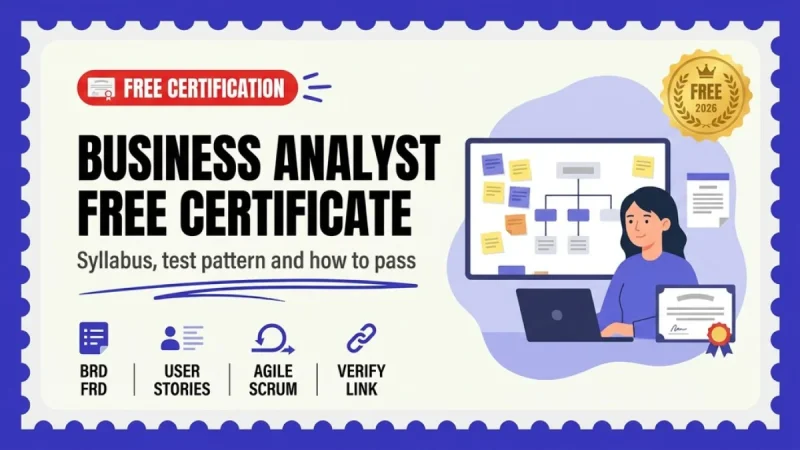
FREE CERTIFICATION · BUSINESS ANALYSTBusiness Analyst Certification Free Online: Syllabus, Test Pattern and How to Pass
Requirements, BRD and FRD, user stories, process maps, Agile — what the test covers and how to get ready in a week.
📍 IN SHORT
BeInCareer Genie runs a
free Business Analyst certification: a
25-question, 15-minute online test on requirement gathering,
BRD and FRD, user stories, process mapping, gap analysis, UML, Agile/Scrum and JIRA. Score
30/50 to get a certificate with a public verify link, valid for one year. It is a quick, free way to show a recruiter you know the basics; for a senior career, IIBA’s ECBA, CCBA and CBAP are the recognised industry certifications.
📝 Test Pattern at a Glance
Questions
25, generated fresh by AI for every attempt (easy, medium and hard)
Marks
50 — 2 marks per question, 4 options, one correct answer
Time
15 minutes; the test submits itself when time runs out
Pass mark
30 out of 50 (60%)
Certificate
Unique certificate number and a public verify link; one-tap add to LinkedIn
Validity
One year from the date of issue; retake the test to renew
Fee
None. You need a free Genie account; a test uses AI credits that Genie gives free when you join
Rules
Switching tabs more than 3 times ends the test; leaving a test unfinished locks the track for 3 days
📚 What You Will Be Tested On
requirement gatheringBRD and FRDstakeholder managementuser storiesprocess mappinggap analysisUML basicsAgile and ScrumJIRAdata-driven decisions
Every paper mixes three levels: core concepts 45%, practical application 35% and advanced or scenario questions 20%. Scenario questions usually give you a short business situation and ask which document, diagram or Scrum event fits.
💡 The Concepts That Carry Most Marks
BRD vs FRD
A BRD (Business Requirements Document) says what the business needs and why. An FRD (Functional Requirements Document) says how the system must behave to meet it: screens, rules, validations.
User story
The standard form is “As a [user], I want [goal], so that [benefit]”, with acceptance criteria that say when it is done. A good story follows INVEST: independent, negotiable, valuable, estimable, small, testable.
Gap analysis
Compare the current state (as-is) with the desired state (to-be) and list what must change to close the gap.
Process mapping
Flowcharts or BPMN diagrams of a process step by step, often in swimlanes so each team’s steps sit in its own lane.
UML basics
A use-case diagram shows actors and what they do with the system; an activity diagram shows the flow of steps and decisions.
Scrum
Roles: Product Owner, Scrum Master, Developers. Events: Sprint, Sprint Planning, Daily Scrum, Sprint Review, Sprint Retrospective. The Product Backlog is owned by the Product Owner.
Stakeholders
Identify them, map their power and interest, and agree how often each one hears from you. Conflicting requirements go back to the person who owns the decision.
JIRA
Epics hold large features, stories and tasks sit under them, and a board moves work from To Do to Done through a sprint.
✍️ Three Practice Questions
Which document describes how the system should behave to meet a business need?
A. BRD
B. FRD
C. Project charter
D. Gap analysis
Answer: B. The FRD turns business needs into system behaviour; the BRD states the business need itself.
Who owns and prioritises the Product Backlog in Scrum?
A. Scrum Master
B. Business Analyst
C. Product Owner
D. Project sponsor
Answer: C. The Product Owner orders the backlog. A BA often helps write and refine the items.
Comparing the as-is process with the to-be process is called…
A. SWOT analysis
B. Gap analysis
C. Root-cause analysis
D. Regression testing
Answer: B. Gap analysis lists what must change between the current and desired state.
📅 A One-Week Preparation Plan
Days 1–2: requirement gathering techniques (interviews, workshops, observation, surveys) and the BRD vs FRD difference.
Day 3: write ten user stories with acceptance criteria for an app you use every day.
Day 4: draw one process as a swimlane flowchart and one use-case diagram.
Day 5: Scrum roles, events and artefacts; create a free JIRA board and run a pretend sprint.
Day 6: gap analysis and stakeholder mapping on a real process, such as your college’s admission process.
Day 7: take the Genie test. If you miss 30/50, note the weak topics and retake later.
💼 Where This Certificate Helps
A free, verifiable certificate helps a fresher clear the first resume screen and gives an interviewer something to ask about. It does not replace experience or the industry certifications employers name in senior listings, such as IIBA’s ECBA (entry), CCBA and CBAP. Pair it with one small project: a BRD and a set of user stories for a real problem, shared as a PDF on your LinkedIn. Our business analyst career roadmap for freshers covers the job side.
💬 Frequently Asked Questions
Is the business analyst certification on BeInCareer Genie free?
Yes. There is no fee; you need a free Genie account, and a test uses AI credits that Genie gives free when you join.
How many questions are in the test and what is the pass mark?
25 questions for 50 marks in 15 minutes. You need 30 out of 50 to pass.
Is this the same as IIBA ECBA or CBAP?
No. Genie’s certificate is a free skill test. ECBA, CCBA and CBAP are the International Institute of Business Analysis’s professional certifications.
Can a fresher become a business analyst?
Yes, many companies hire freshers as junior or associate business analysts. Requirement writing, Excel or SQL and clear communication matter most.
Source: Exam format, rules and topic list: the BeInCareer Genie track page
beincareer.in/certification.php?t=business-analyst, read on 28 November 2026. Practice questions on this page are written by BeInCareer, not taken from the Genie test.
Note: BeInCareer Genie is BeInCareer’s own career platform. Its certificate is a free, verifiable proof of a skill test; it is not a university qualification or a vendor certification. Test rules are as published on the Genie track page on 28 November 2026 and may change.