
CAREER GUIDE · 29 OCT 2026
After B.Pharmacy: Every Real Route, Honestly Mapped — Industry, Research, Regulatory and Beyond
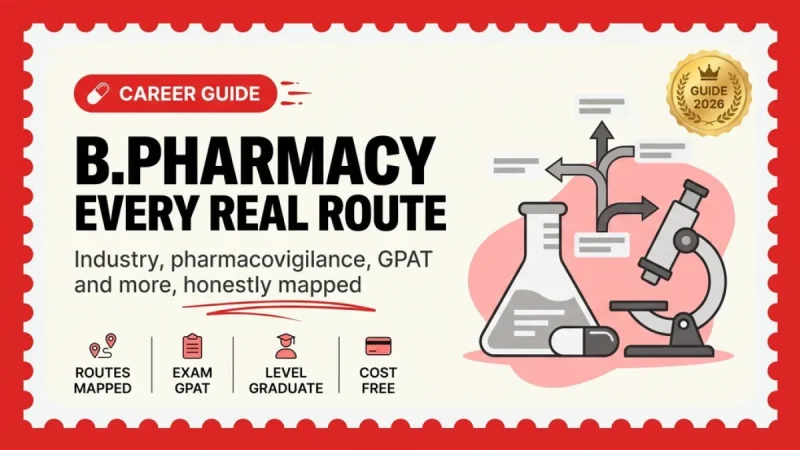
B.Pharmacy students in AP and Telangana sit inside one of India’s biggest pharma belts and still graduate hearing only two options: a medical shop or “try for government”. The real map has at least eight routes. Here it is, without invented salary bands.
ADVERTISEMENT
❗The problem this page is trying to fix
Pharmacy has a strange information gap. The degree itself is well structured — four years, regulated by the Pharmacy Council of India — but career guidance around it collapses into cliché: open a shop, join a shop, or prepare for government exams. Students in Visakhapatnam literally live beside pharma manufacturing clusters and still do not hear about production, quality control, pharmacovigilance or regulatory affairs until after graduation.
Meanwhile the walk-in boards tell the real story: pharma production and QC drives for B.Pharm freshers appear regularly — we have covered them. The industry routes are not hypothetical; they are hiring.
This page maps every route with what it is, who it suits and how entry works — and refuses, as always, to invent the numbers nobody publishes.
🔍The degree itself, structurally
Duration and regulator
B.Pharmacy is a four-year degree regulated by the Pharmacy Council of India (PCI).
Registration
To practise as a pharmacist you register with your state pharmacy council after the degree — registration is the licence, the degree alone is not.
B.Pharm vs D.Pharm
D.Pharm is the shorter diploma route oriented to dispensing practice; B.Pharm opens the industry, research and postgraduate routes this page maps.
The PG gate
GPAT — the national graduate pharmacy aptitude test — is the main gateway to M.Pharm seats and the scholarships attached to them.
Where you are sitting
AP and Telangana together hold one of India’s densest pharma manufacturing footprints — which is why industry routes are unusually reachable from here specifically.
The honest baseline
Fresher entry in industry is shift-based plant work with real discipline requirements. The routes are real; none of them is glamorous in year one.
📋The eight real routes after B.Pharmacy
Grouped by where the work happens. Most students fit two or three of these — almost nobody fits all eight.
🏭 Industry (the plant routes)
Production / manufacturingQuality Control (QC labs)Quality Assurance (QA, documentation)Packing and warehouse operationsMaintenance of GMP compliance
🔬 Research and data routes
Pharmacovigilance (drug safety data)Clinical research / CRO rolesClinical data managementMedical writingMedical coding (full guide linked below)
📄 Regulatory and office routes
Regulatory affairs (dossiers, filings)Drug regulatory documentationPharma sales and marketing (MR route)Pharma procurement / supply chain
🎓 Practice and study routes
Hospital pharmacistCommunity pharmacy (own or employed)GPAT → M.Pharm specialisationsGovernment exam routes (drug inspector and similar, via official notifications)Ph.D → academia
ADVERTISEMENT
✨What nobody tells B.Pharm students in time
Industry entry is heavily walk-in driven. Production and QC fresher hiring in the AP/TS pharma belt runs through walk-in drives and campus-adjacent pools — we cover these drives as they appear. Waiting for an online portal posting misses most of them.
QA and QC are different jobs. QC is lab testing — instruments, samples, chemistry. QA is documentation and process compliance — writing and checking, all day. Students use the letters interchangeably and then land in the wrong one.
Pharmacovigilance and clinical data roles are office-based English-heavy work — the natural route for students who want pharma without the plant shift. Written English quality is the screening filter.
GPAT decides more than admission. It gates M.Pharm seats and attached stipends — for students aiming at research or academia it is the single highest-leverage exam, and it rewards early preparation.
The registration step is not optional. Practising routes — hospital and community pharmacy — require state pharmacy council registration after the degree. Industry routes generally do not, which surprises students in both directions.
🎓What you can do in final year, at zero cost
The students who exit well start these in third year, not after convocation.
Pick your two likeliest routes from the eight above and learn their vocabulary — being able to explain GMP, or what a deviation report is, separates you at a walk-in.
Follow the pharma walk-in drives we publish for Visakhapatnam and Hyderabad — attend one in third year as rehearsal, seriously in final year.
If research or PG is plausible, start GPAT preparation from your own course material now — the syllabus overlaps your degree heavily, and early starters compound.
Strengthen written English if the data routes attract you — pharmacovigilance and clinical data screening leans on it hard.
Get the state pharmacy council registration process understood (not necessarily done) before you graduate, so the practising routes stay open without a scramble.
🗺Choosing between the routes, honestly
1
Want hands-on lab and chemistry? → QC
Quality Control suits students who liked the practical labs. Entry is walk-in heavy in this region; shift work is standard; instrument experience compounds into real seniority.
2
Want structure, writing and checking? → QA or regulatory
Quality Assurance and regulatory affairs reward precision and documentation discipline. Less glamour, high stability, and the compliance skill set travels across every pharma employer.
3
Want office work and English? → the data routes
Pharmacovigilance, clinical data management and medical writing are desk roles screening on written English and attention to detail — and they neighbour medical coding, which has its own guide below.
4
Want depth and research? → GPAT and M.Pharm
The PG route gates specialisations and academia. It costs two more years; it changes which doors exist afterward. Decide by third year so preparation is real.
5
Want practice? → register, then choose hospital or community
The practising routes run on state council registration. Hospital pharmacy offers institutional structure; community pharmacy offers independence with business risk. Both are legitimate; neither is the only option — which is the whole point of this page.
ADVERTISEMENT
⚠️ What this page deliberately does NOT tell you
No salary figures. Fresher pay differs by company, route and city, and no reachable first-party page publishes a current scale — not published in our source, so we print none.
No college rankings or fees. Pharmacy college fees and counselling details are set through official admission processes we have not re-verified for this page; check the official counselling notifications directly.
No GPAT dates or pattern details. The conducting body publishes these per cycle; reproducing them from memory risks staleness. Check the current official notification.
No drug inspector / government post specifics. Those run on official recruitment notifications with their own criteria per cycle — verify on the issuing body’s notification, not on summary sites.
💬Frequently Asked Questions
What can I do after B.Pharmacy other than a medical shop?
Eight real route families: production, QC, QA, pharmacovigilance, clinical research and data management, regulatory affairs, pharma sales, and the study routes through GPAT to M.Pharm — plus hospital pharmacy. In the AP/TS pharma belt the industry routes hire freshers through regular walk-in drives we cover.
Is B.Pharmacy good for a student from AP or Telangana specifically?
The honest locational answer: yes, better than for most of India — the two states hold one of the country’s densest pharma manufacturing footprints, so production, QC and QA entry roles are unusually reachable, often through local walk-ins rather than relocation.
What is the difference between QA and QC?
QC (Quality Control) is laboratory testing — samples, instruments, chemistry, shift work. QA (Quality Assurance) is process documentation and compliance — checking that procedures were followed and recorded. Lab-lovers belong in QC; precise writers belong in QA. Interviews notice when candidates cannot distinguish them.
Do I need GPAT?
Only for the postgraduate route — GPAT gates M.Pharm admission and attached stipends. Industry and data routes hire B.Pharm freshers without it. Decide by third year: if research, specialisation or academia attracts you, GPAT preparation from your own course material is the highest-leverage work you can do.
What is pharmacovigilance and can a fresher enter it?
Drug-safety work: collecting, processing and reporting adverse-event data, mostly desk-based and English-heavy. Freshers do enter, screened primarily on written English, attention to detail and terminology basics — it is the natural route for students who want pharma without plant shifts.
Do I have to register with the pharmacy council?
For practising routes — hospital and community pharmacy — yes: state pharmacy council registration after the degree is the licence to practise. Industry, data and regulatory routes generally do not require it. Understand your state’s process before graduating so no route closes by accident.
📚Read Next on BeInCareer
Daily job & course updates, free
Walk-in drives, admission dates and new government courses — the day they are announced.
Source: This is career guidance written by the BeInCareer editorial team on 29 October 2026. Structural facts stated — the four-year PCI-regulated degree, state council registration for practice, GPAT as the M.Pharm gateway — are long-standing published features of the Indian pharmacy system; everything else is guidance. Salary figures, college fees, GPAT cycle dates and government recruitment criteria are not published in our source and are therefore not printed here; verify each on the official notification concerned.