
CAREER GUIDE · 29 OCT 2026
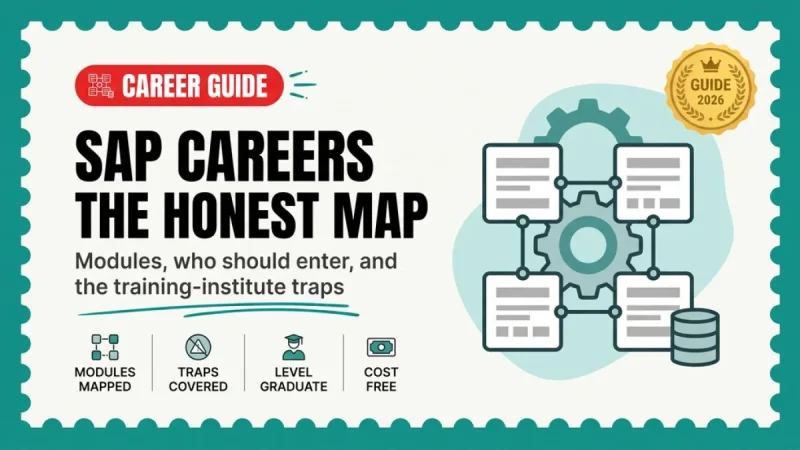
SAP as a Career: What the Work Actually Is, Functional vs Technical, and How People Really Enter
“Do an SAP course, get a big job” is one of the most aggressively sold promises in Indian IT training — usually without explaining what SAP work even is. This page explains the real work, the module map, who actually gets hired, and where the course-selling machine misleads freshers.
ADVERTISEMENT
❗The problem this page is trying to fix
SAP occupies a strange place in the fresher imagination: everyone has heard the name, almost nobody can say what the work is, and an entire training industry profits from that gap. Students pay serious fees for module courses chosen at random, then discover that fresher-direct SAP consultant roles are scarce and that employers wanted domain sense plus the module — not a certificate alone.
The truth is neither “SAP guarantees a career” nor “SAP is a scam”. SAP skills power the operations of a huge share of large companies, the ecosystem genuinely employs at scale, and commerce and engineering graduates both have real doors. But the honest entry path runs through domain work and support roles more often than through a paid weekend course.
Below: what the work is, the module families decoded, the realistic entry doors, and the questions that expose a low-quality institute in one conversation.
🔍What SAP work actually is
The one-line version
SAP is the software large companies run their operations on — finance, purchases, sales, inventory, HR. SAP professionals configure, support and extend that system for each company’s needs.
Functional vs technical
Functional consultants translate business processes into system configuration (no heavy coding). Technical roles program and integrate the system. Different skills, both real careers.
Who employs SAP people
The services giants and consultancies, product companies running SAP internally, and GCCs — plus a contract market for experienced consultants.
The commerce-graduate door
Functional finance modules value accounting sense. A B.Com graduate with strong accounting basics has a genuine lane here — often via finance-operations jobs first.
The experience catch
Companies prefer consultants who know the business process being configured. This is why end-user and support experience converts to consulting better than certificates alone.
What we do not quote
Course fees, placement rates or salary bands — the training market’s own numbers are marketing, and verified figures are not published in our source.
📋The module map, decoded
You specialise in a module family, not in “SAP”. Pick by your background, not by an institute’s batch schedule.
💼 Functional families
Finance and controlling (FI/CO) — the commerce doorSales and distribution (SD)Materials management / procurement (MM)Production planning (PP)Human capital / SuccessFactors (HR)Warehouse and logistics modules
💻 Technical families
ABAP development (SAP’s programming language)Basis (system administration)Integration and middleware workSAP on cloud platform roles (BTP-era work)Fiori/UI developmentData migration and BW/analytics work
🚪 Adjacent and entry roles
SAP end-user roles (using the system in a company job)SAP support / helpdesk (L1-L2) — the classic fresher doorFinance-operations roles in GCCs on SAP systemsTesting roles on SAP projectsData maintenance and master-data rolesInternal transfers from domain jobs to SAP teams
ADVERTISEMENT
✨What changed — and what it means for entry
The cloud migration wave keeps demand alive. Large companies continue multi-year programmes moving to the current SAP generation — sustained project work for functional and technical roles alike.
Fresher-direct consultant roles are the exception, not the rule. The common real sequence is support or end-user or domain work first, consulting second. Institutes selling “consultant in 3 months” are selling the exception.
Services companies do run SAP fresher intakes. The big consultancies train graduates into SAP practices through their own programmes — a door that runs through their normal fresher hiring, not through private institutes.
Domain + module beats module alone. An accountant who learns FI, a storekeeper who learns MM, a payroll executive who learns the HR module — this combination is what interviews actually reward.
Official certification exists — and is not the same as institute certificates. SAP runs its own certification; local institute certificates are not it. Knowing the difference protects your money.
🎓What you can do before paying anyone
A fortnight of free work tells you whether SAP fits you — and arms you against bad institutes.
Learn what an ERP is and map one business process end to end on paper — a purchase from requisition to payment. If this bores you completely, SAP work will too; better to learn that free.
Pick your module family by background: commerce → FI/CO; engineering/logistics interest → MM/PP/SD; coding interest → ABAP. One page of notes on why.
Explore SAP’s own free learning portal — official introductory courses exist at no cost and are the cleanest first exposure.
If employed or interning anywhere: find out what system the company runs and get end-user exposure — it is the most convertible SAP experience there is.
Interrogate any institute with three questions: Which exact module and version? Is the certification SAP’s official one or your in-house paper? Can I speak to two placed students directly? Vague answers end the conversation.
Strengthen the base skills that every SAP lane rewards: Excel (free certification below) and clear written English (60-day plan below).
🗺The realistic entry sequences
1
Sequence A — the services-company door
Enter a services company or GCC through normal fresher hiring (any lane), signal interest in the SAP practice, and convert internally — companies staff SAP teams from inside continuously.
2
Sequence B — the domain door
Work a domain job — accounts, stores, procurement, HR ops — on any ERP, learn the matching module in parallel, then move as a domain-plus-module candidate. Strongest profile per year spent.
3
Sequence C — the support door
SAP support (L1/L2) roles take freshers with basics and communication. Two years of tickets teaches the system as it actually breaks — valuable, convertible knowledge.
4
Treat paid training as acceleration, not entry
A course makes sense once a sequence above is underway and you know exactly which module and certification you need. As a standalone ticket, it mostly funds the institute.
5
Verify everything against official sources
Module names, certification validity and exam details live on SAP’s own pages. Any claim you cannot verify there — especially “guaranteed placement” — is marketing.
ADVERTISEMENT
⚠️ What this page deliberately does NOT tell you
No salary figures. SAP pay varies by module, role type, company and experience; no verifiable first-party source publishes a current fresher scale — not published in our source, so we print none.
No institute recommendations. Training quality varies wildly and changes batch to batch; the three-question interrogation above protects you better than any list we could print.
No course fees. Institute and official certification costs change; check SAP’s official pages and the institute’s written quote — and treat large upfront fees with placement promises as the red flag they are.
No demand statistics. “X lakh SAP jobs waiting” figures originate in training-industry marketing. The structural demand is real; the circulating numbers we do not reprint.
💬Frequently Asked Questions
Is SAP a good career for a fresher in 2026?
The ecosystem is large, the cloud-migration wave sustains demand, and both functional and technical lanes are real careers. The caveat is the entry: fresher-direct consultant roles are scarce, so plan one of the realistic sequences — services-company intake, domain-first, or support-first — rather than buying a course and waiting.
I am from commerce. Can I really work in SAP?
Yes — the finance modules (FI/CO) specifically value accounting sense, and the domain-first sequence (accounts job plus module learning) is arguably the strongest commerce route into SAP consulting. Our B.Com career guide below pairs with this page.
Functional or technical — which should I choose?
By background and taste: functional if business processes interest you and coding does not (commerce and management profiles fit here); technical (ABAP, Basis, integration) if you want to program. Pay and prospects are healthy in both; switching later is possible but costs time.
Will an SAP course guarantee me a job?
No course guarantees a job, and institutes promising guaranteed SAP placement are the sector’s known trap. What converts: domain sense plus module knowledge, official (not in-house) certification where relevant, and entry through support, domain or services-company sequences. Treat courses as acceleration inside a plan.
What is the difference between SAP certification and an institute certificate?
SAP certification is issued by SAP itself after its official exams; institute certificates are the training company’s own paper. Employers weigh the first; the second mostly proves attendance. Before paying anyone, confirm in writing which one the fee leads to.
Can SAP skills become freelance or contract income?
At the experienced-consultant level, yes — a substantial contract market exists. As a fresher, no: contract work hires proven implementation experience. Build the employee-route experience first; the independent lane opens from year four or five onward.
📚Read Next on BeInCareer
Daily job & course updates, free
Walk-in drives, admission dates and new government courses — the day they are announced.
Source: This is career guidance written by the BeInCareer editorial team on 29 October 2026, describing the SAP ecosystem’s role families and the entry sequences freshers realistically use. It deliberately contains no salary figures, no fees, no demand statistics and no institute recommendations, because verified current figures are not published in our source and the training market is where students are most commonly oversold. Verify modules, certifications and exams on SAP’s own official pages.