
Both qualifications let you register as a pharmacist in India. They differ in length, in what you can do next, and in how far you can go. Here is what the Pharmacy Act, 1948 and the Pharmacy Council of India regulations actually say — not what admission websites claim.
Quick snapshot
- D.Pharm is a 2-year diploma plus 500 hours of practical training spread over a minimum of three months. B.Pharm is a 4-year, 8-semester degree.
- Both are recognised for registration as a pharmacist with a State Pharmacy Council. This is the single most misunderstood point in pharmacy admissions.
- D.Pharm registration requires a pass in Part I and Part II plus satisfactory completion of Part III (the training). The diploma alone is not enough.
- A D.Pharm holder from a PCI-approved institution gets lateral entry into the third semester of B.Pharm, with 52 credits transferred.
- Under Section 42 of the Pharmacy Act, only a registered pharmacist may compound, prepare, mix or dispense a medicine on a medical practitioner's prescription.
- Pharm.D is a separate 6-year programme (5 years of study + 1 year of internship); the Post Baccalaureate route for B.Pharm holders is 3 years.
- M.Pharm is 2 years / 4 semesters and needs B.Pharm with not less than 55% aggregate. D.Pharm does not lead to it directly.
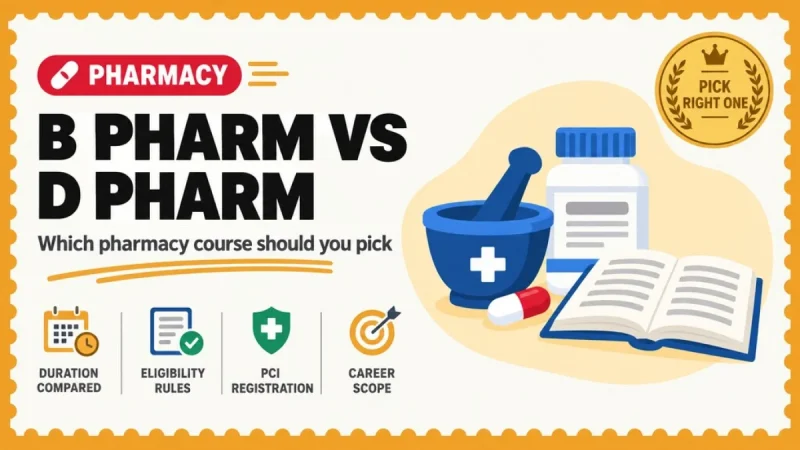
D.Pharm is a two-year diploma that qualifies you to register as a pharmacist and dispense medicines; B.Pharm is a four-year degree that does the same thing and also opens the industry, regulatory and postgraduate routes that the diploma does not. Under the Pharmacy Council of India's regulations, D.Pharm registration requires passing Part I and Part II and satisfactorily completing Part III — 500 hours of practical training over at least three months. B.Pharm runs eight semesters across four academic years and its certificate is issued expressly for the purpose of registration as a pharmacist under the Pharmacy Act, 1948.
If your goal is to run or staff a retail pharmacy quickly and at lower cost, D.Pharm does the job. If you want hospital pharmacy at a senior level, manufacturing, quality assurance, quality control, regulatory affairs, clinical research, M.Pharm, Pharm.D or a government drug inspector-type role, take B.Pharm — and if you have already done D.Pharm, use lateral entry into the third semester instead of starting again.
1. The side-by-side comparison that matters
Pharmacy education in India is regulated by the Pharmacy Council of India, a statutory body constituted under the Pharmacy Act, 1948. The PCI frames the Education Regulations for D.Pharm and the course regulations for B.Pharm, Pharm.D and M.Pharm. Everything in the table below comes from those regulations.
| Point of difference | D.Pharm | B.Pharm |
|---|---|---|
| Nature of award | Diploma | Degree |
| Duration | 2 academic years, each of not less than 180 working days, plus 500 hours practical training over at least 3 months | 4 academic years / 8 semesters |
| Structure | Part I (year 1), Part II (year 2), Part III (practical training) | Semesters I to VIII, credit-based |
| Entry qualification | 10+2 from a recognised board in the academic stream, with Science: Physics and Chemistry compulsory, plus Biology or Mathematics | 10+2 with English plus Physics, Chemistry, and Mathematics and/or Biology |
| Registration as pharmacist | Yes — pass in Part I and Part II plus satisfactory completion of Part III | Yes — the B.Pharm certificate is issued for the purpose of registration under the Pharmacy Act, 1948 |
| Lateral entry available | Into B.Pharm third semester, 52 credits transferred | Not applicable |
| Leads directly to M.Pharm | No | Yes, with not less than 55% aggregate |
| Typical work | Retail and hospital dispensing, stores, pharmacy assistant and pharmacist roles | All of the above plus industry, QA/QC, regulatory affairs, clinical research, academia |
We are not quoting fees or salary ranges, and here is why
Pharmacy course fees in India are fixed institution by institution and regulated by state fee-fixation committees. A government polytechnic D.Pharm, a private self-financed D.Pharm and a private B.Pharm at a deemed university differ by several multiples. Neither the PCI nor AICTE publishes a national fee figure, so any single "D.Pharm fees in India" number you see online is somebody's estimate.
The same holds for starting salary. No official source publishes national pay bands for retail or industry pharmacists. Government posts are the exception — the pay level is stated in each recruitment advertisement, so read it there. Get fees from the institution's official fee notification and the state admission brochure for the current year.
2. Registration: what the Pharmacy Act actually requires
This is where most confusion lives. A pharmacy qualification by itself does not let you dispense medicines. You must be entered on the register of pharmacists maintained by a State Pharmacy Council.
Section 31 of the Pharmacy Act, 1948 sets the conditions for first entry on the register: the person must have attained the age of 18 years, and must hold a degree or diploma in pharmacy or pharmaceutical chemistry, or a chemist and druggist diploma, of an Indian university or State Government, or a prescribed qualification granted outside India. Section 32 deals with later entries on the same basis.
Then comes the provision that makes registration commercially necessary. Section 42 provides that no person other than a registered pharmacist shall compound, prepare, mix or dispense any medicine on the prescription of a medical practitioner. Contravention is punishable with imprisonment of up to six months, or a fine of up to one thousand rupees, or both.
Finish the qualification properly
For D.Pharm that means Part I, Part II and Part III. The PCI's Education Regulations say the minimum qualification for registration is a pass in Diploma in Pharmacy (Part I and Part II) and satisfactory completion of Diploma in Pharmacy (Part III). Students who skip or short-change the 500-hour training cannot register.
Check the institution is PCI-approved
The PCI grants approval to institutions for the purpose of Section 12 of the Act. A qualification from a non-approved institution will not get you registered and will not be accepted for lateral entry. Verify approval status on the PCI website before you pay any fee.
Apply to your State Pharmacy Council
Registration is done by the State Pharmacy Council of the state where you intend to practise, not by the PCI centrally. Each state council has its own application form, document list and renewal cycle. Fees and renewal periods vary by state, so take them from your own council's official notification.
Keep the registration live
Pharmacist registration is renewable. If you let it lapse, your licence-linked employment at a retail or hospital pharmacy becomes irregular. Drug licences for retail premises are issued on the basis of a registered pharmacist being present.
3. Lateral entry: the D.Pharm to B.Pharm bridge
If you have already finished D.Pharm and want the degree, you do not repeat the first year. The PCI's Bachelor of Pharmacy (B.Pharm) Course Regulations, 2014 provide for lateral entry.
The key terms:
- A candidate who has passed D.Pharm from an institution approved by the PCI under Section 12 of the Pharmacy Act is eligible for admission to the third semester of B.Pharm.
- 52 credits from the diploma are transferred, so the lateral-entry student is treated as having completed the first two semesters.
- The remaining programme is six semesters — three academic years — instead of eight.
- Seats for lateral entry are supernumerary or within sanctioned intake as the state admission authority prescribes. The number of lateral seats and the selection method are set by the state, so check the state admission brochure.
Net effect: D.Pharm (2 years) followed by lateral entry (3 years) is five years to a B.Pharm, against four years direct. You pay one extra year, but you were a registrable pharmacist from the end of year two, which many students use to earn while studying.
4. Pharm.D and M.Pharm: where each route can go next
The progression ladder is the strongest practical argument between the two qualifications.
| Programme | Duration (PCI regulations) | Entry requirement |
|---|---|---|
| D.Pharm | 2 academic years + 500 hours training | 10+2 academic stream with Physics and Chemistry plus Biology or Mathematics |
| B.Pharm | 4 academic years / 8 semesters | 10+2 with English, Physics, Chemistry and Mathematics and/or Biology |
| B.Pharm (lateral entry) | 6 semesters | D.Pharm pass from a PCI-approved institution; 52 credits transferred |
| Pharm.D | 6 academic years — Phase I of 5 years of study plus Phase II of 1 year internship or residency; each academic year not less than 200 working days | 10+2 with Physics and Chemistry plus Biology or Mathematics, or a D.Pharm pass |
| Pharm.D (Post Baccalaureate) | 3 academic years — 2 years of study plus 1 year internship or residency | B.Pharm from a PCI-approved institution |
| M.Pharm | 2 academic years / 4 semesters | B.Pharm with not less than 55% aggregate |
Read that table carefully and the asymmetry is obvious. D.Pharm is accepted for entry into Pharm.D and for lateral entry into B.Pharm, but it does not take you into M.Pharm. Every research, teaching and senior industry track in Indian pharmacy runs through M.Pharm or Pharm.D, and the standard route to M.Pharm is a B.Pharm with 55% aggregate.
One more distinction students miss: Pharm.D is a clinical pharmacy doctorate, not a medical degree. It trains you for patient-facing clinical pharmacy, therapeutic drug monitoring and ward rounds, with a compulsory internship year. It does not make you a doctor and does not permit you to prescribe.
5. Career outcomes, honestly separated
The functional difference is not prestige. It is which employers will shortlist you at all.
Open to both D.Pharm and B.Pharm
- Retail pharmacy — working as the registered pharmacist on a retail drug licence, or owning the outlet
- Hospital pharmacy — dispensing, inventory, narcotics register, stores and purchase
- Community and government health facility pharmacist posts, where the recruitment rules accept a diploma
- Medical representative and front-line sales roles
- Wholesale and distribution compliance roles tied to drug licences
Realistically B.Pharm (or higher) only
- Manufacturing and production in formulation or API plants
- Quality assurance and quality control — GMP documentation, stability, analytical method validation
- Regulatory affairs — dossier preparation, submissions to the national regulator and to overseas agencies
- Clinical research — clinical trial coordination, pharmacovigilance and medical writing
- Formulation research and development
- Academia — teaching in pharmacy institutions, after M.Pharm
- Drug regulatory service posts where the recruitment rules specify a degree in pharmacy
Government jobs: read the recruitment rules, not the rumour
Pharmacist posts in central and state health services, railways, ESIC, defence establishments and municipal hospitals are advertised regularly. The essential qualification differs post by post: some accept D.Pharm with registration, others require B.Pharm. Drug Inspector-type posts under the state drug control administration generally specify a degree in pharmacy or pharmaceutical science.
We are not listing age limits, pay levels or vacancy counts here because those are set afresh in each advertisement and change between cycles. Take them from the notification itself. The one thing that is constant across almost every pharmacist advertisement in India is the requirement of a valid registration with a State Pharmacy Council, so get registered as soon as you qualify rather than when a vacancy appears.
6. Which one should you actually pick?
| If this is you | Pick | Why |
|---|---|---|
| You want to start earning in two years and run or staff a medical shop | D.Pharm | Shortest route to a registrable qualification; retail drug licences need a registered pharmacist |
| You want industry, QA/QC, regulatory affairs or clinical research | B.Pharm | Those recruitment pipelines are built around the degree; the diploma is usually filtered out at screening |
| You intend to do M.Pharm, teach, or go into research | B.Pharm | M.Pharm entry requires B.Pharm with not less than 55% aggregate |
| You want patient-facing clinical pharmacy in a hospital | Pharm.D | Six-year programme with a compulsory internship or residency year built in |
| You have already completed D.Pharm and want the degree | Lateral entry B.Pharm | Direct admission to the third semester with 52 credits transferred — three years, not four |
| You are unsure and cost is the binding constraint | D.Pharm, then decide | You can register, work, and still laterally enter B.Pharm later without losing the two years |
A final caution on 10+2 subject combinations. D.Pharm admission requires the academic stream of a recognised board with Physics and Chemistry compulsory. B.Pharm requires English along with Physics, Chemistry and Mathematics and/or Biology. If you took a vocational stream, confirm eligibility with the state admission authority in writing before you apply, because this is a common rejection ground at document verification.
Frequently asked questions
Can a D.Pharm holder work as a pharmacist in India?
Yes. The Pharmacy Council of India's Education Regulations state that the minimum qualification required for registration as a pharmacist is a pass in Diploma in Pharmacy (Part I and Part II) together with satisfactory completion of Diploma in Pharmacy (Part III), the practical training component. Once you are entered on the register of a State Pharmacy Council you are a registered pharmacist and may compound and dispense medicines on a medical practitioner's prescription.
What is the duration of D.Pharm and B.Pharm?
D.Pharm runs for two academic years, each of not less than 180 working days, followed by 500 hours of practical training spread over a minimum of three months. B.Pharm is four academic years organised as eight semesters. A D.Pharm holder entering B.Pharm laterally completes six semesters instead of eight.
How does D.Pharm to B.Pharm lateral entry work?
Under the B.Pharm Course Regulations, 2014, a candidate who has passed D.Pharm from an institution approved by the Pharmacy Council of India under Section 12 of the Pharmacy Act is eligible for admission to the third semester of B.Pharm. Fifty-two credits from the diploma are transferred, so you are treated as having completed semesters one and two. The number of lateral entry seats and the selection process are decided by the state admission authority.
Is B.Pharm better than D.Pharm?
For dispensing work both are sufficient, because both lead to pharmacist registration. B.Pharm is clearly better if you want pharmaceutical manufacturing, quality assurance, quality control, regulatory affairs, clinical research or academia, and it is necessary if you want M.Pharm, which requires a B.Pharm with not less than 55 per cent aggregate. D.Pharm is better if your constraint is time and cost and your goal is retail or hospital dispensing.
Can I do M.Pharm after D.Pharm?
Not directly. The PCI regulations for M.Pharm require a B.Pharm degree from an approved institution with not less than 55 per cent aggregate. A D.Pharm holder must first complete B.Pharm, which can be done through lateral entry into the third semester, and only then apply for M.Pharm.
What is Pharm.D and is it the same as being a doctor?
Pharm.D is a clinical pharmacy doctorate regulated by the PCI. It runs for six academic years: Phase I of five years of study and Phase II of one year of internship or residency, with each academic year of not less than 200 working days. A separate Post Baccalaureate route of three years is open to B.Pharm holders. It is not a medical degree and does not confer any right to prescribe; it trains you for clinical pharmacy practice alongside the treating team.
What subjects do I need in 12th for pharmacy?
For D.Pharm you need a 10+2 pass from a recognised board in the academic stream with Science, where Physics and Chemistry are compulsory along with Biology or Mathematics. For B.Pharm you need 10+2 with English plus Physics, Chemistry, and Mathematics and/or Biology. Vocational-stream candidates should confirm eligibility with the state admission authority before applying, as this is a frequent cause of rejection at verification.
What are the fees for B.Pharm and D.Pharm?
There is no national figure and we will not estimate one. Fees are fixed institution by institution and regulated by state fee-fixation committees, so government, private self-financed and deemed-university programmes differ widely. Use the official fee notification of the institution and the current state admission brochure, and budget hostel, laboratory and examination charges separately.
Sources: Pharmacy Council of India — Education Regulations and course regulations; The Pharmacy Act, 1948 (India Code) — Sections 12, 31, 32 and 42; Pharmacy Council of India, Education Regulations, 1991 (Diploma in Pharmacy); Pharmacy Council of India, Bachelor of Pharmacy (B.Pharm) Course Regulations, 2014; Pharmacy Council of India, Doctor of Pharmacy (Pharm.D) Regulations, 2008; Pharmacy Council of India, Master of Pharmacy (M.Pharm) Regulations.
Related guides on BeInCareer
- BSc Nursing course guide: eligibility, entrance and careers
- BSc Agriculture course guide: ICAR admission and careers
- BiPC career guide: courses, colleges and options
- Career after Inter BiPC: full roadmap
- NEET career opportunities and roadmap
- AI and healthcare careers in India
- Career mistakes students make after Intermediate
- Short-term courses after a degree that lead to jobs
- Government job vs private job: an honest comparison
- Government exams you can write after graduation