
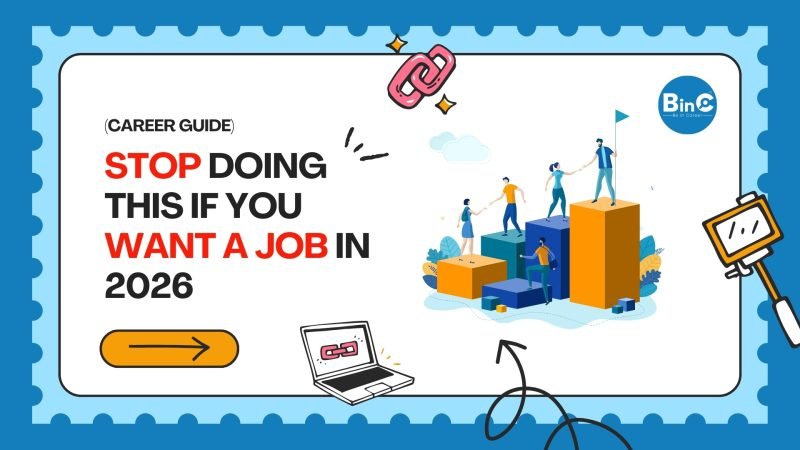
The Job Market in 2026 Won’t Reward Average Preparation
Automation is increasing, AI tools are mainstream, and hiring teams filter candidates using smart tracking systems.
Remote work also means you’re competing with talent beyond your city — sometimes beyond your country.
If you want a job in 2026, you don’t just need effort — you need direction.
2026 Hiring Reality (Quick Snapshot)
| Reality | What it Means for You | What to Do |
|---|---|---|
| ATS + AI screening | Resumes get filtered before humans see them | Use ATS-safe formatting + matching keywords |
| Global competition | Remote roles increase candidate pool | Show skills + projects + measurable results |
| Skill-based hiring | Degrees alone don’t prove job readiness | Build portfolio, tools knowledge, real projects |
| Personal branding | Recruiters verify online presence | Strong LinkedIn + consistent learning posts |
13 Things to Stop Doing If You Want a Job in 2026
Many students and fresh graduates work hard — but on the wrong things. These mistakes quietly reduce interview calls.
Below are the most common “career killers” in 2026, and what to do instead.
1) Stop Depending Only on Your Degree
In 2026, a degree is a basic qualification. It does not prove you can solve real-world problems. Recruiters differentiate candidates using
skills, tools knowledge, and execution ability.
- Learn tools relevant to your domain (IT: Python/SQL/Power BI; Mechanical: AutoCAD/SolidWorks; Marketing: SEO/Ads).
- Build 3–5 projects that show real outcomes.
- Create a portfolio (GitHub, website, or case-study PDF).
- Show measurable results (time saved, accuracy, growth, engagement, revenue influenced).
2) Stop Using an Outdated Resume
If your resume hasn’t been updated in the last year, you’re behind. Many candidates apply to 100 jobs with the same resume and wonder why
they get zero calls. In 2026, ATS systems scan keywords and structure before a recruiter sees anything.
- Long paragraphs and generic objectives
- Fancy graphics/icons (ATS can’t read)
- Responsibilities instead of achievements
- Irrelevant details and fake experience
- Keep it clean and 1-page (freshers)
- Use clear headings: Skills, Projects, Internships, Certifications
- Match keywords from the job description
- Quantify outcomes (%, time saved, growth)
Write: “Managed Instagram content and increased engagement by 35% in 3 months.”
3) Stop Ignoring Communication Skills
Many technically strong candidates fail interviews because they can’t explain their work clearly.
You don’t need perfect English — you need clarity and confidence, especially for remote interviews.
- Practice speaking daily (15–20 minutes)
- Record yourself answering interview questions
- Learn basic professional email writing
- Do mock interviews and improve feedback areas
4) Stop Wasting Social Media Time
Spending hours on reels but zero time building a professional presence is a silent career killer.
In 2026, networking and visibility matter more because many jobs get filled via referrals and recruiter outreach.
- Create a clean LinkedIn profile with a professional photo
- Write a strong headline and short summary
- Post about your learning and projects weekly
- Engage with HR posts and connect with professionals
5) Stop Complaining About “No Experience”
“No experience” is not a final label. Experience can be built through internships, freelancing, volunteering,
hackathons, case studies, and real projects. Employers want applied knowledge — not only theory.
- Internships (paid/unpaid)
- Freelancing projects (even small ones)
- College projects with real users
- Hackathons and challenges
- Case studies + documentation + results
6) Stop Waiting Only for Government Jobs Without a Backup Plan
Government exams are a respectable goal, but waiting 4–5 years without additional skills is risky.
Vacancies are limited, competition is high, and exam cycles can be unpredictable.
- Prepare for exams
- Simultaneously learn a job-ready skill
- Take part-time/private roles if needed
- Maintain stability and avoid long gaps
7) Stop Being Afraid to Apply
Job descriptions describe ideal candidates, not realistic ones. If you wait until you match 100%, you’ll never start.
Apply strategically and treat rejection as part of the learning loop.
Each interview increases confidence, clarity, and self-awareness.
8) Stop Learning Random Skills Without Direction
Course addiction is real: multiple courses, many certificates, zero projects.
Learning without execution has no career value.
- Choose one domain (example: Data Analyst / Java Developer / Digital Marketing)
- Learn fundamentals deeply
- Build 3 practical projects
- Document your learning (LinkedIn, GitHub, portfolio)
- Apply to relevant roles weekly
9) Stop Comparing Your Timeline With Others
Comparison creates anxiety and distraction. Every career path is different.
Compare your skills and discipline with your previous version, not someone else’s highlight reel.
- Am I more skilled than last year?
- Am I more confident than last month?
- Am I more disciplined than yesterday?
10) Stop Ignoring Personal Branding
In 2026, personal branding is not optional. Recruiters search candidates online.
A strong LinkedIn profile, project proof, and clean digital footprint increase credibility.
- Keep LinkedIn updated and consistent
- Share insights about your domain
- Document projects and outcomes
- Avoid controversial public content
11) Stop Thinking Soft Skills Don’t Matter
Technical skills get interviews. Soft skills get promotions. Automation can replace repetitive tasks,
but it cannot replace collaboration, adaptability, and emotional intelligence.
12) Stop Avoiding Feedback
Rejection is information. Instead of taking it personally, use it to improve.
Ask for feedback, identify weak areas, and practice targeted improvement.
13) Stop Being Inconsistent
Career building requires consistency. Even 2–3 focused hours daily can transform your career within one year.
Small consistent actions create big outcomes.
What You Must Start Doing Today (2026 Roadmap)
| Step | Action | Output |
|---|---|---|
| 1 | Choose your domain | Clear target role (no confusion) |
| 2 | Learn market-relevant skills | Tool proficiency (job-ready) |
| 3 | Build projects | Portfolio proof (3 projects) |
| 4 | Optimize resume (ATS) | Interview-ready resume |
| 5 | Improve communication | Clear project explanation |
| 6 | Network actively | Connections + referrals |
| 7 | Apply consistently | Interview pipeline |
| 8 | Track progress | Weekly improvements |
Final Thoughts
Getting a job in 2026 is not impossible, but it will not happen automatically. The market rewards preparation — not intention.
Stop the habits that reduce your chances, and start building skills, projects, communication, and consistency.
FAQ (Job Preparation in 2026)
What skills should I learn to get a job in 2026?
How important is LinkedIn for freshers?
How many jobs should I apply to?
About BeInCareer
BeInCareer helps students and job seekers with career guidance, resume strategy, interview preparation, and job updates —
built around practical skills and real outcomes.
Top Premium articles – Giving for free:
Popular Posts in Google in 2026
Interview Preparation Checklist