
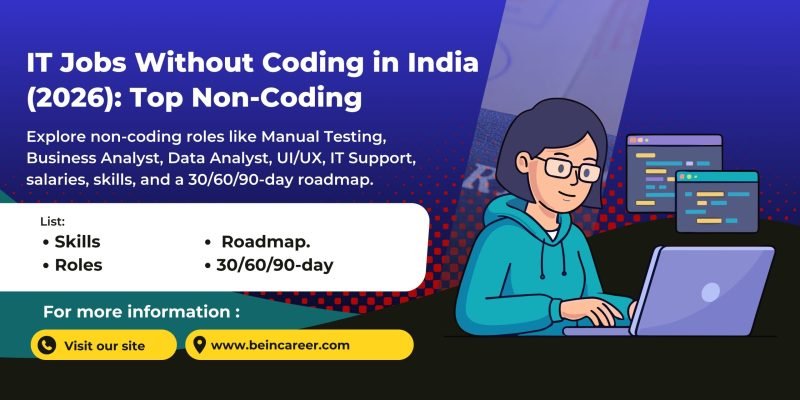
Coding Raakapoyina IT Job Kavala?
A complete, practical guide to non-coding IT jobs, required skills, salary expectations, job roadmaps, and how to crack interviews even if you hate programming.
Is it possible to get an IT job without coding?
Yes. But here is the truth that most people miss: You don’t need coding, but you do need job-ready skills.
- They apply for developer roles without interest
- They don’t know what non-coding roles exist
- They can’t explain skills in interviews
- They have “knowledge”, but no projects/portfolio
- Clear communication + documentation
- Problem-solving mindset
- Tool-based work readiness
- Ownership (you can deliver outcomes)
Quick Snapshot (Read this first)
| Topic | Simple Answer |
|---|---|
| IT job without coding? | Yes. Many IT roles are tool + communication focused. |
| Fastest entry roles | Manual Testing, IT Support, Operations, Digital Marketing (tech niche) |
| Best long-term roles | Business Analyst, Data Analyst, Product/Project roles, UX |
| Fresher salary range | ₹3–6 LPA (depends on role + city + company) |
| Biggest interview mistake | “Skill undi” but no real examples / no clarity in explanation |
What you actually need (Skill Weightage)
Most non-coding IT roles are driven by communication + tools + thinking.
Top IT Jobs Without Coding (Role-wise Guide)
Below are the most practical non-coding IT careers in India. For each role you’ll get: what you do, who it suits, key skills, and growth direction.
1) Software Tester / QA (Manual Testing)
QA ensures the software works correctly. You test features, find bugs, write test cases, and communicate issues clearly to the dev team.
- SDLC & STLC basics
- Test case writing (positive/negative)
- Bug reporting (severity/priority)
- Basic tools: Jira / Trello (any one)
- Manual Tester → Senior QA
- QA Lead → QA Manager
- Optional: Automation (Selenium) later
2) Business Analyst (BA)
BA is a bridge between the client/business and the tech team. You convert business needs into clear requirements and ensure everyone is aligned.
- Communication & questioning
- Documentation (BRD/FRD, user stories)
- Process mapping (basic flowcharts)
- Excel + presentation basics
- Strong English/communication candidates
- Commerce/Arts/MBA/BBA graduates
- People who like analysis more than coding
3) Data Analyst (Low-code entry)
You analyze data to find insights, build dashboards, track KPIs, and support business decisions. Start with Excel and Power BI; SQL can come later.
- Excel (pivot tables, VLOOKUP/XLOOKUP)
- Power BI or Tableau (choose one)
- Basic statistics + KPI thinking
- SQL (basic SELECT, WHERE, GROUP BY)
- Sales dashboard
- Recruitment funnel dashboard
- Customer support ticket trends
4) IT Support / Technical Support
You solve user issues via tickets/calls, troubleshoot software/hardware, and ensure smooth operations. Communication and problem-solving are your assets.
- Windows/Mac basics, installation, updates
- Networking basics (IP, DNS, VPN basics)
- Ticketing: ServiceNow/Freshdesk (any one)
- Email etiquette + call handling
- Support → L2/L3 Specialist
- Operations → IT Ops / Infra Support
- Optional: Cloud basics later
5) UI/UX Designer
You design app/web experiences using tools like Figma. Your portfolio matters more than your degree. Show 3–5 strong case studies.
- Figma (wireframes → prototypes)
- Design principles (spacing, hierarchy)
- User flows + information architecture
- Basic UX research (surveys/interviews)
- Job portal UI redesign
- College app onboarding flow
- HR dashboard UI
6) Digital Marketing in IT (SEO / Ads / Content)
IT companies need leads and visibility. If you can do SEO, content strategy, social growth, and performance marketing, you can enter tech without coding.
- SEO basics + on-page
- Google Ads basics
- Analytics: GA4 basics
- Content planning + copywriting
- Case study: traffic growth screenshot
- Keyword plan + content calendar
- Simple campaign mock (ads structure)
7) Project Coordinator / Product Operations
You coordinate timelines, ensure tasks move forward, support sprint planning, and communicate status to stakeholders. Organization + communication = your superpower.
- Jira / Asana / Trello (any one)
- Google Sheets / Excel tracking
- Basic Agile concepts (sprint, backlog)
- Coordinator → PMO
- Product Ops → Product Manager (with experience)
Skills Required for Non-Coding IT Jobs
Core Skills (must-have)
- Communication: explain clearly with examples
- Tool readiness: Excel/Jira/Figma/Power BI (role-specific)
- Documentation: structured writing + reporting
- Logical thinking: detect patterns, find issues, propose fixes
Soft Skills (interview-deciders)
- Confidence without over-claiming
- Clarity: “what I did + why + result”
- Listening skills (understanding the question)
- Professional etiquette (mail/chat/calls)
Reason: skill undadam saripodu — ela explain chestunnoro adhi matter. Interview exam kaadu… conversation.
Salary Expectations in India (2026)
Salary varies by city, domain, and company size. Use this as a practical baseline.
| Role | Fresher (LPA) | 3–5 yrs (LPA) |
|---|---|---|
| Manual QA / Tester | 3–5 | 7–12 |
| Business Analyst | 4–6 | 10–18 |
| Data Analyst | 4–6 | 8–15 |
| IT Support | 2.5–4 | 5–9 |
| UI/UX | 3–6 | 8–16 |
| Digital Marketing (Tech) | 3–5 | 7–14 |
30/60/90-Day Roadmap (Non-Coding IT Entry)
This roadmap works for Testing / BA / Data / Support / UI/UX. Adjust tools based on your chosen role.
- Choose one role (QA / BA / Data / Support / UX)
- Learn fundamentals: SDLC basics, product thinking, common IT terms
- Pick one primary tool for your role (Jira / Excel / Power BI / Figma)
- Create a learning notebook: notes + screenshots + mini tasks
- Start LinkedIn: headline + “open to work” + 1 post/week
- Build 2 role-based projects (even dummy case studies are OK)
- Create documentation: test cases / user stories / dashboards / wireframes
- Learn 10–15 interview questions and answer with examples
- Start applying to internships + entry jobs daily
- Collect proof: GitHub (optional), Google Drive portfolio links, Behance (UX)
- Mock interviews: record your answers (improve clarity)
- Rewrite resume to match job descriptions (ATS-friendly)
- Prepare “Tell me about yourself” story for your chosen role
- Apply to 50–100 roles with targeted keywords (not generic)
- Network: 5 messages/week to recruiters & professionals
Resume + Interview Strategy (This decides your selection)
Resume rules (non-coding roles)
- Use a role-specific headline (e.g., “Manual QA Tester | Test Case Writing | Jira”)
- Show projects first: links + screenshots + outcomes
- Write skills in the language of job descriptions (ATS friendly)
- Keep it to 1 page for freshers
- Avoid irrelevant subjects; focus on proof-of-work
Interview framework (answer like this)
- Situation: what problem you worked on
- Task: your responsibility
- Action: what exactly you did (tools + steps)
- Result: what improved (speed/accuracy/clarity)
Top interview questions (non-coding IT)
- Why did you choose this role (QA/BA/Data/Support/UX) instead of coding?
- Explain one project/case study you built (steps + tools).
- How do you handle mistakes or bugs found at the last moment?
- How do you communicate with stakeholders when requirements change?
- What will you do in your first 30 days if you join our team?
Certifications (Only the ones that help)
Certifications help only when you also have projects. Use them to validate your skills.
- Testing
- ISTQB Foundation (optional but useful)
- Jira basics + Test case writing practice
- API Testing basics (Postman) – optional upgrade
- Agile basics (Scrum fundamentals)
- Requirements documentation (BRD/FRD/User stories)
- Excel + PPT mastery (client-ready reporting)
- Excel (Pivot, Power Query basics)
- Power BI / Tableau (choose one)
- SQL basics (SELECT, JOIN, GROUP BY)
- Figma (wireframes → prototypes)
- UX case studies (3–5) on Behance/Drive
- Design principles (spacing, hierarchy, accessibility)
- Networking basics (IP, DNS, VPN, troubleshooting)
- Ticketing tools (Freshdesk/ServiceNow – any one)
- ITIL Foundation (optional for ops/support growth)
Which Non-Coding IT Role Should You Choose? (Decision Framework)
If you’re confused, use this simple mapping. Choose the role that matches your natural strength.
| If you enjoy… | Best-fit role | Start with |
|---|---|---|
| Finding mistakes, checking details | Manual QA / Tester | Test cases + Jira |
| Talking to people, clarifying requirements | Business Analyst | User stories + BRD/FRD |
| Numbers, patterns, dashboards | Data Analyst | Excel + Power BI |
| Design, creativity, user experience | UI/UX | Figma + case studies |
| Troubleshooting, helping users | IT Support | Networking + ticketing |
| Planning, coordination, tracking | Project / Product Ops | Agile + Jira/Asana |
Common Myths About IT Jobs Without Coding
Truth: BA, Data, Product roles can pay very well with experience.
Truth: Growth depends on ownership + domain skills, not coding.
Truth: Skills + proof-of-work matter more than branch.
Truth: Projects + interview clarity convert calls to offers.
Helpful Resources (Internal + Outbound)
Use these to continue your learning and job readiness.
FAQs (SEO Optimized)
These answers are written for Google Discover and common user doubts.
Can I get an IT job without coding in India?
Which is the fastest IT job without coding for freshers?
Is data analyst possible without coding?
Do companies reject candidates for not knowing programming?
How do I explain non-coding skills in interviews?
Can BSc/BCom/BA students enter IT without coding?
About This Guide
This BeInCareer guide is designed for Indian students and career switchers who want practical clarity: which non-coding IT roles exist, what to learn, how to build proof-of-work, and how to convert interviews into offers.
Interlinking Articles (Add your internal links)
Popular Posts (Internal Linking Box)
| Join on WhatsApp | Follow on Instagram |
Career tips, job updates & interview guidance — simple, practical, and job-ready.