ORIGINAL DATA
📊 46 LISTINGS READ
38 employers
November 2026
Generative AI · India · Skills demand
Gen AI Jobs in India: What 46 Real Listings Actually Ask For
We read every listing line by line and counted the skills. Two results contradict almost every Gen AI course advert you have seen. 🤖
⚠️ 0 of 46 listings mentioned freshers or entry level
💡 Prompt engineering ranked 7th, behind retrieval, agents and LangChain
⚡ The Data
Listings read46
Employers38
In south India29 (63%)
Asked a degree7 of 46
Took freshers0
📍 IN SHORT
We pulled
46 live Generative AI job listings in India from 38 employers — including Apple, Barclays, SAP, Nomura, Wells Fargo, Infosys, Accenture, KPMG and Pfizer — and counted what each one asked for. Three things stand out.
Not one listing mentioned freshers or entry level. Prompt engineering came seventh, well behind retrieval and RAG. And
only 7 of the 46 asked for a degree at all. Taken together the picture is clear: Indian Gen AI hiring right now is
experienced, skills-first integration work — plugging existing models into products — not model training, and not a fresher market.
🤖 BeInCareer AI
New AI & tech openings — free on Genie!
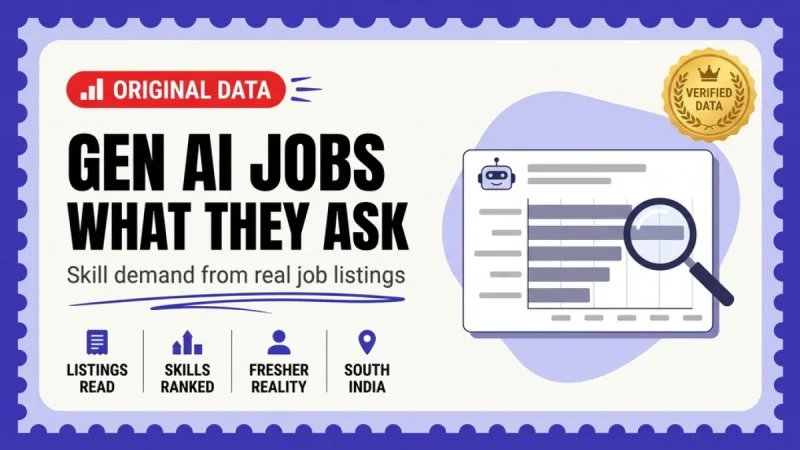
📊 Every Skill, Ranked by How Often It Appeared
Share of the 46 listings that mentioned each skill. Learn top-down, not by what a course advert tells you.
🔍 Three Things the Data Says That Course Adverts Do Not
1️⃣
Nobody is advertising a fresher Gen AI job.
Zero of the 46 listings used the words fresher, entry level or zero years. Where a range was given it started at three years and the median first number was six. If a course is selling you a Gen AI job straight out of college, the live market does not currently support that promise. The realistic route is to get any software, data or support job first and move sideways into AI work from inside a company.
2️⃣
Prompt engineering is assumed, not paid for.
It appeared in 63% of listings — seventh place. Above it sat retrieval and RAG at 83%, agents at 76% and LangChain at 74%. Writing a good prompt is treated as basic literacy. What gets paid is connecting a model to a company’s own data and making it act reliably.
3️⃣
These are integration jobs, not model-training jobs.
Fine-tuning appeared in only 26%, TensorFlow in 26% and Hugging Face in 9%. Meanwhile APIs appeared in 72% and vector databases in 63%. The everyday job is: take a model that already exists, feed it your employer’s documents, wrap it in an API, and keep it from saying something wrong.
🎓 What to Learn, in the Order the Data Supports
This is simply the frequency table turned into a sequence. Nothing here is our opinion about what is interesting — it is what employers wrote down.
1
Python and how an LLM behaves
87% and 96%. Everything else sits on top of these two. You do not need the maths behind a transformer; you need to be able to call one and reason about why it answered the way it did.
2
Retrieval and RAG
83%. This is the single most under-taught skill relative to how often employers ask for it. Chunking documents, embedding them, retrieving the right passage and grounding an answer in it.
3
Agents and LangChain
76% and 74%. Chaining steps, giving a model tools, handling failures when a step returns nonsense.
4
APIs and vector databases
72% and 63%. Pinecone, Chroma, FAISS or similar, and the plumbing that exposes your work to the rest of the product.
5
Cloud: AWS or Azure
41% each, GCP 15%. Pick one, not all three. AWS and Azure are equally weighted in this sample.
6
Only then, training and tuning
Fine-tuning 26%, PyTorch 33%, TensorFlow 26%. Useful, but it is the last rung, not the first — the opposite of how most syllabuses are ordered.
📍 Where These Jobs Are
29 of the 46 listings were in south India. Bengaluru alone had 19 and Hyderabad 6, with the rest in Trivandrum, Kochi, Gurugram, Mumbai, Delhi and Pune.
For a candidate in Andhra Pradesh or Telangana that is actually good news and bad news in one line. Hyderabad is a real local Gen AI market — small, but real, and it is the only one in the Telugu states. Visakhapatnam and Vijayawada did not appear once in this sample. If you want this work without relocating, Hyderabad is the move; if you want the deepest market, it is Bengaluru.
The employers were not only startups. The list included Apple, Barclays, SAP, Nomura, Wells Fargo, Pfizer, Eli Lilly, KPMG India, Accenture, Infosys, EPAM, NTT DATA, UST and GE Vernova, alongside smaller AI-first firms.
⚖️ What This Study Cannot Tell You
46 listings is a sample, not the whole market. It is one platform, read on one day. A bigger or different sample would shift the percentages, though the ordering is unlikely to flip.
A skill not mentioned is not a skill not wanted. Some employers write short adverts. SQL appeared in only 22%, which almost certainly understates how much SQL these jobs involve.
We did not collect salaries. Almost none of these listings published one, so any figure we gave you would be invented. Ask the recruiter in writing.
Zero fresher mentions is about adverts, not about hiring. Companies do move juniors into AI teams internally. What the data shows is that they are not advertising those seats publicly under Gen AI titles.
❓ Frequently Asked Questions
Can freshers get a Generative AI job in India?
Not from these listings. We read 46 live Generative AI job postings in India in November 2026 and not one of them mentioned freshers, entry level, or zero years of experience. Where an experience range was stated it typically started at three years. That does not mean AI is closed to freshers, but it does mean the roles advertised under Gen AI titles today are not fresher roles, and any course promising you one is overselling.
Is prompt engineering the most important Gen AI skill?
No, and this is the clearest finding in the data. Prompt engineering appeared in 63% of the 46 listings. Retrieval and RAG appeared in 83%, agents in 76% and LangChain in 74%. Prompting is assumed; what employers actually pay for is wiring a model into a working system.
Do I need a degree for a Gen AI job?
Most listings did not ask for one. Only 7 of the 46 mentioned a degree at all, 3 a bachelor's and 4 a master's. These are overwhelmingly skills-first adverts, which is unusual compared with most Indian IT hiring.
Do I need to know how to train or fine-tune models?
Usually not. Fine-tuning appeared in only 26% of listings, TensorFlow in 26% and Hugging Face in 9%. The common pattern is integration work: take an existing model, give it your company's data through retrieval, wrap it in an API and ship it.
Which Indian cities have the most Gen AI jobs?
Of the 46 listings, 29 were in south India. Bengaluru had 19, Hyderabad 6, with the rest spread across Trivandrum, Kochi, Gurugram, Mumbai, Delhi and Pune. For candidates in Andhra Pradesh and Telangana, Hyderabad is the realistic local market and Bengaluru the realistic move.
What should I learn first?
Follow the frequency order in the table on this page. Python and LLM basics first because they appear in nearly every listing, then retrieval and RAG, then agent frameworks and LangChain, then vector databases and APIs. Cloud comes next, and model training comes last if at all.
📚 Method
On
22 November 2026 we pulled Generative AI job postings for India from LinkedIn’s public job pages using the search terms
generative ai,
gen ai engineer,
llm engineer and
ai engineer. After removing duplicate company-and-title pairs we were left with 49 unique postings, and we successfully read the full description of
46 of them, from
38 employers.
Each description was searched for a fixed list of skill terms, and a listing was counted once per skill no matter how many times the word appeared. Percentages are the share of those 46 listings.
We have not added a salary, a company or a requirement that was not in a listing we actually read. Where the sample is thin — experience ranges were stated in only a minority of adverts — the page says so rather than rounding it into a confident number.
Published 22 November 2026. We intend to re-run this count periodically; the skill ordering is the part worth watching.