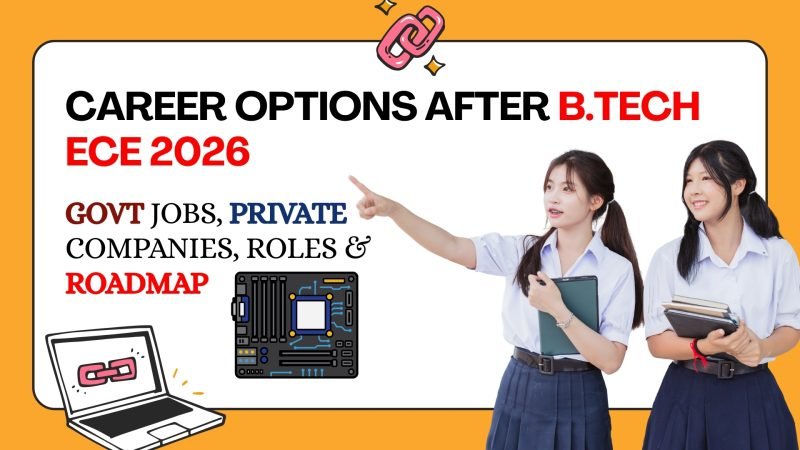
Career Options After B.Tech ECE – Government & Private Jobs, Roles, Companies, Preparation Roadmap
Completing B.Tech in Electronics and Communication Engineering (ECE) opens doors to one of the most diverse career landscapes
in engineering. Unlike many branches that restrict graduates to a narrow set of roles, ECE offers opportunities across
core electronics, IT & software, government services, research, higher education, and emerging technologies.
However, many ECE students feel confused after graduation due to the wide range of options available.
This detailed BeInCareer guide explains why ECE is a strong career choice, what paths are available in
government and private sectors, companies and roles you can work in, and a step-by-step preparation roadmap
to crack jobs successfully.
Why Choose Electronics & Communication Engineering (ECE)?
ECE is a foundational engineering discipline that sits at the intersection of hardware, software, and communication systems.
It forms the backbone of modern technologies such as mobile networks, semiconductors, automation, artificial intelligence,
electric vehicles, and defense systems.
| Reason | Explanation |
|---|---|
| Versatile Degree | Allows entry into core electronics, IT, government, research, and management roles. |
| Strong Industry Demand | Used in telecom, semiconductor, aerospace, defense, automotive, and IT sectors. |
| Future-Proof Skills | Plays a critical role in AI, IoT, robotics, EVs, and 5G/6G technologies. |
Career Options After ECE – Government Sector
Government jobs are a preferred choice for ECE graduates due to job security, stable income, prestige, and long-term benefits.
ECE students are eligible for a wide range of central and state government roles.
Major Government Exams & Departments for ECE
| Exam / Department | Roles | Work Nature |
|---|---|---|
| GATE (PSUs) | Engineer, Executive Trainee | Core electronics, R&D, operations |
| ISRO / DRDO / BARC | Scientist / Engineer | Space, defense, advanced research |
| Indian Railways | JE / SSE | Signaling, telecom, power systems |
| Defense Services | Technical Officer | Defense communication & systems |
How to Prepare for Government Jobs (ECE)
- Master core subjects: Networks, Signals, Analog, Digital, Control Systems
- Practice previous years’ GATE & PSU questions
- Start preparation early (2–3 years recommended)
- Follow structured study plans and mock tests
Career Options After ECE – Private Sector
The private sector offers faster career growth, exposure to global projects, and a wide variety of roles.
ECE graduates can work in core electronics industries or shift to IT and software roles.
Top Private Companies for ECE Graduates
| Industry | Companies |
|---|---|
| Semiconductors | Intel, Qualcomm, NVIDIA, AMD |
| Telecom | Ericsson, Nokia, Samsung |
| IT & Software | TCS, Infosys, Wipro, Accenture |
| Embedded & Automotive | Bosch, Continental, Tata Elxsi |
Common Job Roles in Private Sector
| Role | Skills Required |
|---|---|
| Embedded Engineer | C, C++, Microcontrollers, RTOS |
| VLSI Engineer | Verilog, SystemVerilog, ASIC flow |
| Software Engineer | Python, Java, DSA, Web frameworks |
| Network Engineer | CCNA, routing, switching |
How to Apply for Jobs After ECE
- Campus placements and off-campus drives
- Job portals and company career pages
- Walk-in drives and hiring events
- LinkedIn networking and referrals
- Skill-based platforms like BeInCareer & TryBinc
What Should ECE Students Do While Learning?
| Year | Focus Areas |
|---|---|
| 1st–2nd Year | Strong fundamentals, coding basics, mini projects |
| 3rd Year | Internships, core specialization, competitive exams |
| Final Year | Placements, real-time projects, resume building |
A B.Tech ECE degree offers unmatched flexibility and career growth. Success depends on choosing the right path early,
upgrading skills continuously, and taking a strategic approach toward learning and applications.
With proper guidance and planning, ECE graduates can build strong careers in both government and private sectors.
Frequently Asked Questions (FAQs) – Career After B.Tech ECE
1. What are the best career options after completing B.Tech ECE?
After B.Tech ECE, students can choose careers in government jobs, private sector jobs, IT/software roles,
core electronics, higher studies, research, or emerging technologies like AI, IoT, VLSI, and EV systems.
The best option depends on individual interest, skills, and long-term career goals.
2. Is ECE a good branch for the future?
Yes. ECE is one of the most future-proof engineering branches. It plays a key role in
semiconductors, telecommunications, defense, space research, electric vehicles, AI, robotics, and automation.
With India focusing on chip manufacturing and digital infrastructure, ECE demand is expected to grow.
3. What government jobs are available after ECE?
ECE graduates are eligible for multiple government roles through exams like GATE, ISRO, DRDO, BARC,
Indian Railways, SSC, UPSC, and Defense Services. Popular roles include
Scientist, Engineer, Technical Officer, JE, and Executive Trainee.
4. Can ECE students apply for IT and software jobs?
Yes. ECE students are highly eligible for IT and software jobs.
Many companies hire ECE graduates for roles such as
Software Engineer, Full Stack Developer, Data Analyst, Cloud Engineer, and Cyber Security Analyst,
provided they have strong programming and problem-solving skills.
5. Which private companies hire ECE graduates?
ECE graduates are hired by companies across multiple industries including:
IT services (TCS, Infosys, Wipro), semiconductor companies (Intel, Qualcomm),
telecom companies (Ericsson, Nokia), automotive & embedded firms (Bosch, Continental),
and product-based companies.
6. What are the common job roles for ECE graduates in the private sector?
Common roles include Embedded Systems Engineer, VLSI Engineer, Network Engineer,
Software Developer, Hardware Design Engineer, and Test Engineer.
Role selection depends on the skills and specialization chosen during learning.
7. How should ECE students prepare for government jobs?
Students should focus on core ECE subjects such as Networks, Signals,
Analog & Digital Electronics, Control Systems, and EMFT.
Regular practice of previous year question papers, mock tests, and structured study plans
is essential for cracking exams like GATE and PSU recruitments.
8. What skills should ECE students learn for private jobs?
For private sector jobs, students should learn:
Programming (C, C++, Python, Java), Embedded Systems, VLSI tools,
Data Structures & Algorithms, Networking basics, and project-based skills.
Internships and hands-on projects significantly improve job readiness.
9. Is higher education beneficial after ECE?
Yes. Higher studies such as M.Tech, MS, MBA, or PhD help students gain
specialization, research exposure, and leadership opportunities.
Higher education is especially beneficial for students targeting R&D, teaching,
or high-end technical roles.
10. How can ECE students apply for jobs effectively?
ECE students should apply through campus placements, off-campus drives,
company career portals, walk-in drives, LinkedIn networking, referrals,
and verified platforms like BeInCareer and TryBinc.
Maintaining a strong resume and professional online profile is crucial.
11. What should ECE students do during B.Tech to crack jobs easily?
Students should focus on strong fundamentals, skill-based learning, internships,
real-time projects, certifications, resume building, and mock interviews.
Early planning from the 1st or 2nd year gives a major advantage during placements.
12. Is coding mandatory for ECE students?
Coding is not mandatory for all ECE roles, but it is highly recommended.
Even core electronics roles require basic programming knowledge.
Coding skills greatly expand job opportunities in IT, automation, and embedded systems.
13. How does BeInCareer help ECE students?
BeInCareer provides verified job updates, walk-in drive alerts,
career guidance articles, skill roadmaps, and employer insights.
It helps ECE students make informed career decisions and connect with real opportunities.