

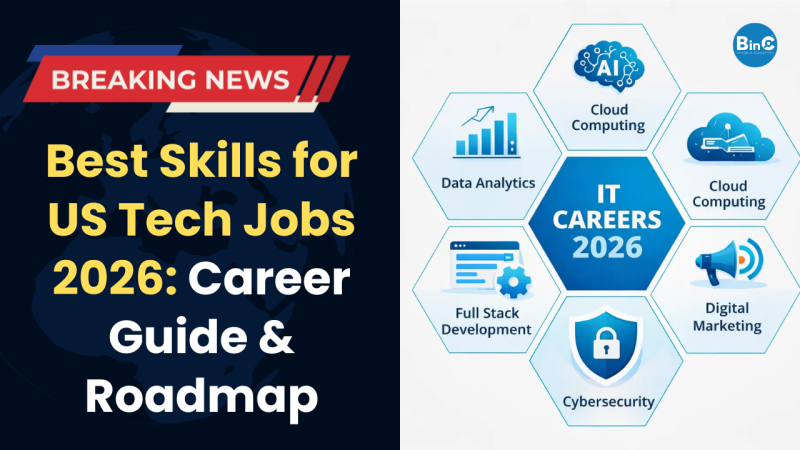
In 2026, hiring is strongly shifting toward AI adoption, cloud-native builds, security-by-default, and automation. Pick one domain + build a portfolio (projects) + strengthen communication to stand out.
Reading time: ~10–12 mins
Why Choosing the Right Skills Matters for US Tech Jobs
The US tech market rewards people who can build, ship, and solve — not just people who “know theory.”
In 2026, companies (from startups to Big Tech) are filtering candidates based on practical projects, strong fundamentals,
and clear communication. A degree helps, but it’s no longer the deciding factor.
- Real-world experience (projects/internships/open-source)
- Problem-solving + system thinking
- Specialized skills (AI/Cloud/Security/Data)
- Communication + collaboration
- Unlock higher salary bands
- Win remote/contract opportunities
- Improve chances for sponsorship (H-1B / employer transfer)
- Build a global career trajectory
Quick Fact Box (2026 Hiring Reality)
Top Technical Skills to Learn for US Tech Jobs (2026)
If your goal is a US tech career, focus on skills that are high-demand + future-proof + portfolio-friendly.
Below are the domains US companies are actively hiring for right now.
If you want long-term career safety, AI/ML is one of the strongest bets.
$110k–$160k
- Python, data structures, math basics (linear algebra, probability)
- ML algorithms + model evaluation
- Deep learning, NLP, computer vision
- TensorFlow / PyTorch
- Data modeling + feature engineering
- Machine Learning Engineer
- AI Engineer
- Data Scientist
- Applied AI / Research Engineer
$100k–$150k
- AWS / Azure / GCP fundamentals
- Containers: Docker, Kubernetes
- IaC: Terraform (or CloudFormation)
- Cloud security basics + IAM
- Monitoring + logging
- Cloud Engineer
- DevOps / Platform Engineer
- Cloud Architect
- Site Reliability Engineer (SRE)
$95k–$140k
- Network + web security fundamentals
- Security tools, monitoring, incident response
- Ethical hacking & penetration testing (legal + safe practice)
- Risk management + compliance basics
- Cloud security & IAM concepts
- Security Analyst
- Security Engineer
- Penetration Tester
- Security Consultant
$90k–$130k
- SQL (must-have), Python/R
- Statistics + experimentation basics
- Power BI / Tableau + dashboards
- Data pipelines (ETL/ELT)
- Big data: Spark/Hadoop basics (role-dependent)
- Data Analyst
- BI Analyst
- Data Engineer
- Data Scientist (advanced track)
$80k–$120k
- HTML, CSS, JavaScript
- React (or Angular/Vue)
- Node.js (or Java/Spring, .NET, Python backend)
- Databases: PostgreSQL/MySQL + MongoDB
- REST APIs, Git/GitHub, testing
- Frontend Developer
- Backend Developer
- Full Stack Engineer
$85k–$125k
- Android: Kotlin
- iOS: Swift
- Cross-platform: Flutter or React Native
- APIs, state management, testing
- Publishing + performance basics
- Android Developer
- iOS Developer
- Mobile App Engineer
$100k–$145k
- Linux basics + networking
- CI/CD pipelines
- Docker + Kubernetes
- Terraform
- Observability: logs/metrics/traces
- DevOps Engineer
- Platform Engineer
- Site Reliability Engineer
Best Non-Technical Skills for US Tech Jobs
In the US market, your technical skill gets you noticed — but your communication and execution often decide the offer.
Hiring managers want people who can explain decisions, document work, and collaborate across time zones.
- Explain clearly (simple + structured)
- Write professional emails & docs
- Present your project story
- Think in trade-offs
- Debug systematically
- Break big problems into steps
- Collaboration habits
- Time management
- Ownership mindset
Top Certifications That Help in the US Job Market
Certifications are not mandatory — but they can boost credibility, especially when you don’t have US work experience yet.
Choose certifications that match your domain (don’t collect random badges).
Step-by-Step Roadmap (Beginner → Job-Ready for US Roles)
Don’t try to learn everything at once. Pick one domain, build fundamentals, then show proof through projects + interviews.
- Pick ONE track: AI / Cloud / Security / Data / Dev
- Learn basics: programming + Git + debugging
- Start daily problem-solving (small)
- Learn core tools in your track
- Build 2 mini projects (small + focused)
- Write clean README + screenshots
- Build 1 big “production-like” project
- Add deployment link + documentation
- Do 1 relevant certification (optional but helpful)
- ATS-friendly resume + LinkedIn makeover
- Apply daily (quality > quantity)
- Mock interviews + system design basics
How to Get US Tech Jobs from India (Practical Paths)
Many people think “US job” means only onsite. In reality, multiple paths exist — depending on your experience and profile strength.
- Remote internships / junior roles
- Freelance + contract work
- Open-source contributions
- Build relationships (networking)
- Employer sponsorship (H-1B) — competitive
- Internal transfer via global companies
- Higher studies → internships → full-time
- Specialized niche skills (AI/Cloud/Security)
Salary Expectations in US Tech Industry (Typical Ranges)
Salaries vary by state, company size, and experience level — but these ranges are commonly seen for many roles.
Common Mistakes to Avoid (Most People Lose Here)
- Learning everything at once (results: confusion + no mastery)
- No projects (skills without proof don’t convert into offers)
- Weak communication (even strong coders fail interviews here)
- No portfolio / GitHub (hiring managers need evidence)
- Ignoring networking (referrals significantly improve interview chances)
Future of US Tech Jobs (What Will Grow in 2026+)
The strongest career safety comes from skills that improve speed, security, and intelligence:
AI, automation, cloud-native engineering, cybersecurity, and data systems.
If you align your learning with these, you’ll stay relevant even when tools change.
Timeline Plan (6–12 Months to Become Job-Ready)
Quality & Safety Notes (Important)
- Don’t rely on “certificate-only” learning. Build projects and show proof.
- Be careful with unknown consultancies or fake sponsorship claims — verify everything.
- If you’re applying for roles, ensure your resume is honest and project links are real.
- If you do security learning, practice only in legal labs (CTFs/sandboxes) and follow ethical guidelines.
Conclusion
To land US tech jobs in 2026, focus on high-demand skills, build real projects, strengthen communication,
and use certifications only as support — not as the whole plan. Pick one domain, master it, and stay consistent.
That’s how you build the career you’re aiming for.
Frequently Asked Questions (FAQ)
1) Which skill is best to get a job in the USA in 2026?
Pick one based on your interest, then build projects to prove your ability.
2) Can I get a US tech job without experience?
Your GitHub + deployed projects can act as your “experience” when done well.
3) Which programming language is most in demand in the USA?
For enterprise, Java/.NET are also common — but Python + JS is a safe combo for many paths.
4) Is certification necessary for US tech jobs?
Projects + interview performance still matter more.
5) Can Indians get tech jobs in the USA?
A strong portfolio + specialization improves your chances.
6) Which IT field has the highest salary in the USA?
Compensation can increase significantly in high-cost states and top companies.
7) How long does it take to learn skills for US tech jobs?
The key is focus — one domain, strong portfolio.
8) Is cybersecurity a good career in the USA?
9) Can freshers get jobs in the USA?
10) What is the easiest tech skill to learn for beginners?
About BeInCareer
BeInCareer is a career and recruitment community helping students and job seekers with job updates, skill guidance, and hiring insights across India.
We focus on practical, action-based guidance so candidates can build real skills and get real outcomes.
Disclaimer: This article is for educational guidance only. Hiring rules, salaries, and job requirements can change. Always verify details on official company pages.