
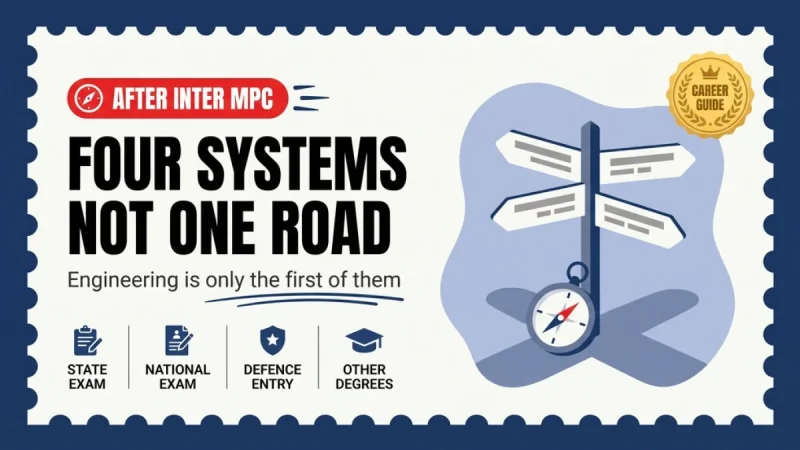
MPC is treated as a single road to B.Tech. It is not. The decision that matters is not which branch — it is which of four different systems you enter, because each one has a different exam, a different timeline and a different exit.
Quick snapshot
- MPC opens four systems: state engineering, national institutes, defence and services, and pure sciences and other degrees.
- Most students only ever enter the first one, because it is the only one their school talks about.
- JEE and EAPCET are different exams with different syllabi and different calendars. Preparing for one does not automatically prepare you for the other.
- B.Sc and B.Stat routes are the least-known and least-crowded, and lead to research and analytics careers.
- Branch matters less than most families believe; college and what you build matter more.
After Inter MPC the main routes are B.Tech through state EAPCET or through JEE for national institutes, defence entries such as NDA and the services academies, pure science degrees including B.Sc Mathematics, Physics, Statistics and Computer Science, and professional routes such as architecture through NATA, design, commerce and law. There is no single best course; the right answer depends on whether you want an engineering job, a research path, a government career or an early exit into work.
System 1 — state engineering through EAPCET
The default path. B.Tech in a state college through the Engineering stream of the state common entrance test, with counselling by the state authority.
Who it suits: students who want an engineering degree and a campus placement, and who are realistic about which college their rank reaches.
What to be careful about: the college matters more than the branch. A core branch at a college with no placement record is a worse outcome than a less fashionable branch at a college that places. Check the actual placement list, not the brochure.
System 2 — national institutes through JEE
NITs, IIITs and centrally funded institutions through JEE Main, and the IITs through JEE Advanced.
The mistake: treating JEE as "EAPCET but harder". They are different exams. The syllabus overlaps but the question style, depth and calendar do not. A student preparing seriously for JEE must still plan the state exam separately, because the two calendars collide.
Who it suits: students willing to commit two years to a specific exam, with a backup that does not depend on it.
System 3 — defence and services
- NDA — after Intermediate, for Army, Navy and Air Force; MPC is required for the Air Force and Navy routes
- Indian Navy and Coast Guard entries that take Intermediate with Maths and Physics
- Merchant Navy through B.Tech Marine Engineering or nautical science courses
These are badly under-applied for in Andhra Pradesh relative to the number of eligible students. The selection is hard, but the applicant pool is far smaller than engineering.
System 4 — the degrees nobody mentions
| Course | Why consider it |
|---|---|
| B.Sc Mathematics / Statistics | The direct route into analytics, actuarial work and data roles; far less crowded than B.Tech |
| B.Sc Computer Science | Same subject area as a CSE degree, lower cost, admission usually on marks |
| B.Sc Physics / Chemistry | Research route through M.Sc and national entrance exams |
| B.Arch (through NATA) | A separate profession with its own council; five years |
| B.Des / design | Design entrances; suits students with a portfolio rather than ranks |
| B.Com / BBA | Open to MPC students; the route to CA, CMA, CS and finance |
| Integrated law (BA LLB, BBA LLB) | Through CLAT or state law entrances |
| Diploma / polytechnic lateral entry | Earlier entry into work, with a route back into B.Tech later |
B.Sc Statistics is the most under-used degree in this state. Analytics and data roles hire from it, the fees are a fraction of private engineering, and almost nobody applies — which is exactly why it is worth looking at.
The branch question, answered honestly
Families spend months on CSE-versus-ECE-versus-Mechanical. The evidence from hiring is less dramatic than the argument:
- College placement record beats branch in almost every comparison that matters.
- Software hires from every branch. Our analysis of what non-software roles actually pay shows the reverse is also true — core engineering is not a dead end.
- What you build in four years separates two students from the same branch more than the branch separates two colleges.
- Core branches are cyclical. Choosing one because it is currently unfashionable is a reasonable bet, not a sacrifice.
A sequence that works
- Decide in Inter first year whether JEE is a serious two-year commitment or not. Be honest; half-commitment is the worst outcome.
- Register for the state EAPCET regardless.
- If defence interests you at all, write NDA. The attempt costs very little.
- Shortlist two non-engineering degrees you would actually accept, with their admission routes.
- Before accepting any seat, ask the college for last year's placement list by branch — the list, not the highest package.
What this guide does not contain
No fees, no cut-off ranks and no college rankings. Fees change every year and by college and category, cut-offs move with the paper and the number of applicants, and rankings in this space are mostly paid placements. Any number we printed would mislead someone into a decision.
Exam patterns, eligibility and counselling authorities change between years and differ between Andhra Pradesh and Telangana. Confirm each route on its current official notification before planning around it.