
CAREER GUIDE · 29 OCT 2026
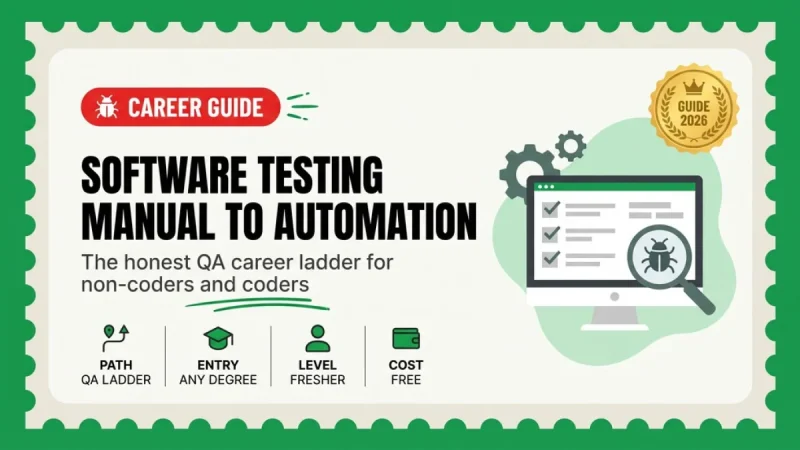
Software Testing as a Career: From Manual to Automation, Explained Without the Snobbery
Half of engineering students are told testing is “what you do if you can’t code”. Meanwhile companies run entire quality teams and automation engineers are hired like developers. This page explains the real work, the real ladder, and how a fresher enters — with or without a coding background.
ADVERTISEMENT
❗The problem this page is trying to fix
Software testing suffers from a reputation problem that costs students real careers. The myth says testing is a fallback for students who could not become developers — so strong candidates never consider it, and weak preparation walks into testing interviews assuming they will be easy.
The reality: quality work is a core engineering function. Automation engineers write code daily. API, performance and security testing are specialised crafts. And the field has one of the clearest skill ladders in IT — you can enter through manual testing fundamentals and climb to automation in a structured, learnable sequence.
Below: what the work actually is, the full role ladder, the skills per rung, and a realistic fresher entry plan.
🔍What testing work actually is
The core job
Finding how software breaks before users do: designing test cases, executing them, reporting defects clearly, and verifying fixes. Clear writing is half the craft.
Manual vs automation
Manual testing designs and runs tests by hand; automation writes code that runs them repeatedly. Automation is not a different career — it is the next rung of the same one.
The coding question
Entry through manual testing needs logic and precision, not programming. Growth into automation needs one language — learnable on the job and before it.
Where testers work
Every services company, product company and GCC runs QA teams. Hyderabad’s walk-in listings regularly include QA roles — it is a volume hiring lane.
The toolbox
Test-case management, defect trackers, browser automation frameworks, API testing tools, and SQL for checking data. Each tool is free to learn.
What testing is not
Not “clicking around”, not a no-growth lane, and not immune to change — AI tools are reshaping the routine parts, which moves the value toward test design and automation skill.
📋The role ladder and its skills
Three tiers. Freshers enter at the first, aim deliberately at the second, and specialise in the third.
🔍 Entry: functional testing
Test-case design and executionDefect reporting and trackingRegression and smoke testingSDLC and agile ceremony basicsClear written English for bug reportsSQL basics for data checks
⚙️ Growth: automation
One programming language (Java or Python typically)Browser automation (Selenium-class frameworks)API testing (request tools and scripted checks)Test frameworks and assertionsVersion control basicsCI pipeline awareness
🚀 Specialisation lanes
Performance and load testingMobile app testingSecurity testing basicsETL / data testingTest environment and release coordinationQA lead and quality engineering management
ADVERTISEMENT
✨What changed — and what it means for freshers
Automation became the default expectation. Pure-manual career plans stall earlier than they used to; the hiring market treats manual skill as the entry rung and automation as the assumed direction.
API testing moved to the centre. Modern apps are APIs talking to each other; testers who can test beneath the UI are consistently more valuable than UI-only profiles.
AI tools absorbed routine execution. Generating obvious test cases got cheap. Designing the non-obvious ones — and automating reliably — got more valuable. The ladder steepened; it did not collapse.
QA walk-ins remain a real door. The walk-in drives we track include QA and automation roles routinely — for freshers without campus placement this is a genuine entry channel.
Non-CS graduates still enter. B.Sc, B.Com and BCA graduates continue to enter through functional testing, especially in domains (banking, healthcare, retail) where domain sense matters as much as tooling.
🎓What you can do this week, at zero cost
The entire entry skill stack is learnable free. No testing course fee is required to become a candidate.
Pick any app you use daily and write 20 test cases for one screen — valid, invalid and edge inputs. This is the actual entry-interview skill, practised directly.
Write 5 defect reports for real bugs you find: steps to reproduce, expected vs actual, severity. Put the best ones in your interview folder.
Start the free Python certification we link below — one language, slowly, aimed at automation later.
Learn basic SQL free — SELECT, WHERE, JOIN — enough to verify data behind a screen.
Read one plain-language introduction to API testing and make your first request against any free public API — the concept matters more than the tool.
Prepare the “why testing?” answer honestly — interviewers filter hardest on candidates who treat QA as a backup. “I like breaking things systematically” with evidence beats any rehearsed line.
🗺A realistic fresher entry plan
1
Build the functional foundation first
Test design, defect writing, SDLC vocabulary, SQL basics. Two to four weeks of deliberate free practice makes you interview-ready for functional QA roles.
2
Start one language in parallel
Python or Java, 30 minutes daily, aimed at automation. You are not becoming a developer — you are future-proofing the testing career you are entering.
3
Apply through every open channel
Walk-in drives (QA roles appear regularly in our city listings), off-campus portals, services companies’ fresher intakes and staffing firms. Volume plus a prepared folder of test cases and bug reports.
4
Interview with artefacts
Bring written test cases and defect reports. Almost no fresher does this; the few who do are remembered. Walk through your edge cases out loud.
5
Automate within the first year
Once inside, volunteer for automation work early — convert your language practice into real scripts. The manual-to-automation transition is easiest while the functional context is fresh.
ADVERTISEMENT
⚠️ What this page deliberately does NOT tell you
No salary figures. QA pay varies by company, city and automation depth; no reachable first-party source publishes a current fresher scale — not published in our source, so we print none.
No tool version specifics. Frameworks and tools release constantly; version-specific advice goes stale in months. The skill families above are the stable truth.
No certification verdicts. Testing certifications exist and some employers value them; whether one is worth your money depends on the employer set you target. Check current job descriptions in your target city before paying.
No “testing is safe from AI” promise. Routine execution is automating fast. The honest claim is narrower: test design, domain judgment and automation engineering remain valuable, and that is where this roadmap points you.
💬Frequently Asked Questions
Is software testing a good career or a compromise?
It is a core engineering function with a clear ladder: functional → automation → specialisation or lead roles. Treated as a deliberate career with automation ambition, it is genuinely good. Treated as a fallback with no growth plan, it stalls — like any field.
Can I get into testing without knowing coding?
Entry, yes — functional testing interviews test logic, test design and clear defect writing, not programming. But plan to learn one language within your first year, because the market increasingly assumes automation as the growth path.
Manual testing or automation — which should a fresher target?
Target functional (manual) roles for entry while learning a language in parallel — that is the realistic sequence. Fresher-direct automation roles exist but usually filter for coding ability; your test-design foundation still decides whether the automation is any good.
Which language should I learn for automation?
Python or Java — pick by comfort and stick with one. Python is gentler to start and widely used; Java dominates many enterprise stacks. The frameworks matter less than genuine comfort writing and debugging simple programs.
Do non-engineering graduates get testing jobs?
Yes — B.Sc, BCA and even commerce graduates enter through functional testing, particularly where domain knowledge counts (banking operations, healthcare claims, retail). The artefact folder — written test cases and defect reports — matters more than the degree name.
Will AI replace software testers?
AI is absorbing routine test generation and execution, which shrinks the pure-manual middle. It is not absorbing test strategy, domain edge-case judgment or automation engineering. The career advice embedded in this page — enter functional, climb to automation quickly — is precisely the AI-aware version.
📚Read Next on BeInCareer
Daily job & course updates, free
Walk-in drives, admission dates and new government courses — the day they are announced.
Source: This is career guidance written by the BeInCareer editorial team on 29 October 2026, describing the software testing role ladder and how freshers commonly enter it. It deliberately contains no salary figures, no tool-version specifics and no certification verdicts, because current verified figures are not published in our source. Verify any employer’s requirements on that employer’s own job description.