
CAREER GUIDE · 29 OCT 2026
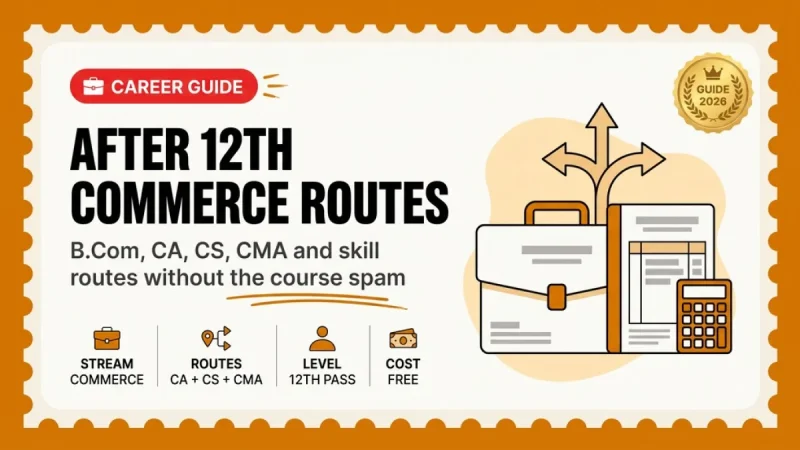
Career After 12th Commerce: Degrees, Professional Courses and the Job Doors Nobody Explains
Commerce students get the laziest advice in India: “do B.Com, then we will see.” The real map has professional courses, focused degrees and early job doors — each with different costs, timelines and honest failure rates. This page puts the whole map on one screen.
ADVERTISEMENT
❗The problem this page is trying to fix
The commerce stream has a strange fate: it feeds the biggest hiring lanes in the country — accounting, banking, finance operations, sales — and yet commerce students receive the least concrete guidance of any stream. “Do B.Com” is not a plan; it is a postponement.
Meanwhile two traps wait. The first is drifting through a plain degree with no stacked skill, then discovering at graduation that every job wants something demonstrable. The second is signing up for a professional course (CA, CS, CMA) because it sounds prestigious, without understanding the honest time commitment and attempt structure.
Below: every real route, what each one demands, which ones can be combined, and the free moves that make any of them stronger.
🔍The route families, stated honestly
The default degree
B.Com remains the backbone — but B.Com plus one demonstrable skill (accounting software, Excel, communication) is a career; B.Com alone is a certificate.
The professional tier
CA, CS and CMA are serious, exam-gated professions with long timelines and real attempt risk. Prestigious, yes — but enter with the structure understood, not on relatives’ pressure.
The combination play
CA/CS/CMA foundation can run alongside B.Com. If the professional route stalls, the degree still completes — this is the standard risk hedge.
The management lane
BBA now, MBA later is a valid lane — strongest when the BBA years produce internships and projects, weakest when they produce only attendance.
The early-job door
Accounts-assistant, audit-office, banking-operations and retail roles hire commerce students early. Working while studying (evening/distance degree) is a real route, not a failure.
What we do not quote
No course fees, no pass percentages, no salary figures — current verified numbers are not published in our source. Institutes publish their own; read them there.
📋Every real route after 12th Commerce
Three families. Most students should pick one primary route and one hedge — not five brochures.
🎓 Degree routes
B.Com (General / Computers / Honours)BBA / BBMB.Com + CA/CS/CMA foundation comboBA EconomicsIntegrated law (B.Com LL.B via CLAT)Hotel management degreesAviation and travel degreesDesign and media degrees (portfolio-gated)
💼 Professional and exam routes
CA (Chartered Accountancy)CS (Company Secretary)CMA (Cost and Management Accountancy)ACCA and global accounting routesBanking exams after graduationInsurance and financial-services certificationsStock-market operations certifications (NISM family)
🛠 Skill and early-job routes
Accounting software (Tally-class tools) + GST workAdvanced Excel and MIS rolesBanking operations entry rolesRetail and store operationsBPO and customer supportDigital marketing support rolesData entry → MIS → analyst ladderFamily business + formal skill stack
ADVERTISEMENT
✨What changed — and why commerce is quietly strong
Finance operations became a mass hirer. GCCs and services companies run huge Record-to-Report, Procure-to-Pay and Order-to-Cash teams that hire commerce graduates continuously — our GCC guide below maps that door.
GST made accounting skill local and permanent. Every business above a threshold files returns; every town needs people who can operate accounting software correctly. This work cannot be outsourced away from your district.
The CA/CS/CMA foundation-with-degree combo is now standard. Running the foundation alongside B.Com is the accepted hedge — the degree completes either way.
Excel stopped being optional. Demonstrable Excel separates commerce freshers more reliably than marks do — our free Excel certification guide below is the zero-cost starting point.
Banking hiring shifted toward private and operations roles. Beyond government bank exams, private banks and NBFCs hire freshers into sales, operations and support lanes year-round — a route most commerce students never formally consider.
🎓What you can do this week, at zero cost
None of these costs money, and each one strengthens every route on the map.
Start the free Tally-class accounting certification we link below — it is the single most route-agnostic skill a commerce student can hold.
Do the free Advanced Excel certification (linked below). Every interview in every commerce lane benefits.
If CA/CS/CMA tempts you: read the institute’s own official page on structure, papers and attempts — one evening of primary-source reading prevents a half-informed three-year commitment.
Find one person in each route you are considering — an articled assistant, a bank employee, an accounts executive — and ask what a normal Tuesday looks like.
Write a one-page budget with your family: what each route costs per year and for how many years. Money truth first prevents mid-course dropouts later.
Start the 60-day English communication plan (linked below) — commerce careers are talking careers, and clarity compounds from day one.
🗺How to choose, step by step
1
Answer the professional-course question first
CA/CS/CMA: yes or no, decided on the official structure and your honest study appetite — not on prestige. If yes, run it alongside B.Com as the hedge. If no, say so and move on without guilt.
2
Pick the degree by what it produces
Choose the college and course that will let you intern, work part-time or build the skill stack — a slightly less famous college with flexibility often beats a rigid “better” one.
3
Stack one skill per semester
Accounting software, then Excel, then communication, then a domain extra (GST filing exposure, MIS, basic analytics). By third year the stack — not the marksheet — is your resume.
4
Take real exposure early
An audit office internship, a shop’s accounts, a cousin’s GST filings — small real work beats certificates-only profiles in every commerce interview.
5
Protect yourself from the course-selling industry
Nobody legitimate guarantees a CA pass, a bank job or a “placement after our diploma”. Fee-for-promise offers are the commerce stream’s most common trap.
ADVERTISEMENT
⚠️ What this page deliberately does NOT tell you
No pass percentages or difficulty claims for CA/CS/CMA. The institutes publish their own results cycle by cycle; current verified figures are not published in our source, so we characterise the routes as exam-gated and stop there.
No fees. Degree and professional-course costs vary by institute, city and year. Confirm on the official institute pages and college notices, never on hearsay.
No salary figures. Pay in accounting, banking and operations varies by employer, city and role; no reachable first-party source publishes a current fresher scale, so we print none.
No “CA vs MBA” style verdicts. Those comparisons depend entirely on the individual student; a universal answer would be content, not guidance.
💬Frequently Asked Questions
Is plain B.Com enough to get a job?
B.Com opens the door only when something demonstrable sits on top of it: accounting software you can operate, Excel you can demonstrate, communication that survives an interview. B.Com plus a two-skill stack is genuinely employable; B.Com alone competes with every other plain B.Com in the state.
Should I attempt CA? Everyone says it is the best.
Attempt it only after reading the institute’s official structure and being honest about your study discipline. It is a long, exam-gated route with real attempt risk — excellent for the student who chooses it deliberately, punishing for the one pushed into it. The standard hedge is running foundation alongside B.Com.
What is the fastest route to earning for a commerce student?
The skill lane: accounting software plus GST work exposure, or retail/banking-operations entry roles, or BPO and support work — each can start during or right after the degree. Fast earning and long-term growth are different questions; ideally pair an earning lane with a growing skill stack.
Is BBA better than B.Com?
Neither is better in the abstract. BBA leans management and presentation; B.Com leans accounting depth and pairs better with CA/CS/CMA. Judge by what you will actually do in the three years — internships and projects decide more than the degree name.
Can a commerce student get into IT companies?
Yes — through finance operations (R2R, P2P, O2C) in GCCs and services companies, through MIS and analytics support roles, and through non-coding IT lanes. Our GCC and non-coding IT guides below map these doors in detail.
Which computer courses actually help a commerce student?
In order of return: accounting software (Tally-class), Advanced Excel, then basic data/MIS skills. All three have free starting routes linked below. Random “computer diploma” packages sold to commerce students mostly repackage these at a fee.
📚Read Next on BeInCareer
Daily job & course updates, free
Walk-in drives, admission dates and new government courses — the day they are announced.
Source: This is career guidance written by the BeInCareer editorial team on 29 October 2026, mapping the degree, professional and skill routes open after 12th Commerce. It deliberately contains no fees, no pass percentages and no salary figures, because current verified numbers are not published in our source. Verify course structures on the official institute pages and admissions on official counselling portals.