
CAREER GUIDE · 29 OCT 2026
English for Jobs: What Interviews Actually Test, and a 60-Day Fix That Costs Nothing
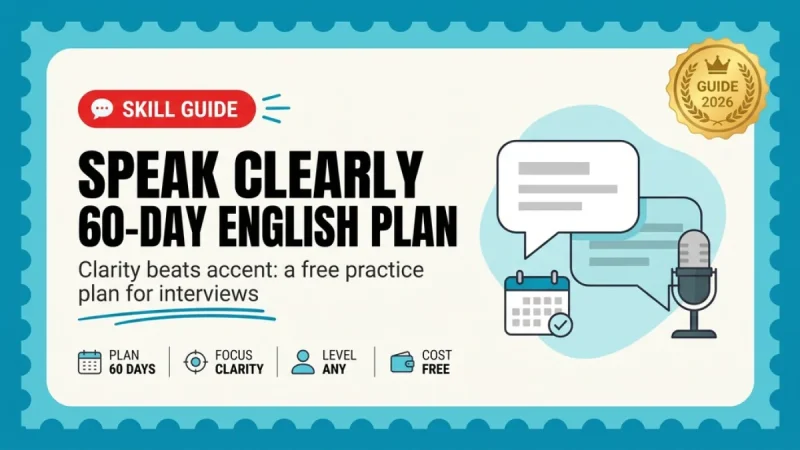
More careers in AP and Telangana are blocked by English fear than by marks. And the fear is aimed at the wrong target — interviews do not test accent or vocabulary size. They test whether you can say a clear thing clearly. That is trainable in 60 days, free.
ADVERTISEMENT
❗The problem this page is trying to fix
A Telugu-medium student walks into an interview knowing the subject, and freezes — not because the English is missing, but because every sentence is being silently translated, grammar-checked and judged before it is allowed out. The interviewer reads the silence as not knowing. The candidate leaves having never shown what they knew.
The spoken-English industry profits from this exact fear. It sells accent training, vocabulary lists and “fluency courses” — none of which address what hiring conversations actually require: short, clear, confident sentences about things you know.
This page narrows the problem to the five situations that matter, and gives a 60-day practice plan that requires no course, no partner and no money.
🔍What interviews actually test
Not accent
Nobody hiring in Hyderabad or Vizag rejects a Telugu accent. Interviewers across India have regional accents themselves. Accent anxiety is solving a problem that does not exist.
Not vocabulary size
A clear answer in simple words beats a memorised answer with big words, every time. Complex vocabulary delivered nervously reads worse than plain English delivered calmly.
Clarity
Can you answer a question in 2-4 short sentences that follow one line of thought? That is the real test, and it is a thinking habit more than a language skill.
Recovery
Everyone stumbles. The test is whether you stop, smile, and restart the sentence — or spiral. Recovery is pure practice.
Listening
Half of “poor English” rejections are actually answers to a different question than the one asked. Listening fully before composing is a trainable habit.
The written layer
One readable email with a clear subject line, and a resume without copied paragraphs. Written clarity is screened before you ever speak.
📋The five situations that matter — and the traps
Do not train “English” in general. Train these five situations specifically — they cover nearly every hiring interaction.
🎯 Train these five situations
The 60-second self-introductionAnswering “tell me about your project”The standard HR questions, in your own wordsA phone or video call with a strangerOne clear professional email
❌ Traps that make English worse
Memorising full answers word for wordAccent-change obsessionBig-word vocabulary listsTranslating from Telugu mid-sentenceApologising for your English before speakingWaiting to be “ready” before speaking at all
✅ Signs you are actually improving
Shorter sentences, said fasterRestarting calmly after a stumbleAnswering the question that was askedThinking the answer in English directlySpeaking first in group settings occasionally
ADVERTISEMENT
✨Why 60 days is enough (for this specific goal)
The goal is narrow. You are not becoming a public speaker — you are becoming able to handle five specific situations calmly. Narrow goals move fast.
You already have the vocabulary. Years of English-medium textbooks mean the words exist passively. The 60 days convert passive recognition into active speech — which only happens by speaking aloud, not by more reading.
Daily beats intense. Twenty minutes of speaking aloud every day outperforms a weekend workshop by a huge margin, because speech is muscle memory, not knowledge.
Recording yourself is the single fastest feedback loop. One minute of recorded self-introduction, listened back, teaches more than an hour of passive video watching. It is uncomfortable precisely because it works.
Interviews themselves are training. Walk-in drives let you practise the real situation repeatedly at zero cost. Treat early attempts as rehearsals — the flinch fades only through exposure.
🎓The 20-minute daily practice, at zero cost
No course, no partner, no app purchase. A phone that records audio is the entire toolkit.
Minutes 1-5: read any English paragraph aloud — news, textbook, anything. Out loud is the non-negotiable part; silent reading trains nothing spoken.
Minutes 6-10: describe your day, in English, aloud, to nobody. Simple sentences. The goal is thinking in English without translating.
Minutes 11-15: answer one interview question aloud and record it. Listen back once. Note one thing to fix. Tomorrow, same question, better.
Minutes 16-20: rewrite one of your long spoken sentences as two short ones, and say the short version. Shortening is the highest-leverage English skill that exists.
Weekly: one real conversation with a stranger in English — a shop, a phone enquiry, a walk-in drive. Controlled discomfort, once a week, on purpose.
🗺The 60-day plan, staged
1
Days 1-15 — aloud, alone
The daily 20 minutes, in private. Target: the self-introduction said calmly in under a minute, recorded, without reading. Nothing else. One situation mastered beats five attempted.
2
Days 16-30 — your content, your words
Project description and the standard HR answers — built from bullet points, never memorised scripts. Three bullets per answer, spoken differently each time. Scripts shatter under one follow-up question; bullets bend.
3
Days 31-45 — strangers
One English interaction with a stranger every two days: phone enquiries, shop conversations, front-desk questions. Low stakes, real humans, real recovery practice.
4
Days 46-60 — the real room
Attend at least two walk-in drives as rehearsal. The offer is not the point; sitting in the actual situation until it stops producing panic is the point. Many people get the offer anyway.
5
After day 60 — maintain, do not graduate
Keep the five-minute read-aloud daily. Spoken English decays without use like any muscle. The fix is maintenance, not another course.
ADVERTISEMENT
⚠️ What this page is NOT claiming
No fluency guarantee. Sixty days of this makes the five hiring situations manageable. It does not make anyone a fluent orator, and nothing honest can promise that timeline.
No “English level” statistics. Claims about what percentage of rejections are English-related circulate widely; verified current figures are not published in our source, so we print none.
No app or course endorsements. We have audited no spoken-English course’s outcomes and name none. The free method above is complete for the hiring use-case.
No substitute for substance. Clear English presenting an empty project is still an empty project. This page fixes the presentation layer only — the artefact underneath is covered in our other guides, linked below.
💬Frequently Asked Questions
Is my Telugu accent a problem in interviews?
No. Interviewers across India speak with regional accents themselves, and hiring decisions in Hyderabad and Vizag are not made on accent. The real test is clarity — short sentences that follow one line of thought. Accent-change training spends money solving a problem that does not exist.
Should I memorise answers for the HR round?
No — memorised scripts shatter at the first follow-up question, and interviewers recognise recitation instantly. Build each answer as three bullet points and practise saying them in different words each time. Bullets bend under pressure; scripts break.
How much English is needed for a voice-process BPO job?
Clear sentence construction, listening accuracy and calm recovery — tested in the interview itself through conversation rounds. Each employer sets its own bar and tests it directly, so attending the walk-in IS the assessment. Specific per-company requirements are not published in our source.
Can spoken English really improve in 60 days?
For the narrow hiring use-case, yes — because the vocabulary already exists passively from English-medium textbooks, and the 60 days convert it to active speech through daily aloud practice. The broad goal of general fluency takes much longer; this plan deliberately does not chase it.
Do I need a spoken English course?
For interviews, usually no. The components that work — daily aloud practice, self-recording, bullet-based answers, stranger exposure — cost nothing and are fully described on this page. If you do pay for anything, pay for live speaking practice with feedback, never for recorded lectures about English.
English is fine but I still freeze. What is wrong?
Then the problem is rehearsal, not language. Freezing is untrained exposure — the situation is rare for you, so it triggers alarm. The fix is making the situation common: recorded answers daily, strangers weekly, and walk-in drives as live rehearsal until the room stops being novel.
📚Read Next on BeInCareer
Daily job & course updates, free
Walk-in drives, admission dates and new government courses — the day they are announced.
Source: This is practical communication guidance written by the BeInCareer editorial team on 29 October 2026, built for the hiring situations Telugu-medium students most commonly face. It contains no statistics about English-related rejections and no course endorsements, because verified figures and audited outcomes are not published in our source. Employer-specific language requirements are set and tested by each employer directly.