⚠️ Career Alert 2026
✅ Updated March 2026
🎓 For Freshers + IT Pros
⏱ 13 Min Read
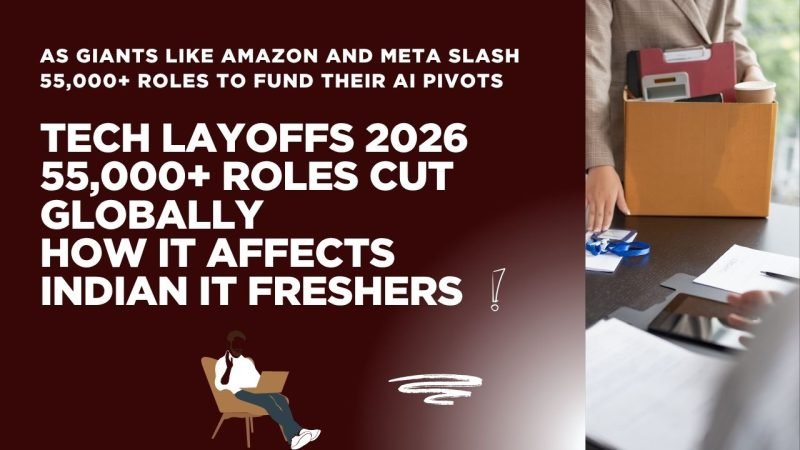
Tech Layoffs 2026 — 55,000+ Roles Cut Globally
How It Affects Indian IT Freshers and What You Must Do Now
Amazon cut 16,000. Atlassian cut 1,600. Block cut 4,000. Globally, over 55,000 tech roles have been eliminated in just the first three months of 2026. In India, fresher IT hiring has collapsed 80% from its peak. The reason is not just cost-cutting — it is a permanent structural shift driven by AI. This guide explains what is happening, who is most at risk, and exactly what Indian IT freshers and professionals must do to stay relevant and employed.
55,911
Global tech job cuts in 2026
80%
Drop in India IT fresher hiring
84%
Indian pros feel unprepared
$100B
Bezos AI manufacturing fund
2×
Applicants per role since 2022
🌍 Global Picture
Who Got Cut — Every Major Tech Layoff of 2026 So Far
Over 55,911 tech workers have lost their jobs globally in the first three months of 2026 alone, across 171 companies — an average of 736 people per day. Also, this pace exceeds 2025’s full-year average. Furthermore, nearly 80% of layoffs in early 2026 came from US-headquartered companies, but the impact is global — with India, Brazil, and Australia experiencing comparable or greater percentage impacts on their local tech workforces. Also, the pattern is clear: every major company justifying these cuts is pointing to the same reason — AI. Furthermore, this is not the post-pandemic overcorrection of 2023 or the macro slowdown of 2024. This is a structural, permanent reshaping of what tech companies need from their workforce.
📊 Major Tech Layoffs in 2026 — Full List (January–March)
| Company | Jobs Cut | When | Stated Reason |
|---|
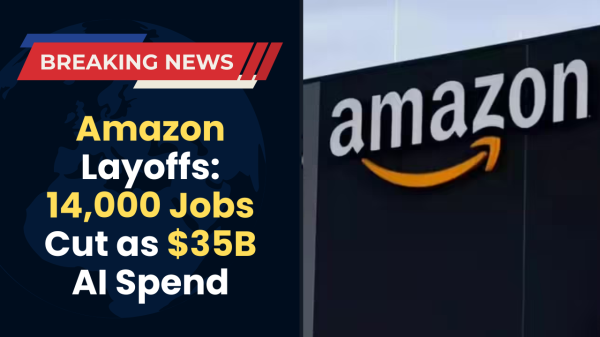
| Amazon | 16,000+ | January 2026 | AI restructuring — AWS, retail, advertising |
| Block (Jack Dorsey) | 4,000 | Q1 2026 | AI handles 70–80% of customer queries |
| Atlassian | 1,600 (10%) | March 12, 2026 | AI investment acceleration — India affected |
| Meta (Reality Labs) | 1,500 | January 2026 | Redirect investment to AI research |
| TCS (FY25) | 12,000 | 2025 (ongoing) | AI-first transformation; campus hiring stable ~40K |
| Oracle (under consideration) | Tens of thousands | Unconfirmed | AI data centre investment ramp-up |
| Others (171 companies total) | ~32,000 | Jan–Mar 2026 | AI automation, restructuring, cost reduction |
Sources: TrueUp.io layoffs tracker (55,911 cuts in 171 companies as of March 2026), BusinessToday, InformationWeek. Oracle layoffs unconfirmed. TCS cuts from FY25 carried into FY26.
💡 The Big Number Explained: At 736 cuts per day, the 2026 pace exceeds 2025’s daily average of 674. Also, if layoffs continue at this rate, analysts project total 2026 global tech job cuts could reach 273,000 by year-end — surpassing 2025’s 245,000. Furthermore, the critical difference from earlier cycles is the stated reason. In 2022–23, companies cited over-hiring during COVID. In 2024, they cited macro slowdown. But in 2026, virtually every major company is explicitly naming AI as the driver.
🇮🇳 India Impact
India’s IT Jobs Crisis — The Numbers Every Fresher Needs to See
The global layoff wave is hitting India in two ways simultaneously. First, Indian employees at multinational tech companies — Amazon, Atlassian, Google, and others — are being laid off directly. Atlassian’s March 2026 cuts explicitly included India. Amazon’s January 2026 restructuring affected teams in Bengaluru, Chennai, and Hyderabad. Second, and more critically for freshers, India’s own IT services giants have dramatically slowed fresher hiring in a structural shift that is unlikely to reverse.
The fresher hiring numbers from India’s IT sector tell a story that should concern every engineering and computer science student graduating in 2026. According to talent analytics firm Xpheno, fresher hiring in India’s IT sector peaked at 600,000 in FY22 — the post-COVID boom year. Also, it had already fallen to approximately 120,000 in FY25 — an 80% decline in just three years. Furthermore, FY26 is expected to be only marginally higher. Also, this means four out of every five IT jobs that existed for freshers in 2022 have effectively disappeared. Furthermore, the competition for the remaining jobs has intensified dramatically — LinkedIn data shows that applicants per open role in India have more than doubled since early 2022.
🏢 TCS
Campus hiring stabilised at ~40,000 per year for two consecutive years — flat with no growth. Also, TCS cut 12,000 employees in 2025 as it pivoted to becoming an AI-first services company. Furthermore, bench strength is being reduced as the company redeploys fewer people per client engagement.
🏢 Infosys
Relatively stronger — maintained a target of 20,000 fresher hires for FY26, with 18,000 already onboarded. Also, Infosys is the most active fresher hirer among the top-tier Indian IT companies. However, even Infosys is prioritising candidates with “future-ready” AI and cloud skills over generic engineering profiles.
🏢 Wipro
Reduced fresher hiring guidance to 7,500–8,000 — down significantly from an earlier estimate of 10,000. Also, Wipro has onboarded roughly 5,000 freshers so far this fiscal year. Furthermore, nearly 200 Wipro recruits have publicly flagged deferred onboarding of 7+ months with vague explanations citing “business requirements.”
🏢 Tech Mahindra
Has indicated it will hire fewer freshers in FY26, instead redeploying existing talent freed up from completed transformation projects. Also, nearly 1,000 candidates reportedly still await joining letters from Tech Mahindra. Furthermore, this pattern — offer letters issued but joining indefinitely deferred — has become a major source of distress for fresh graduates across the sector.
The Global Capability Centres (GCCs) — the India offices of multinational corporations like Google, Amazon, Microsoft, and JP Morgan — offer a partial bright spot. UnearthIQ estimates that approximately 1.2–1.4 lakh net new roles will be added in GCCs in 2026, outpacing layoffs. Also, these GCC roles are typically better-paid and more technically demanding than IT services jobs. However, they are also less accessible to freshers without specialised AI, cloud, or data skills.
⚠️ The Deferred Joining Crisis: One of the most distressing trends for Indian freshers is not just fewer offers — it is offers that arrive but never result in actual employment. Also, a Business Today investigation found that companies are issuing letters of intent, then pushing joining dates by 6–12 months with vague “business requirement” justifications. Furthermore, affected candidates have approached IT workers’ unions for help. Also, this practice creates genuine financial hardship for graduates who turn down other opportunities to wait for a promised joining date. If you have a deferred offer, document everything and actively explore parallel job searches — do not rely on a deferred date alone.
🤖 The Real Reason
Why AI Is the Real Cause — Not Just an Excuse
Every previous wave of tech layoffs had an economic trigger — the dot-com bust, the 2008 financial crisis, the post-COVID over-hiring correction. The 2026 wave is different. Also, it is not triggered by a recession — the global economy continues to grow. Furthermore, it is not triggered by declining tech revenue — companies like Amazon, Microsoft, and Google reported strong earnings in 2025. Also, it is being driven by something companies have been careful to name directly: AI is replacing the work that junior and mid-level employees used to do.
Atlassian CEO Mike Cannon-Brookes was notably direct when announcing 1,600 layoffs in March 2026. He stated: “It would be disingenuous to pretend AI doesn’t change the mix of skills we need or the number of roles required in certain areas. It does.” Also, Block’s 4,000 layoffs were concentrated in customer support — where its AI system now handles 70–80% of customer queries without human intervention. Furthermore, Amazon’s automation now includes one million warehouse robots with a DeepFleet AI system improving fleet efficiency by 10% — meaning the company is systematically reducing human work across every layer of its operations, not just corporate offices. Also, Jeff Bezos launched Project Prometheus in late 2025 with $6.2 billion in funding and is now seeking an additional $100 billion to acquire and automate entire manufacturing industries with AI.
🔴 Roles Most at Risk from AI Replacement
Customer support and service roles have been the most heavily impacted in 2026 — AI chatbots now resolve 70–80% of queries at companies like Block, eBay, and Pinterest. Also, basic software testing and quality assurance — where AI tools now generate and run test suites automatically — is the second most affected area. Furthermore, content creation and marketing roles using standard templates are being automated at scale. Also, basic data entry, report generation, and routine coding tasks (CRUD operations, boilerplate code) are increasingly handled by AI coding assistants like GitHub Copilot and Cursor. Furthermore, Accenture has warned that entry-level roles in testing, support, and basic programming are expected to be affected first as enterprise AI deployments scale.
🟡 The Long-Term Structural Shift — Not a Cycle
The most important thing to understand is that this is not a cycle that will reverse when the economy improves. Also, the old model of Indian IT services — where companies hired tens of thousands of freshers, trained them for 3–6 months, and deployed them on client projects doing routine maintenance and development — is structurally broken. Furthermore, AI tools like GitHub Copilot, Amazon CodeWhisperer, and Google Gemini Code are automating the exact type of work that Indian IT services freshers historically did. Also, what used to require five junior developers now requires one senior developer with AI tools. Furthermore, this is a permanent change — not a temporary one driven by economic conditions.
🛡️ What’s Safe
Which Tech Jobs Are Safe in 2026 — And Which Are Not
Not all tech jobs are equally at risk. The pattern in 2026 is that jobs requiring genuine creativity, complex judgment, and deep domain expertise are growing — while jobs involving routine, predictable, or templated work are shrinking. Jeff Bezos put it clearly: the people AI will never replace are those who can invent and create, not just execute. Here is a direct breakdown of what is safe and what is not.
✅ High-Safety Roles in 2026
AI/ML Engineers: Building, fine-tuning, and deploying AI models. Demand still far exceeds supply.
MLOps Engineers: Deploying and monitoring ML models in production. Highest salary growth in 2026.
Data Scientists (with AI skills): Complex modelling, causal inference, LLM-based analysis — not just dashboards.
Cybersecurity Specialists: Threat detection, penetration testing, compliance — AI creates new attack surfaces too.
Cloud Architects: Designing enterprise cloud infrastructure. AWS/Azure/GCP certified specialists in high demand.
Senior/Principal Software Engineers: System design, architecture decisions, complex problem-solving. AI assists, not replaces.
Product Managers: Business understanding, user empathy, strategy — AI cannot substitute judgment here.
⚠️ High-Risk Roles in 2026
Manual Testers / QA: AI testing tools automate 80%+ of test case generation and execution.
Customer Support Agents: AI chatbots handle 70–80% of queries — most vulnerable role in 2026.
Junior Java/Python developers (routine work): Boilerplate coding, CRUD apps, and maintenance scripts are AI-generated now.
Basic Data Entry and MIS Analysts: Automation replaces routine spreadsheet and reporting tasks.
Generic IT Support (L1/L2): First-level troubleshooting increasingly handled by AI diagnostic tools.
Content writers without domain expertise: Templated, commodity content creation is being automated.
The core principle across all safe roles in 2026 is the same: depth and judgment. Also, AI is excellent at pattern-matching, optimisation, and executing defined tasks at scale. However, it consistently struggles with genuinely novel problems, complex cross-functional trade-offs, and work requiring deep domain knowledge combined with human judgment. Furthermore, the implication for Indian freshers is direct — do not be a generic programmer. Also, be a programmer who deeply understands one domain (finance, healthcare, manufacturing, logistics) and can apply AI tools to solve complex problems in that domain. That combination is what companies will pay a premium for in 2026 and beyond.
🎯 Action Plan
What Indian IT Freshers Must Do Now — A Practical 6-Step Plan
The tech job market is not dying — it is transforming. The engineers who understand this and adapt will have better careers than any previous generation. The ones who wait for it to return to 2022 conditions will be left behind. Here is exactly what to do, in priority order.
1
Learn AI Tools Immediately — Not Theoretically, But Practically
The single most impactful thing any Indian IT fresher can do today is become proficient with AI coding and productivity tools. Learn GitHub Copilot, Cursor, and Amazon CodeWhisperer — these tools are now expected knowledge in technical interviews at GCCs and mid-size tech companies. Also, learn to use Claude, ChatGPT, and Gemini as actual work tools, not just chatbots. Furthermore, practice prompt engineering for your specific domain — finance, healthcare, logistics. Also, take the Google Gemini Developer API course (free) and the GitHub Copilot certification. These certificates signal AI-readiness to recruiters. The goal is not just knowing AI exists — it is being faster and better than a competitor who does not use AI tools.
2
Pivot Away from Commoditised Skills Towards Specialised Ones
Generic Java developer, generic Python developer, generic manual tester — these profiles are becoming commoditised faster than you think. Also, the market is saturated with them and AI is automating the core work. Instead, build a specialisation: MLOps (high demand, low supply), cloud security (AWS/Azure certifications + security), LLM fine-tuning and RAG systems, or data engineering (dbt, Airflow, Spark). Furthermore, pick one and go deep. A fresher with genuine depth in one of these areas will consistently beat ten freshers with generic profiles in interview pipelines. Also, Kaggle competitions, open-source contributions, and real deployment projects on GitHub are the evidence that counts. Furthermore, the GCC market (1.2–1.4 lakh new roles expected in 2026) specifically seeks these specialised profiles over generic ones.
3
Stop Applying to IT Services Alone — Target GCCs, Startups, and Product Companies
Most freshers focus their job search entirely on TCS, Infosys, Wipro, Accenture, and Cognizant — the companies with the largest recruitment advertisements. Also, this is precisely the most competitive segment with the most deferred joinings and lowest growth potential in 2026. Furthermore, Global Capability Centres of companies like Walmart, JPMorgan, Goldman Sachs, Shell, Caterpillar, Siemens, and Apple are actively hiring in Hyderabad, Bengaluru, and Pune — and they offer significantly better pay, more interesting work, and no bench culture. Also, Indian product startups and SaaS companies in Hyderabad (T-Hub), Bengaluru, and Chennai are hiring aggressively for AI-enabled roles. Furthermore, check LinkedIn company pages directly, use Internshala for internship-to-hire pipelines, and reach out directly to hiring managers via personalised LinkedIn messages rather than waiting for mass recruitment drives.
4
Build a Portfolio That Shows Real AI Work — Not Just Course Certificates
84% of Indian professionals feel unprepared to find new jobs (LinkedIn, 2026). The ones who are prepared all share one thing: demonstrated, real work. Also, a GitHub repository with 3–5 quality projects is more powerful than a dozen course completion certificates. Furthermore, build something that uses AI: a RAG-based question-answering system on a real document corpus, a fine-tuned model for a specific domain, or an MLOps pipeline that deploys and monitors a model. Also, participate in Kaggle competitions — even a top-40% finish demonstrates practical ML skills. Furthermore, write 2–3 technical blog posts on LinkedIn or Medium about your projects. This shows employers you can communicate what you build — one of the highest-valued but rarest skills among Indian freshers.
5
Consider a Domain Specialisation — Not All Tech Jobs Are in Pure Tech
Some of the fastest-growing tech roles in India in 2026 are not in pure software development. Also, Healthcare IT (electronic health records, medical imaging AI), financial technology (fraud detection, algorithmic trading, RegTech), and supply chain analytics are all seeing significant demand. Furthermore, a B.Tech graduate who learns SQL, Python, and basic ML and also understands the business logic of BFSI or healthcare becomes far more valuable than a pure-tech fresher who knows only code. Also, domain knowledge from non-tech backgrounds — commerce, life sciences, mechanical engineering — is increasingly being valued alongside programming skills. This is why Accenture has stated that freshers remain important: younger workers often combine fresh AI skills with academic domain knowledge that senior employees lack.
6
Network Relentlessly — 75% of IT Jobs Are Still Filled Through Connections
With applicants per role doubling since 2022, applying to jobs on job boards is increasingly inefficient. Also, most job openings at GCCs and product companies are filled through employee referrals before they are even publicly advertised. Furthermore, building a genuine LinkedIn presence — posting about projects, engaging with industry content, and connecting with professionals at target companies — directly increases your chances of getting a referral. Also, attend tech meetups, hackathons, and company open-days in Hyderabad, Bengaluru, and Chennai. Furthermore, reconnect with college alumni working at your target companies and ask directly for referrals. A referral from inside a company dramatically improves your chances of getting past automated resume screening, which now uses AI to filter out 80–90% of applications before a human ever sees them.
🚀 The $100 Billion Signal — What Bezos’ AI Manufacturing Fund Means for Indian Tech Careers
The most significant signal about where tech jobs are heading in the next decade arrived on March 19, 2026. Jeff Bezos confirmed he is seeking to raise $100 billion — one of the largest private investment funds in history — through his startup Project Prometheus, to acquire traditional manufacturing companies in sectors including semiconductors, aerospace, and defence, and transform them entirely using AI. Also, Project Prometheus has already raised $6.2 billion and appointed Bezos as co-CEO. Furthermore, this is not an abstract technology bet. It is a direct statement that AI is going to reshape not just software jobs but physical manufacturing and industrial jobs on an unprecedented scale.
What does this mean for Indian tech careers? Three things. First, AI engineers, robotics software developers, and simulation engineers — the skills Project Prometheus is aggressively recruiting — will be among the highest-paid tech roles of the next decade. Also, India is already a recruiting ground for these skills. Furthermore, second, the manufacturing AI wave will create entirely new categories of jobs in India’s GCC ecosystem as multinational manufacturers set up AI capability centres. Also, third, this confirms that the current layoff wave is not the end of tech jobs. It is a reallocation of jobs from routine execution to high-skill AI work. The question is simply whether Indian freshers and professionals will have the skills to claim those new roles when they arrive.
💡 Bezos on Who AI Can Never Replace: Speaking at Italian Tech Week 2025, Bezos said the people AI will never replace are those who can invent — not just execute. Also, “Put me in front of a whiteboard and I can generate a hundred ideas in half an hour,” he said. Furthermore, this frames the challenge perfectly for Indian IT freshers. The goal is not to be someone who writes code following instructions — AI does that now. The goal is to be someone who understands what needs to be built and why, can design the approach, and can make judgment calls when the situation is ambiguous. Those skills come from deep curiosity, real project experience, and domain knowledge — not from rote learning or certification alone.
💬 Frequently Asked Questions — Tech Layoffs and India 2026
Is the IT sector in India dying? Should freshers avoid IT jobs entirely?
No — the IT sector is not dying. It is transforming. Also, India’s IT industry still employs over 5 million people and contributes $250 billion+ annually in exports. Furthermore, the GCC sector alone is expected to add 1.2–1.4 lakh net new jobs in 2026. Also, what is dying is the old model of bulk fresher hiring for routine work. The new model rewards specialisation, AI fluency, and domain depth. Furthermore, freshers who adapt to this new model will have better career trajectories, higher salaries, and more job security than the 2022 batch that entered during the bubble. The sector is not shrinking — it is becoming more selective.
I already have a job offer letter from an IT company. Should I be worried about joining?
If you have an offer letter with a confirmed joining date that has not been deferred, you are in a relatively safe position — join and learn. Also, if your joining has already been deferred beyond 6 months with no clear communication, treat it as a warning signal and actively explore alternatives in parallel. Furthermore, document all communications with the company. Also, IT workers’ unions have been helping candidates in deferred-joining situations — consider reaching out to the National Association of Software and Service Companies (NASSCOM) or NITES (Nascent Information Technology Employees Senate) for guidance. Furthermore, never turn down a concrete alternative offer for a speculative deferred joining date from a company that has not given you a clear timeline.
What is the best free course to learn AI skills for an IT fresher in India in 2026?
For immediate job-readiness, start with Andrew Ng’s Machine Learning Specialisation on Coursera (free to audit — the gold standard ML course). Also, take the Kaggle Python, Pandas, and Machine Learning micro-courses (all completely free and practical). Furthermore, learn GitHub Copilot through GitHub’s official learning platform (free). Also, the Google Gemini API Developer course and DeepLearning.AI’s Generative AI short courses are free and directly relevant to 2026 employer requirements. Furthermore, for MLOps — which is the highest-growth specialisation — the MLOps Zoomcamp by DataTalks.Club is completely free and covers the full deployment pipeline. Also, Harvard’s CS50P (Python) on edX is free and considered the best Python foundation course available.
Will AI replace all software engineers eventually? Is learning to code still worth it?
Learning to code is more valuable today than ever — but what you code and how you code needs to change. Also, AI tools amplify the productivity of good engineers enormously — a senior engineer with AI tools can do the work that used to require a team of five. Furthermore, what AI cannot do is understand ambiguous business problems, architect novel systems, and make judgment calls on trade-offs between competing requirements. Also, these are precisely the skills that senior and principal engineers develop through years of real project experience. Furthermore, the engineers who will thrive are those who learn to work with AI tools fluently — treating them as junior developers who need direction — rather than competing against them for routine tasks. Code is a skill. Thinking is the superpower.
Are non-IT backgrounds (Commerce, Science, Arts) completely shut out of tech in 2026?
No — in fact, non-IT backgrounds are becoming more valuable in certain tech roles in 2026. Also, companies are looking for people who combine technical skills with deep domain knowledge. A Commerce graduate who learns SQL and Python and understands BFSI business processes is more valuable to a fintech GCC than a generic B.Tech graduate who can code but has no domain context. Furthermore, healthcare IT, agricultural technology, legal technology, and supply chain analytics all reward domain knowledge from non-CS backgrounds. Also, product management, UX research, and data storytelling are all growing roles that actively prefer people with diverse backgrounds who also have technical fluency. The key is building a combination — domain expertise plus AI tools literacy — that pure-CS graduates often lack.
📚 More Career and Finance Guides on BeInCareer
Connect with BeInCareer
Career guides · IT jobs · Walk-in drives · Finance news daily
© BeInCareer 2026 • Updated March 21, 2026 • beincareer.com
Sources: TrueUp.io Global Layoffs Tracker (March 2026), BusinessToday, Business Standard, InformationWeek, DQ India, TechCrunch, Bloomberg, WSJ (Bezos $100B fund), Xpheno India fresher hiring data, LinkedIn India Skills Report 2026, RationalFx tech layoffs report. This article is for informational purposes only and does not constitute career or financial advice.