
Trump's 48-Hour Ultimatum to Iran — Open Hormuz or the US Will Obliterate Your Power Plants
What It Means for India, Petrol, LPG and the Economy Right Now
On the night of March 22, 2026 — Day 23 of the US-Iran war — President Donald Trump issued the most dramatic ultimatum of the conflict so far. He gave Iran 48 hours to fully reopen the Strait of Hormuz or the US would strike and "obliterate" its power plants. Iran responded by threatening to permanently close the strait and destroy US and Israeli energy infrastructure across the region. PM Modi immediately chaired a third emergency energy meeting. Brent crude jumped to $114 on Sunday. India's crude basket is at $156. This is what every Indian must understand right now.
Trump's Exact Words — And Why They Shook the World
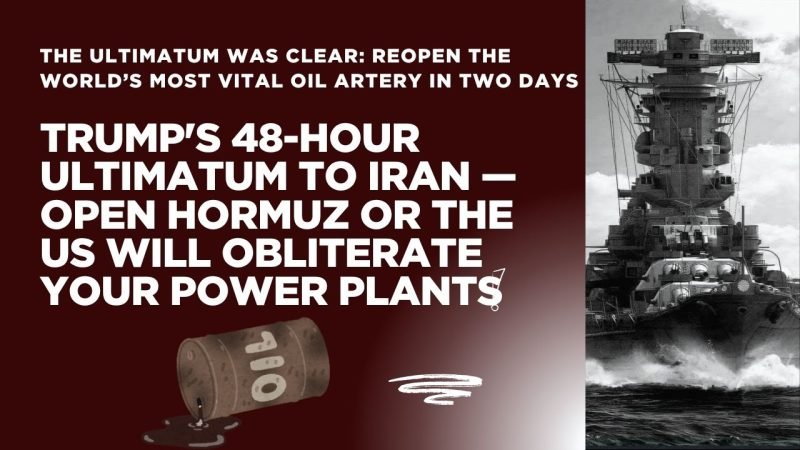
At 23:44 GMT on Saturday, March 22, 2026 — Day 23 of the US-Iran war — President Donald Trump posted on Truth Social from his Florida home. The post was short, typed entirely in capital letters, and it escalated the conflict to a level not seen since the war began on February 28. It was a direct ultimatum to a nuclear-threshold state: reopen a critical global waterway within 48 hours or face the destruction of your civilian power infrastructure. The deadline falls on Monday evening, March 23–24.
"If Iran doesn't FULLY OPEN, WITHOUT THREAT, the Strait of Hormuz, within 48 HOURS from this exact point in time, the United States of America will hit and obliterate their various POWER PLANTS, STARTING WITH THE BIGGEST ONE FIRST!"
The statement marks a dramatic reversal from just 24 hours earlier. On Friday, March 20, Trump had posted that the US was "getting very close to meeting our objectives as we consider winding down our great Military efforts." Also, he had spoken about "winding down" the war without resolving the Hormuz closure — suggesting he was prepared to exit the conflict without forcing the strait open. Furthermore, that posture lasted less than a day. By Saturday night, he had moved to the most aggressive threat of the entire conflict. Also, US National Security Adviser Mike Waltz reinforced the ultimatum on Sunday morning television, saying Trump "will start by attacking and destroying one of Iran's largest power plants" — specifically naming gas-fired thermal plants as likely targets.
The shift in tone appears driven by the economic pain the Hormuz closure is causing back home. Also, US retail gas prices have risen $0.93 per gallon since the war began — hitting $3.94 per gallon on Sunday, a figure that creates direct political pressure on the Trump administration. Furthermore, US crude oil prices rose more than 70% since the start of the year. Also, Trump has been frustrated that NATO allies, China, Japan, and South Korea — who depend far more on Hormuz than the US does — have refused to contribute militarily to keeping the strait open. Trump himself said: "We don't use the strait, the United States. We don't need it. Europe needs it. Korea, Japan, China — they'll have to get involved."
Iran's Counter-Threat — Permanent Closure and Regional Infrastructure Strikes
Iran's response to Trump's ultimatum came swiftly and was more severe than most analysts anticipated. Rather than signalling any willingness to negotiate or partially comply, Tehran escalated on every dimension simultaneously — military threats, economic threats, and a direct challenge to the credibility of Trump's deadline.
Iran's armed forces headquarters declared it is ready to close the Strait of Hormuz indefinitely if Trump carries out his threat — and would not reopen it until any destroyed power plants are fully rebuilt. This is an unprecedented threat: not a temporary blockade in response to military action, but a permanent economic weapon aimed at the entire global oil market until Iran's domestic infrastructure is restored.
"If Iran's fuel and energy infrastructure is attacked by the enemy, all energy and information technology infrastructure and desalination plants belonging to the United States and the Israeli entity in the region will be targeted." This explicitly includes desalination plants — the primary source of fresh water for US military bases and several Gulf states. Attacking desalination plants is considered among the most severe possible escalations because it affects civilian water supply across the region.
Iran's Parliament Speaker Mohammad Bagher Ghalibaf stated that "vital infrastructure as well as energy and oil infrastructure" across the region would become "legitimate targets" the moment Iran's own facilities are hit. He also said the retaliation would drive oil prices even higher — a direct threat to use energy markets as a weapon against the global economy.
Iranian President Masoud Pezeshkian posted on X: "The illusion of erasing Iran from the map shows desperation against the will of a history-making nation. Threats and terror only strengthen our unity. The Strait of Hormuz is open to all except those who violate our soil. We firmly confront delirious threats on the battlefield." Iran's position remains that the strait is open to all nations except the US and Israel — a claim disputed by the reality that tanker traffic has collapsed from 150+ ships per day to near zero.
International analysts are sceptical that Trump's ultimatum will succeed. Aniseh Bassiri Tabrizi of Chatham House said it is "unlikely" Tehran would "cave into the pressure," adding that the Iranian response would be to "continue trying to escalate the costs" — because Iran sees escalation as the only path to forcing a negotiated end to the war. Also, Spain's Prime Minister Pedro Sánchez issued an urgent global appeal on Sunday: "The Government of Spain demands the opening of Hormuz and the preservation of all the energy sites of the Middle East. We stand at a global tipping point. Further escalation could trigger a long-term energy crisis for all humanity." Furthermore, Goldman Sachs warned on Friday that elevated oil prices could persist through 2027 regardless of how this specific ultimatum resolves.
What Happened to Oil Prices After Trump's Ultimatum
Global oil markets reacted immediately. Brent crude — the international benchmark — surged 1.69% to $114.09 per barrel at Sunday's open after Iran threatened to permanently close the strait. US crude (WTI) rose 2% to $100.29. The combined threat of a US attack on Iranian power plants and Iran's counter-threat to shut Hormuz permanently and destroy regional energy infrastructure created the most dangerous single-day escalation for oil markets since the war began.
| Date / Event | Brent $/bbl | India Crude Basket |
|---|---|---|
| Before war (mid-Feb 2026) | ~$70–73 | ~$63 |
| Mar 2 — Hormuz closed | ~$84 | Rising sharply |
| Mar 9 — Crossed $100 | $102.50 | $120 |
| Mar 19 — Diego Garcia attack | $119.50 (peak) | $146 |
| Mar 20 — US lifts Iran sanctions | ~$109–112 | ~$156 |
| Mar 22–23 — Trump ultimatum | $114.09 ↑ 1.69% | $156+ (estimated) |
Sources: BusinessToday, CNN Business, IEEFA, Sacnilk. India crude basket reflects additional insurance, logistics costs over Brent.
The reason India's crude basket ($156) is so much higher than Brent ($114) is critical to understand. India pays Brent plus a premium for war-risk insurance on tankers transiting the Persian Gulf, plus elevated freight rates due to the shortage of ships willing to sail through the conflict zone. Shipping costs have risen 30% since the war began. Also, the rupee has fallen to ₹92–94 against the dollar — near all-time lows — meaning India is paying even more in rupee terms for every barrel it imports. Furthermore, Goldman Sachs warned on Friday that these elevated prices could persist through 2027, even in a scenario where the military conflict ends. Also, the reason is structural: the war has damaged LNG infrastructure in the region that cannot be repaired quickly, creating a "structural hole in global supply that no amount of diplomatic goodwill can close before the 2026–27 winter," according to Business Standard.
How the Iran Ultimatum Directly Hits Every Indian Household
India is among the most exposed major economies in the world to the Hormuz crisis — and the Trump ultimatum and Iran's counter-response make a bad situation significantly worse. Here is a sector-by-sector breakdown of what is happening right now and what could follow if the situation escalates further.
Regular petrol and diesel prices have been held steady by oil marketing companies (OMCs) ahead of state elections in April. In Delhi, petrol is at ₹94.77/litre. In Mumbai, ₹103.54. Also, premium petrol (XP95, Power petrol) was hiked ₹2–₹2.35/litre on March 21 — crossing ₹112 in Bengaluru. Furthermore, industrial diesel has already risen 25% — from ₹87.67 to ₹109.59/litre — pushing up transportation and manufacturing costs across the country. Also, with India's crude basket at $156, OMCs are absorbing a massive under-recovery on every litre sold at controlled prices. Furthermore, analysts warn that once state elections conclude in April, a significant hike in regular petrol and diesel prices is highly likely if crude stays above $100.
India imports 80–90% of its LPG from the Gulf. The domestic cylinder price was hiked ₹60 to ₹913 (Delhi) on March 7 — and that was before the 48-hour ultimatum. Also, commercial cylinders (used by hotels, restaurants, dhabas) were hiked ₹115–₹144 to ₹1,884.50. Furthermore, LPG hoarding and black marketing have been reported across multiple states, prompting government raids. Also, the government has increased domestic LPG production from refineries and raised the commercial LPG allocation to 50%. Furthermore, the LPG supply crisis is being partially addressed by tankers arriving from the US — the Singapore-flagged Pyxis Pioneer docked at New Mangalore Port on Sunday. If Iran acts on its threat to permanently close the strait, LPG supply to India faces a structural crisis, as no alternative route can move the same volume as Hormuz.
The rupee has fallen to ₹92–94 against the dollar — a record low — compounding every import cost. Also, India imports over 88% of its crude oil, meaning every rupee of depreciation raises the domestic cost of energy. Furthermore, the MUFG formula is stark: for every $10 per barrel rise in crude, India's current account deficit (CAD) widens by 0.4–0.5% of GDP. Also, at $100 crude, India's CAD could reach 3% of GDP — a level associated with balance-of-payments stress. Furthermore, 10-year bond yields rose 11 basis points to 4.39% — a 44-basis-point increase since the war began — reflecting rising inflation and fiscal pressure. Also, the Sensex is expected to open over 300 points down on Monday as energy supply fears weigh on markets. Furthermore, the combination of higher crude, a weaker rupee, and rising inflation is squeezing household budgets across India — particularly those in the lower-middle income bracket who spend a higher share of income on fuel, LPG, and food.
India imports significant quantities of LNG-based fertiliser feedstock through Hormuz. Also, the Essential Commodities Act has prioritised natural gas for residential piped networks and CNG for transport first, with fertiliser production second. Furthermore, if LNG supply is further disrupted, fertiliser production could be constrained heading into the Kharif sowing season — with potential knock-on effects on food prices. Also, businesses in cities like Bhopal have already started switching from LPG to induction cooking due to supply uncertainty. Furthermore, transport costs are rising across the supply chain — from raw material input to retail shelves — creating broad-based inflationary pressure that will be felt most sharply in food and consumer goods prices.
PM Modi's 3rd Emergency Meeting — What the Government Is Doing
Prime Minister Narendra Modi chaired a high-level emergency meeting on Sunday evening — his third such meeting since the war began — to review India's preparedness across petroleum, crude oil, natural gas, power, and fertiliser sectors. The meeting brought together India's entire economic security cabinet: Home Minister Amit Shah, Defence Minister Rajnath Singh, External Affairs Minister S. Jaishankar, Finance Minister Nirmala Sitharaman, Health Minister J.P. Nadda, Agriculture Minister Shivraj Singh Chouhan, Petroleum Minister Hardeep Singh Puri, Commerce Minister Piyush Goyal, and Railways Minister Ashwini Vaishnaw.
The meeting is India's most direct governmental response to Trump's 48-hour ultimatum. Also, the presence of the full economic cabinet signals that the government is treating this as a potential inflection point — a moment where the conflict could escalate significantly or could begin to de-escalate, and India must be prepared for both. Furthermore, discussions focused on ensuring uninterrupted supply chains, stable logistics, and efficient distribution of essential resources. Also, officials briefed the PM on current stock levels, import dependencies, and contingency plans. Furthermore, while the government has consistently said stocks are adequate, the invocation of the Essential Commodities Act and the raising of commercial LPG allocation to 50% indicates genuine underlying concern about sustained supply disruption.
• Commercial LPG allocation raised to 50%
• All refineries operating at high capacity
• LPG hoarding raids across multiple states
• 22 Indian-flagged vessels monitored in Persian Gulf
• 24-hour control room for 600+ seafarers and families
• 3.5 lakh Indians repatriated from the region
• US LPG tanker + Pyxis Pioneer docked at Mangalore
• Modi spoke to leaders of Saudi, UAE, Qatar, Iran, France, Israel
• India exploring African producers (Angola, Nigeria) as alternatives
• Iran has said it will provide no extra supply to India via sanctions waiver
• Rupee at record lows — compounding every import cost
• Regular petrol and diesel under-recovery growing daily
• Goldman Sachs: elevated prices could persist through 2027
• LNG supply — 10-day buffer only; Qatar routes disrupted
• Fertiliser production at risk for Kharif season
• State elections in April may delay petrol/diesel price revision
• Global LNG infrastructure damage may not be repairable before winter
• No Indian Navy escort capacity in Persian Gulf currently
India's diplomatic position throughout this crisis has been carefully balanced. Also, Modi has spoken with leaders on both sides — including Iran and Israel — stressing the need for peaceful resolution and open sea lanes. Furthermore, India has signed a joint statement with 20+ nations calling on Iran to cease immediately its threats and comply with UN Security Council Resolution 2817 on Hormuz. Also, India is simultaneously exploring Iranian oil purchases through the US sanctions waiver — a position that requires careful navigation given that Iran itself has said it has no extra supply available and that the waiver is "solely aimed at giving hope to buyers." Furthermore, India's two African energy partners — Angola and Nigeria — have been identified as potential alternative crude sources, but neither can match the volume or proximity of Gulf suppliers.
🔭 What Happens Next — Three Possible Scenarios for India
The 48-hour deadline expires Monday evening (March 23–24, Indian time). Three distinct scenarios are possible, each with very different implications for Indian petrol, LPG, and economy.
Iran allows tanker traffic to resume without formally complying with Trump's demand, framed as a unilateral decision rather than capitulation. Trump declares victory. Brent drops sharply to $90–95. India crude basket falls to $120–130 in 4–6 weeks. Regular petrol and diesel prices may not be hiked after all. LPG supply stabilises. Rupee recovers partially.
Iran ignores the deadline. Trump does not immediately strike power plants — possibly due to legal, military, or political constraints. The war continues in its current form with limited shipping through Hormuz. Brent stays in the $100–$115 range. India faces a prolonged supply squeeze. Petrol and diesel prices hiked ₹8–12/litre after April state elections. LPG cylinder could hit ₹1,000+ in coming weeks. Goldman Sachs scenario: elevated prices through 2027.
US strikes Iran's power plants. Iran executes its threat: permanently closes Hormuz and destroys US/Israeli energy and desalination infrastructure across the region. Saudi Aramco facilities targeted. Brent could spike past $150. India crude basket could exceed $200. Petrol at ₹120–₹130/litre. LPG cylinder could hit ₹1,200–₹1,500. Rupee could weaken to ₹100+. India's CAD could exceed 4–5% of GDP. Emergency rationing of fuel possible. Goldman Sachs called elevated prices through 2027 in a moderate scenario — this is well beyond that.
💡 What Should Indian Households Do Right Now? Do not panic-buy petrol or LPG — the government has confirmed adequate stocks and panic buying worsens supply. Also, if you have a deferred LPG refill, book it promptly through the official OMC apps (HP Gas, Indane, Bharat Gas). Furthermore, households dependent on commercial cylinders (restaurants, dhabas, catering) should explore induction cooking alternatives as a contingency for sustained supply disruption. Also, if you are planning a large petrol vehicle purchase, factor in the possibility of a ₹8–12/litre hike post-April elections into your EMI calculations. Furthermore, watch the Sensex and rupee daily — continued weakness signals the market is pricing in prolonged disruption.
💬 Frequently Asked Questions
Will petrol and diesel prices be hiked immediately in India?
Not immediately. Oil marketing companies have held regular petrol and diesel prices steady ahead of state elections expected in April 2026. However, with India's crude basket at $156 and OMCs absorbing massive under-recovery on every litre sold at controlled prices, a significant hike — estimated at ₹8–12/litre — is widely expected after the elections. Premium fuels (XP95, Power petrol) have already been hiked ₹2–₹2.35/litre as of March 21. Industrial diesel has already risen 25%.
Will Iran actually close the Strait of Hormuz permanently?
Iran has threatened permanent closure only in the specific scenario that the US strikes its power plants. Most international analysts, including Chatham House, assess that Iran is unlikely to comply with Trump's ultimatum — but also that Iran would suffer significant domestic consequences from a permanent Hormuz closure, since Iran itself needs the strait to export the oil that funds its own economy. The permanent closure threat is therefore a deterrent designed to prevent the power plant strikes, not a likely operational reality. What is more probable is a continued partial blockade — allowing some vessels but not others — as Iran has been doing since March 2.
Why is India's crude oil basket price ($156) so much higher than Brent ($114)?
India's crude basket reflects the actual cost of oil as it arrives at Indian refineries — which includes the Brent benchmark price plus war-risk insurance premiums for tankers in the conflict zone, elevated freight rates due to ship shortages (shipping costs are up 30% since the war), and the impact of the rupee's depreciation against the dollar. All these factors compound: a weaker rupee means India pays more in rupee terms for the same dollar-denominated barrel, further widening the gap between what the world sees as "Brent" and what India actually pays per barrel.
What is India doing to protect its oil and LPG supply?
India has invoked the Essential Commodities Act to regulate LPG and natural gas distribution. PM Modi has chaired three emergency meetings and spoken with leaders of Saudi Arabia, UAE, Qatar, Iran, France, and Israel. The government has increased domestic LPG production, raised the commercial LPG allocation to 50%, and is receiving LPG tankers from the United States and via alternate routes. India is also exploring African crude suppliers (Angola, Nigeria) and is considering purchasing Iranian oil under the US 30-day sanctions waiver, pending government guidance on payment and compliance terms. Strategic reserves of crude oil and LPG are maintained at approximately 25 days of supply.
How does this affect the Indian stock market and the rupee?
The Sensex is expected to open over 300 points lower on Monday, March 23, as energy supply fears weigh on sentiment. The rupee has already fallen to ₹92–94 against the dollar — near all-time lows — driven by rising oil import costs, FII outflows, and global risk aversion. 10-year government bond yields have risen 44 basis points since the war began. Oil marketing company stocks (BPCL, IOC, HPCL) are under pressure due to under-recovery concerns. However, upstream oil companies (ONGC, Oil India) and private energy companies may benefit from higher crude prices. Aviation stocks are under severe pressure as jet fuel costs have more than doubled in three weeks.
Sources: Al Jazeera, NBC News, CNN, Axios, Fox News, PBS NewsHour, The Week, BusinessToday, IEEFA, PGurus, India.com (ANI), Business Standard, Goldman Sachs (via CNN Business). Oil price data as of March 22–23, 2026. This article is for informational purposes only and does not constitute financial or investment advice.