
LPG Crisis May Trigger Milk Shortage in India 2026
Only 10 Days of Packaging Stock Left — Dairies Sound Alarm
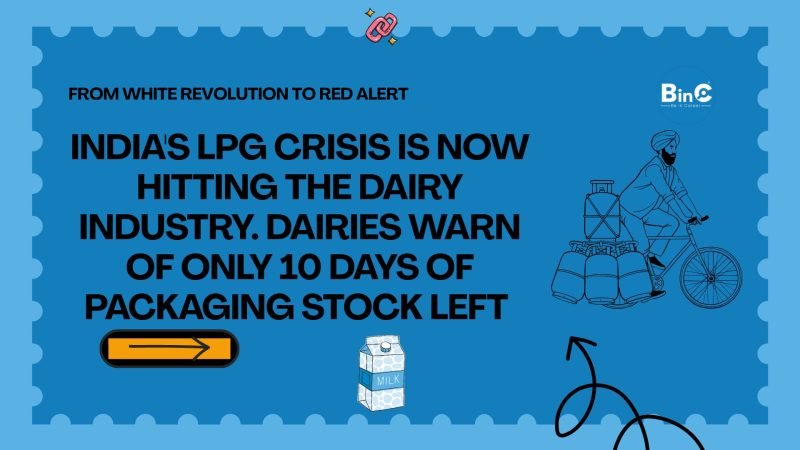
The LPG crisis triggered by the Iran war is now hitting India's dairy industry. Dairy owners in Maharashtra have warned that the country has barely 10 days of milk packaging stock left. LPG powers pasteurisation, milk processing, and the plastic packet factories that package milk. Without it, milk spoilage rises and supply breaks down. Here is everything you need to know — and what to do.
📌 Quick Summary — LPG Milk Crisis March 17, 2026
Why is India's LPG crisis now threatening a milk shortage?
LPG powers two critical parts of milk supply — pasteurisation (heating milk to kill bacteria) and the plastic packaging factories that make milk pouches. Both need LPG to operate. The Iran war has disrupted India's LPG imports through the Strait of Hormuz. So supply to industrial users — including dairies — has been cut. Dairy owners in Maharashtra warn that only 10 days of milk packaging stock remains. Gujarat already cut LPG supply to milk processing units by 40%. If the shortage continues beyond 10–12 days, India faces a real risk of milk supply disruption across major cities.
Why India Has an LPG Crisis — The Full Story
India is the world's second-largest LPG consumer — with over 332 million active household connections. However, India only produces about 38% of its LPG needs domestically. The rest comes from imports. Also, about 90% of those imports normally travel through the Strait of Hormuz. So when the Iran war closed that route in late February 2026, India's LPG supply took a direct hit.
In January 2026 alone, India produced 1.158 million tonnes of LPG — but imported 2.192 million tonnes. So imports are nearly double domestic production. Furthermore, India has only 25–30 days of LPG strategic stock — compared to 60 days of crude oil in underground caverns. LPG requires specialised high-pressure or cryogenic storage that is both expensive and limited. So when Hormuz closed, the shortage hit fast — within just 2–3 weeks.
The Strait of Hormuz is only 33 km wide at its narrowest point. Iran blocked it using drone threats from February 28, 2026. About 20% of global oil and 19% of global LNG travel through it every day. For India, 90% of LPG imports use this route. So the blockade directly slashed India's LPG supply — with no quick alternative route available at this scale.
The government prioritised household cooking gas under the Essential Commodities Act. So commercial and industrial LPG was cut first. Restaurants, hotels, bakeries, dairies, and factories lost access before households. In Andhra Pradesh, hotel owners reported cylinder availability dropped by 40–50%. Commercial kitchens in Mumbai and Bengaluru began closing operations entirely.
On March 7, 2026, oil marketing companies raised domestic LPG prices by ₹60 — taking a 14.2 kg cylinder to ₹913 in Delhi. Also, black market prices are 2–3X the official rate in some cities. The government's LPG subsidy outgo for FY27 has already crossed ₹11,000 crore alongside a ₹17,500 crore support package for oil marketing companies to absorb losses.
Two Indian-flagged LPG carriers — Shivalik and Nanda Devi — crossed the Strait of Hormuz under Indian Navy escort on March 15–16. Together they carry 92,000 metric tonnes of LPG. However, this is only about 5% of India's monthly import needs. So while it provides short-term relief, it does not solve the full crisis on its own.
The government also raised domestic LPG production by about 25% by directing refineries and petrochemical plants to divert propane, butane, and other streams toward LPG output. However, this higher production covers only about 10% of national consumption needs. So the gap remains large — and the dairy industry is now the latest sector to sound the alarm.
How LPG Powers India's Milk Supply — And Why It Is at Risk
Most people think of LPG only as cooking gas. However, LPG plays a critical role in India's entire dairy supply chain — far beyond the kitchen. Without it, the dairy industry cannot function at scale. Here is exactly how the connection works and why the 10-day warning is so serious.
Pasteurisation is the process of heating raw milk to 72°C for 15 seconds to kill harmful bacteria like Salmonella, E. coli, and Listeria. This extends shelf life and makes milk safe to drink. Most Indian dairies use LPG-fired boilers and heating systems for pasteurisation. Without LPG, dairies cannot pasteurise at scale. Also, small and medium dairies do not have alternative fuel systems. So they are the most vulnerable. Without pasteurisation, raw milk spoils within hours in India's warm climate — making it unsafe and unsellable.
India distributes most of its milk in plastic pouches. The factories that manufacture these pouches also use LPG in their production process. So the LPG shortage is hitting the packaging supply chain separately from the pasteurisation problem. Dairy owners report that current packaging stock will last only about 10 days. After that, even if they can pasteurise milk, they will have nothing to pack it in. Furthermore, without packets, milk cannot reach consumers through the standard retail network of local shops and milk booths.
Gujarat — one of India's biggest dairy states and home to Amul — has already taken direct action. The state government slashed LPG supply to milk processing units by 40% to protect household cooking gas stocks. Also, fertiliser units received a 40% cut. Overall industrial supply was cut by 50%. This means Gujarat's dairy output is now running at just 60% capacity. Gujarat produces a large share of India's packaged milk and dairy products — so the impact will be felt nationwide in the coming days.
Industry representatives have warned that the crisis could escalate into a major supply disruption within the next 10–12 days if LPG supplies are not restored. Moneycontrol reported the warning from Maharashtra dairy owners on March 16. If the two LPG tankers that crossed Hormuz on March 15–16 are followed quickly by more shipments, the dairy sector may get partial relief. However, if the Hormuz blockade continues, India faces a genuine risk of milk supply shortages in major cities by the end of March 2026.
The LPG Crisis Is Hitting Far More Than Just Milk
The dairy warning is the latest in a long list of sectors now affected by the LPG crisis. Here is a full picture of what is happening across India as of March 17, 2026.
Over 800 hotels and restaurants in Thane alone face potential closure. Bengaluru eateries are running out of LPG and cutting menus. Some restaurants are adding a "gas crisis charge" to food bills. The Delhi High Court canteen removed main course items due to LPG unavailability. Also, Indian Railways has advised train caterers to explore alternative fuels for long-distance train food service.
Gas-based crematoriums in Pune have temporarily shut down — families cannot complete last rites in time. Hospital kitchens are also under pressure. However, the government has prioritised LPG supply to hospitals and educational institutions from existing dealer stocks. No disruption has been reported at Tirumala Tirupati Devasthanams kitchens, which were designated as an essential supply point.
Gujarat cut fertiliser unit LPG supply by 40%. This could hit the upcoming kharif crop season if production falls. Also, telecom tower manufacturing supply was halted from March 5 — potentially delaying 5G expansion. Hundreds of MSMEs, food delivery services, wedding caterers, community kitchens, and small bakeries are all struggling with rising LPG prices and shrinking cylinder availability.
While the government is protecting household supply, some cities now see domestic shortages too. In Jaipur, residents say both online and phone cylinder bookings are failing. Also, domestic shortages are beginning in Himachal Pradesh. The crisis is worst in southern and western states. Furthermore, cities without piped natural gas are entirely dependent on cylinders — making their households far more vulnerable to any supply disruption.
📊 The Scale: India has 332 million active LPG household connections and 104 million PMUY connections. 54% of normal LPG availability is at risk if Hormuz stays closed — because India imports 60% of its LPG and 90% of those imports flow through Hormuz. The dairy warning is the latest — and most visible — sign of how deep this crisis runs.
📍 State-Wise LPG Crisis Impact — Where Is It Worst?
The LPG crisis is not equal across India. It is hitting some states much harder than others. Cities with piped natural gas (PNG) infrastructure are better placed than those entirely dependent on cylinders.
Maharashtra is the most severely affected state. Mumbai, Pune, Thane, and Nashik all report serious commercial LPG shortages. Over 800 hotels and restaurants in Thane are at risk of closure. The BMC headquarters canteen — serving hundreds of workers daily — was running on its last day's stock as of March 12. Also, Pune's gas-based crematoriums have closed. Furthermore, it is Maharashtra's dairy owners who raised the 10-day milk packaging alarm that is now making national news.
Gujarat is India's biggest dairy state and home to Amul — one of the world's largest dairy cooperatives. The Gujarat government ordered a 40% cut in LPG supply to milk processing units and fertiliser plants to protect households. Overall industrial supply was cut by 50%. So Gujarat's dairy industry is now running at 60% capacity. This directly affects Amul and other brands that supply packaged milk, paneer, butter, and ghee across India — and the impact is already spreading to neighbouring states.
In Bengaluru, restaurants are running out of LPG and temporarily shutting kitchens. In Andhra Pradesh, hotel owners report cylinder availability dropped by 40–50%. However, Karnataka announced a subsidy for eateries shifting to electric cooking — making it one of the first states to respond proactively. Also, no disruption has been reported at Tirumala Tirupati Devasthanams kitchens, which serve lakhs of pilgrims daily and received priority LPG allocation from the state.
Jaipur is now reporting domestic LPG shortages — not just commercial. Residents say online and phone booking systems are failing. People are arriving at LPG distribution vehicles with empty cylinders. Also, Rajasthan's rural areas — where PNG is not available — are more vulnerable than urban areas. Also, Rajasthan has a large number of roadside dhabas and small eateries. Most depend entirely on commercial LPG — many of whom now operate on just a day's supply at a time.
Areas with piped natural gas (PNG) infrastructure are less affected. Parts of Delhi, Mumbai, and Hyderabad have PNG connections and do not depend on LPG cylinders for daily cooking. However, PNG covers only a fraction of Indian homes — mostly newer urban residential areas. Also, even PNG supply partly depends on imported LNG, which faces some disruption. But the impact on PNG users is far less immediate and severe than on LPG cylinder-dependent households and businesses.
🏛️ What the Government Is Doing — Full Response
The central government has taken several emergency steps to manage the crisis. However, experts say none of these are enough to solve the problem as long as the Hormuz blockade continues at current levels.
The Centre invoked the Essential Commodities Act and issued directives through the Ministry of Petroleum and Natural Gas. Domestic LPG supply for residential consumers became the top priority. Commercial and industrial users now receive supply only after household needs are met. Hospitals and educational institutions are among the protected essential services receiving priority allocation from dealer stocks.
On March 8, the government directed all refineries and petrochemical plants to maximise LPG output by diverting propane, butane, propylene, and other streams. Domestic output rose by about 25% as a result. However, this extra production covers only around 10% of national consumption — so the gap from missing imports remains very large and cannot be bridged by production increases alone.
Indian Navy ships are actively monitoring cargo vessels bound for India in the Gulf under Operation Sankalp. Two Indian-flagged LPG carriers — Shivalik (45,000 MT) and Nanda Devi — crossed the Strait of Hormuz under naval escort on March 15–16. Together they carry 92,000 metric tonnes. This is the first successful LPG convoy since the war began. However, it covers only 5% of monthly import needs — so more convoys must follow urgently.
India is now increasing LPG sourcing from the US, Norway, Canada, and Russia. India had already arranged a 2.2 million tonnes per annum US LPG deal for 2026 — equivalent to about 10% of annual imports. However, US-origin LPG takes longer to arrive and costs more. Also, a ₹17,500 crore support package for oil marketing companies helps them absorb higher import costs without immediately passing the full impact to consumers at the pump.
Despite all steps, the core problem remains. India cannot fully replace 90% of its LPG imports in a short time. Also, strategic LPG storage is only 25–30 days — unlike crude oil at 60 days. Furthermore, India does not have enough alternative energy infrastructure — piped natural gas reaches only a small fraction of Indian cities. So the crisis will continue as long as Hormuz stays blocked. Union Petroleum Minister Hardeep Singh Puri says there is no shortage for domestic consumers — but dairy owners, restaurant operators, and crematoriums tell a very different story on the ground.
✅ What Every Indian Family Should Do Right Now
The crisis may deepen before it improves. Here is a practical checklist for every household, dairy-dependent family, and small business owner in India.
Do not panic-buy or hoard LPG cylinders — it makes the shortage worse for everyone. Also, consider buying an induction stove as a backup — stocks are still available. Induction cooktops need specialised flat-bottomed cookware, so buy compatible pots too. Furthermore, report any black-market cylinder selling to the National Consumer Helpline at 1915 or your local district consumer forum.
Buy your regular milk supply as normal — do not overbuy or hoard. Hoarding creates shortages for everyone else. Also, check if your local dairy or cooperative is still operating at full capacity. Furthermore, long-life UHT milk cartons are not affected by this crisis and are widely available in supermarkets — a sensible small backup to keep at home.
Explore induction-based commercial cooking equipment immediately. Also, check if your state has announced special LPG allocation for essential food businesses. Register your business as an essential food service provider with your district administration. Furthermore, contact your LPG dealer for priority allocation if you serve hospitals, schools, or healthcare workers.
Contact your state milk federation or cooperative (Amul, KMF, Aavin, Mahananda) immediately to request priority LPG allocation. Also, raise the packaging stock crisis formally with your industry association and the Ministry of Petroleum. Furthermore, explore electric boiler alternatives for pasteurisation on an emergency basis — Karnataka is offering subsidies for businesses switching to electric cooking.
📞 Key Helplines: LPG consumer helpline: 1906 (24/7) · Indian Oil: 1800-2333-555 · HPCL: 1800-2333-555 · BPCL: 1800-22-4344 · National Consumer Helpline (for over-pricing/black market): 1915
What India Must Do to Fix This — Long-Term Energy Security
The LPG crisis has exposed a deep structural weakness in India's energy security. Experts say the country needs to fix several things at once — not just manage the current emergency. Here is what India must do over the next 2–5 years to prevent this from happening again.
India has only 25–30 days of LPG strategic storage. This must grow to at least 60–90 days — matching crude oil reserves. Also, a new storage facility in Mangalore commissioned in late 2025 is a start, but more are needed in coastal states like Andhra Pradesh, Tamil Nadu, and Kerala. Furthermore, rail and pipeline connectivity from ports to inland storage must improve significantly to handle larger volumes.
Induction stove sales have already surged — showing households respond fast when reliability is threatened. Also, India has 143.60 GW of solar capacity — more than enough to power electric cooking at scale. Furthermore, 195 compressed biogas plants are being set up. A coordinated push for electric and biogas cooking — especially for dairies and restaurants — would reduce LPG dependence significantly within just 2–3 years with the right investment and policy push.
India already has a 2.2 MTPA US LPG deal for 2026. However, this needs to grow significantly. Australia, Norway, Canada, and Russia should all become regular suppliers. Also, India must negotiate long-term contracts rather than depending on spot market purchases. Furthermore, concentrating 90% of imports through one chokepoint — Hormuz — is a structural risk that must be systematically eliminated over the next 3–5 years through policy and contracts.
Large dairies — including Amul and state cooperatives — must invest in electric boilers and heat pumps for pasteurisation. Also, biogas from cattle dung is an excellent natural fuel source for dairies — India has millions of cattle. Furthermore, solar thermal energy can supplement or replace LPG for heating processes. The 10-day warning should be a turning point for the entire dairy sector to reduce LPG dependency permanently through investments starting now.
The Observer Research Foundation has noted that India's clean-cooking resilience cannot depend on a single imported fuel passing through a single strategic chokepoint. The current crisis may be the wake-up call India needs to build a more resilient, diversified energy system. Also, the government's ₹17,500 crore support to oil marketing companies shows the growing fiscal cost of this dependence. Every year India delays diversification adds to this national bill — making the case for urgent action even stronger.
🎓 How the LPG & Milk Crisis Affects Students and Young Professionals
The LPG crisis is not just a household problem. It is already changing daily life for millions of students, young workers, and job seekers across India — in ways most people have not yet noticed.
Most college canteens and hostel mess facilities run on commercial LPG. However, commercial supply has been restricted. So colleges in Maharashtra, Karnataka, and Gujarat are already cutting menu items. Also, hostels in some cities advise students to skip tea, dosa, and chapati. Furthermore, students who depend entirely on mess food for nutrition are most at risk. Some institutions now explore electric induction systems as a quick emergency fix for their kitchens.
When restaurant and canteen LPG costs rise, food prices go up. A ₹50 plate of rice and dal now costs ₹70–80 in many cities. Also, hostel mess fees may increase at short notice as kitchen costs rise. Furthermore, home-cooked food — the most affordable option for students in rented rooms — depends on household LPG cylinders that are becoming harder to refill. So students living alone in paying-guest accommodations are spending more on food while managing tight monthly budgets.
India's food service and dairy sectors employ millions of people. A prolonged LPG crisis could force restaurant closures and dairy cutbacks — directly threatening jobs in cooking, delivery, packaging, and distribution. Also, hospitality and food management freshers expecting jobs in hotel chains may face hiring freezes if the crisis deepens. Furthermore, small food business owners — who often employ local workers — are among the first to shut down when cylinder supply breaks.
However, the crisis is also creating urgent demand for energy efficiency experts, biogas technicians, solar thermal engineers, and electric cooking equipment professionals. India is fast-tracking alternatives to LPG — from compressed biogas plants to solar cooking systems for dairies. Also, government and corporate tenders for alternative cooking energy are likely to surge in the coming months. So students and freshers in mechanical engineering, renewable energy, and food technology have a real opportunity to position themselves in this space right now.
🔍 Bottom Line — What This Crisis Really Means for India
India's LPG crisis is no longer just a restaurant problem or a household inconvenience. It has now reached the dairy industry — and the 10-day milk packaging warning should concern every Indian family. Milk is essential nutrition for children, older adults, and the ill. Also, it is the base of India's tea, curd, paneer, and ghee supply. So a milk shortage, if it happens, will be felt at every kitchen table across India.
However, the crisis is also a turning point. India has known for years that depending on a single fuel — imported through a single chokepoint — is dangerous. The Iran war has made that risk real in every home, every restaurant, and every dairy. Furthermore, the solutions exist — electric cooking, solar thermal, biogas, diversified imports, and larger strategic reserves. However, they need political will and investment to happen fast before the next disruption arrives.
In the short term, stay calm and buy your normal supply — do not hoard. Also, if you run a food business or dairy, contact your state authorities for priority LPG allocation. Furthermore, bookmark BeInCareer for daily updates on the LPG crisis, fuel prices, and how the Iran war is affecting jobs and the Indian economy.
💬 Frequently Asked Questions — LPG Crisis & Milk Shortage India 2026
Will India face a milk shortage in March 2026?
There is a real and growing risk. Dairy owners in Maharashtra have warned that India has only 10 days of milk packaging stock left as of March 16, 2026. Gujarat cut LPG supply to milk processing units by 40%. If LPG supplies are not restored within the next 10–12 days, milk distribution could face serious disruption — especially in Maharashtra and Gujarat, two of India's largest dairy states.
Why does the LPG shortage affect milk supply?
LPG powers two critical parts of milk supply — pasteurisation (heating milk to kill harmful bacteria) and the plastic pouch factories that package milk for retail sale. Both are currently affected by the shortage. Without pasteurisation, milk spoils faster and becomes unsafe. Without packaging, even pasteurised milk cannot reach consumers through the standard retail distribution network.
Why is India facing an LPG shortage in 2026?
The US-Israel war on Iran, which started February 28, 2026, effectively closed the Strait of Hormuz. India imports 62% of its LPG and about 90% of those imports travel through Hormuz. So the blockade directly hit India's LPG supply. Also, India has only 25–30 days of LPG strategic storage — so the shortage became visible within just 2–3 weeks of the blockade beginning.
Is there any relief coming for India's LPG supply?
Yes — partial relief. Two Indian-flagged LPG tankers, Shivalik and Nanda Devi, crossed the Strait of Hormuz under Indian Navy escort on March 15–16 carrying 92,000 metric tonnes — about 5% of monthly needs. India is also sourcing LPG from the US, Norway, Canada, and Russia. But full supply normalisation requires the Hormuz blockade to end or much larger alternative supply routes to be established quickly.
Should I stock up on milk and LPG cylinders now?
No — do not panic-buy. Hoarding makes the shortage worse for everyone, especially low-income households. The government has prioritised domestic LPG supply and is working to bring more shipments in. Buy your normal weekly supply. Also, an induction stove is a sensible long-term backup — but buy it as a permanent alternative, not to hoard. If you run a dairy or food business, contact your state milk federation for priority LPG allocation.
Which sectors are worst hit by the LPG crisis right now?
The worst-hit sectors are restaurants and hotels (over 800 in Thane facing closure), dairy processing, and bakeries. Also, gas-based crematoriums in Pune have closed. Furthermore, fertiliser production in Gujarat faces a 40% cut and telecom manufacturing was halted from March 5. Railway catering is also affected. The crisis is worst in Maharashtra, Gujarat, Karnataka, and Andhra Pradesh. Cities with piped natural gas infrastructure are less affected.
Sources: Moneycontrol, Open Magazine, Business Standard, ORF, IndMoney, India TV News, Legal Service India