
CAREER GUIDE · 26 OCT 2026
Career Gap After Graduation: How to Explain It, and the Honest Way Back In
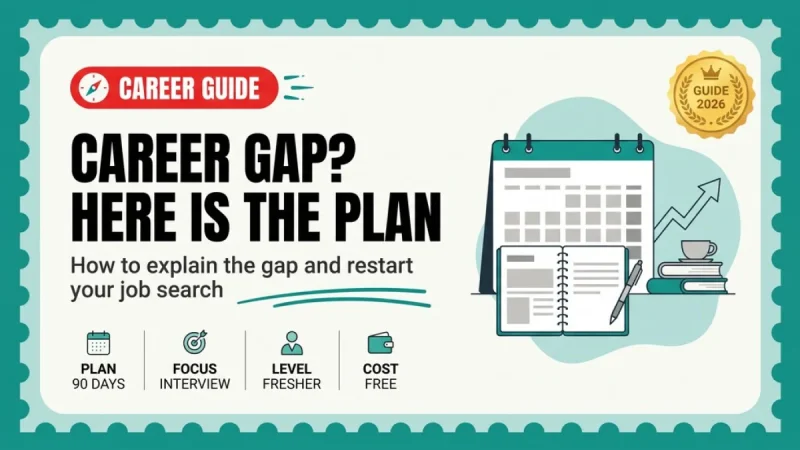
Degree complete, one or two years gone, still no job. Most advice on this either tells you to lie, or tells you to “stay positive”. Neither works in an interview room. This is the practical version — what a gap actually costs you, what to say, and what to do in the next 90 days.
ADVERTISEMENT
❗Why a gap feels worse than it is
A gap does two separate kinds of damage, and most people only notice the first one.
The visible damage is that some filters exclude you. Certain campus and batch-year-linked hiring processes are genuinely closed once your passing year is behind you. That part is real and there is no trick that reopens it.
The damage that actually costs you the job is different: after a long gap most candidates walk into the interview already apologising. The recruiter has not yet decided anything, and the candidate has already conceded. The gap did not reject you — the flinch did.
Everything below is built around that second problem, because that is the one you can still change.
🔍What a gap actually looks like from the other side of the table
What they ask
“What were you doing during this period?” — it is a single question, not a trial.
What they are testing
Whether you can account for your own time calmly. Confusion and defensiveness read as something being hidden.
What a bad answer sounds like
“I was just preparing… actually I tried some exams… then there were family issues also…” — three half-reasons instead of one whole one.
What a good answer sounds like
One sentence of reason, one sentence of what you did about it, one sentence that moves forward. Then stop talking.
Gap length
Six months is barely a question. One year is a question. Two years and beyond is a question you must answer with evidence, not adjectives.
The hard part
A gap you cannot evidence is just a claim. The whole job is converting the gap into something you can point at.
📋Say this, not that
You do not need a dramatic story. You need a true one that is short, specific and finished.
✅ Reasons that are completely fine to state plainly
Preparing for government examsPreparing for a PG entranceFamily medical responsibilityOwn healthWorking in the family businessFreelance or part-time workDoing a certification or skill courseAttempting to clear backlogsRelocation or family relocation
❌ Things that quietly make a gap worse
Backdating a job that did not existInventing a company that cannot be verifiedSaying “nothing, just like that”Blaming the college or the economyGiving three different reasons in one answerApologising repeatedlyHiding the gap by removing dates from the resumeClaiming experience you cannot describe in detail
📎 Evidence that closes the question fast
A certificate with a verifiable issuerA project you can open and explainA GitHub or portfolio linkExam hall tickets or scorecardsFreelance invoices or client referencesA volunteer or internship letterA course completion record
ADVERTISEMENT
✨Five things that genuinely close a gap
Pick one direction and stop hedging. Two years spent half-preparing for government exams and half-applying to IT reads, on a resume, as two years of neither. One clear direction with less time in it beats two directions with more.
Convert time into an artefact. A certificate, a working project, a portfolio, a scorecard — anything a stranger can verify without trusting you. An artefact ends the gap conversation in one sentence.
Put the gap on the resume, with dates, deliberately. A labelled line such as “2025–2026: Government exam preparation / certification” is read as a decision. A silent hole is read as a problem. Removing dates to hide it is the single most common self-inflicted wound.
Target hiring routes that do not run on batch year. Walk-in drives, staffing firms, startups, BPO and support roles, and off-campus drives generally assess you on the day rather than on your passing year. This is why walk-ins matter so much for gap candidates, and we list them city by city.
Rehearse the answer out loud until it is boring. The content of the answer matters less than delivering it without flinching. Say it twenty times. The goal is that it costs you nothing to say.
🎓What you can do this week, at zero cost
None of this requires paying anyone. Be extremely careful with anybody who asks for a fee to “place” you — gap candidates are the exact group that job scams target.
Write your gap answer down in three sentences and read it aloud until it sounds flat and ordinary.
Put the dates back on your resume and label the gap period honestly.
Start one certification you can realistically finish — a finished small course beats an abandoned big one.
Build one project you can demonstrate end to end, even a small one, and be able to explain every part of it.
List the walk-in drives in your city for the coming two weeks and attend at least one, even if you do not expect to clear it. Interview reflexes come back only by interviewing.
Ask one person who already works in your target role to look at your resume. One honest reading is worth more than ten rewrites.
🗺A realistic 90-day plan
1
Days 1–7 — stop the bleeding
Fix the resume dates. Write and rehearse the gap answer. Decide one direction and write it down. Do not start applying yet — applying with a bad answer burns real openings.
2
Days 8–30 — build one artefact
One certification or one project. Finish it. Half-finished work is worth nothing in an interview because you cannot discuss it under questioning.
3
Days 31–60 — start interviewing on purpose
Begin with walk-in drives and roles you are not emotionally invested in. The point of these is not the offer, it is removing the flinch. Expect rejections and treat each one as a rehearsal.
4
Days 61–90 — go after the roles you want
By now the gap answer is automatic and you have something to point at. Apply to the roles that actually matter to you, through off-campus drives, referrals and direct company careers pages.
5
Throughout — protect yourself
No genuine employer charges you to be hired. No genuine employer asks for a security deposit, a training fee or payment for an offer letter. If money flows from you to them before you are employed, walk away.
ADVERTISEMENT
⚠️ What this page is NOT claiming
No statistics. You will see other pages quote things like “companies reject X% of candidates with gaps”. We have no verifiable source for any such number, so we print none.
No company-wise gap policy. Whether a specific company accepts a one-year or two-year gap is set by that company’s own current eligibility criteria. We checked several major IT careers pages on 26 October 2026 and they did not respond to us, so we are not reproducing any company’s policy from memory or hearsay. Check the company’s own careers page.
No salary claims. What you can earn after a gap depends on the role and the employer. Not published in our source.
No guarantee. This is a method for presenting your situation honestly and improving your odds. It is not a promise of placement, and anyone promising you one for a fee is selling something.
💬Frequently Asked Questions
How do I explain a 1-year gap after graduation?
In three sentences: the reason, what you did during that time, and what you want now. For example — you prepared for government exams, you also completed a certification in the period, and you have now decided on a private-sector role in your field. Keep it short, keep it true, and stop talking once you have said it.
Is a 2-year gap too much?
It is not automatically disqualifying, but at two years adjectives stop working and evidence starts mattering. You need something a stranger can verify — a certificate, a project, a scorecard, freelance work. Without an artefact, a two-year gap is only a claim.
Should I hide the gap by removing dates from my resume?
No. It is the most common mistake and it backfires. Recruiters read undated resumes as hiding something, and the gap comes up anyway in the interview, now with suspicion attached. Label the period honestly instead.
Can I say I was preparing for government exams?
Yes, and you should say it plainly if it is true. It is an ordinary, widely understood reason. What hurts is not the exam preparation itself — it is being vague about it or mixing it with two other half-reasons in the same answer.
Which jobs are realistic after a long gap?
Routes that assess you on the day rather than on your passing year: walk-in drives, staffing and recruitment firms, startups, support and BPO roles, and off-campus drives. We publish walk-in drives for Hyderabad, Visakhapatnam and other cities continuously — links are below.
Someone offered me a job for a placement fee. Is that normal?
No. A genuine employer does not charge you to hire you, and does not ask for a security deposit, training fee or payment for an offer letter. Candidates with long gaps are targeted specifically because they are under pressure. We have a separate guide on the warning signs, linked below.
📚Read Next on BeInCareer
Daily job & course updates, free
Walk-in drives, admission dates and new government courses — the day they are announced.
Source: This is practical interview and job-search guidance written by the BeInCareer editorial team on 26 October 2026, not reported fact. It deliberately contains no statistics, no company-wise gap policies and no salary figures, because no first-party page we could reach supports them. Company eligibility criteria change and are published by each company; verify them on that company’s own careers page. Figures that are not published in our source are not printed here.