

(tap)
Why this matters for job seekers (India → USA, global talent)
When US hiring strengthens, it can improve opportunities across tech, healthcare, construction, and services—especially for candidates planning for OPT/H-1B, global hiring, or remote roles. But the headline number is only part of the story—sector concentration and revisions matter too.
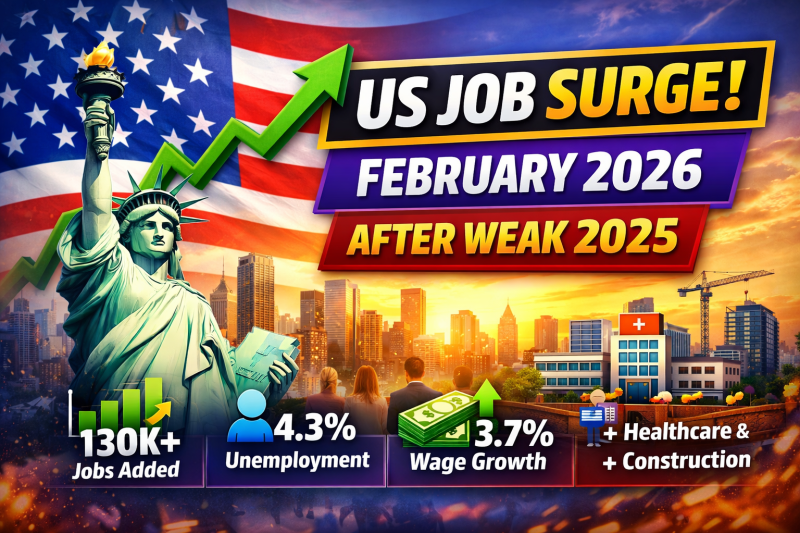
Snapshot: February 2026 US Jobs Report (as shared)
| Metric | What it showed | Why it matters |
|---|---|---|
| Jobs added | ~130,000 (greater-than-expected) | Signals hiring momentum after weak 2025 |
| Unemployment rate | ~4.3% (slightly lower) | Stability suggests labor market still resilient |
| Wage growth | ~3.7% YoY | Supports spending, but can influence inflation & rates |
| Strong sectors | Healthcare, construction | Indicates where demand remains strongest |
| Weak sectors | Federal govt, financial sector | Shows uneven recovery across industries |
Note: This article is rewritten from the report you shared and uses the same core figures and explanations.
What happened in February 2026?
After a soft 2025, US hiring picked up pace in early 2026. The latest report showed employers adding around 130,000 jobs in February,
with the unemployment rate easing to about 4.3%. This helped calm concerns that the labor market was losing steam.
Economists pointed out that immigration-driven population changes can affect how many jobs the US needs to create each month to keep the job market balanced.
At the same time, stronger job numbers can reduce urgency for quick interest rate cuts.
Which sectors drove the gains?
Hiring remained strong in healthcare, a sector that often stays resilient even when other industries slow down.
Construction gains helped lift overall job growth, suggesting continued demand for building, infrastructure, and related services.
Some areas—especially federal government roles and parts of finance—saw job losses, showing the recovery is not uniform.
Insight: Sector concentration matters—if most jobs come from a few areas, the headline number can look stronger than broad market reality.
What this could mean for the Federal Reserve (interest rates)
Stronger job growth tends to reduce immediate pressure on the Federal Reserve to cut interest rates quickly.
With unemployment steady and wages still rising, policymakers can justify a “wait and watch” approach.
Why analysts still urge caution
Some economists believe the February strength could be influenced by data quirks and revisions. Recent job reports have been revised,
and other measures like job openings have shown signs of softness.
- Revisions: Prior months (like November/December) were adjusted lower in the report you shared.
- Sector concentration: Gains clustered in a few industries can overstate broad demand.
- Mixed indicators: Job openings and surveys may not fully match headline payroll growth.
What to do if you’re targeting US jobs (Feb 2026)
FAQ (SEO-Friendly)
How many jobs were added in the US in February 2026?
What is the US unemployment rate in February 2026?
Which sectors are hiring the most in the US right now?
Will this jobs report force the Federal Reserve to cut rates?
How should Indian freshers interpret US job market updates in 2026?
Also watch sector concentration and revisions before assuming broad hiring is booming.
About BeInCareer
BeInCareer is a career and recruitment platform helping students and professionals with job updates, skill guidance, and hiring insights across India and beyond.
We publish simplified explainers so you can make smarter career decisions with clarity.
